Another year passes with the Leandro school funding lawsuit in limbo

Add Axios as your preferred source to
see more of our stories on Google.
Illustration: Maura Losch/Axios
The North Carolina Supreme Court has, once again, not made a ruling in the state's landmark Leandro school funding lawsuit, leaving its outcome in limbo.
Why it matters: It's been 663 days since justices on the Republican-majority Supreme Court have heard oral arguments in Leandro v. North Carolina, a case that could have billions of dollars on the line for public schools in the state.
Driving the news: Last week, the state Supreme Court released its final 19 decisions of the year, and the Leandro case was not among them.
- There is no deadline for when the state Supreme Court must release a ruling, but the Leandro case has taken an unusually long time compared to typical rulings, The Assembly noted.
Flashback: The Leandro lawsuit dates all the way back to 1994, when five low-income counties sued the state over what they considered inadequate funding for public education.
- The case has been heard at many different levels of the court, including multiple times at the Supreme Court. But the current hearings trace back to 2021, when a superior court judge approved a settlement plan that ordered the state legislature to spend $5.6 billion more to ensure a right to "sound, basic education" for public school students.
- Republican lawmakers objected to the idea that the court could order how it spends money. But in 2022, the state Supreme Court, then a Democratic-majority court, ruled the courts could compel the legislature to spend the money.
- Shortly after that ruling, however, Republicans took a majority on the Supreme Court and blocked the money. The case was heard again before the court in 2024, and a ruling has yet to follow.
- "It's past time for the North Carolina Supreme Court to reaffirm its previous ruling that the state must meet its constitutional obligation to provide every student a sound basic education and adequately fund our public schools," a spokesperson for Gov. Josh Stein said in a statement.
What they're saying: Bryan Proffitt, vice president of the North Carolina Association of Educators, which has advocated for more funding, said his organization remains frustrated by how long the case is taking to be resolved.
- Proffitt called the amount of money in the Leandro case "profound" in terms of its potential for the education of young people. But more importantly, he added, "it would reverse the dangerous trend in our state away from public schools and away from investing in public schools and towards privatization."
- The offices of both Senate leader Phil Berger and House speaker Destin Hall, the state's two top Republican lawmakers, have not yet responded to a request for comment.
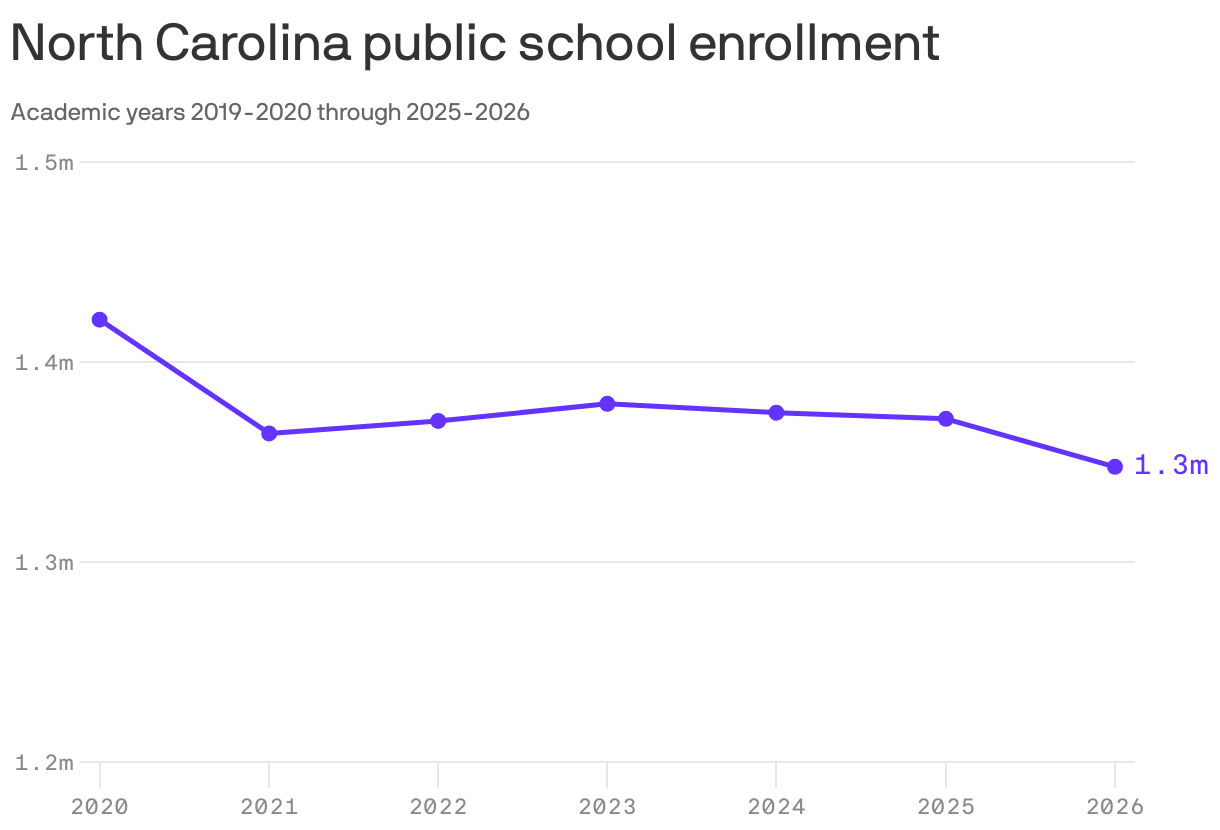
The big picture: That shift toward privatization, Proffitt mentions, is most clearly seen in the rise of charter school enrollment as well as the expanded Opportunity Scholarship program, which provides vouchers for private schools.
- At the same time, public schools lost many students amid disruptions during the COVID-19 pandemic. And a survey from Gallup this year found a record low number of Americans are satisfied with K-12 education
- Enrollment at traditional public schools in the state has fallen 5.2% since 2020 to 1.35 million students, while the population of charter schools, lab schools and regional schools has grown 37.6% to 159,206 students, according to the most recent numbers from the N.C. Department of Public Instruction.
Between the lines: Leandro's impact could increase the amount of funding per CMS student by nearly $2,000, according to estimates from Every Child NC.
- The funds could also help pay for teacher assistants, nurses, psychologists, counselors and social workers. Plus, it allocates supplementary funds for children with disabilities, English learners, and at-risk and disadvantaged students.
The other side: North Carolina GOP lawmakers say education funding should follow students and support families who want a say in their child's schooling.
Zoom in: Those trends can also be seen in the Triangle, with Wake County Public Schools' enrollment down 1% since 2020.
- Durham Public Schools is down 9.5% over the same time frame, while Chapel Hill-Carrboro City Schools is down 12.6%.
- The reasons vary at each school. Durham is blaming an enrollment projection miss on charter schools, and demographers have told Chapel Hill-Carrboro leaders that fewer kids are being born in their district due to high housing costs, The News & Observer reported.
- At Charlotte-Mecklenburg Schools, enrollment has fallen from 141,894 to 139,476 since last year, a 1.7% drop and a 14-year low.
What they're saying: Earlier this year, Wake County Public Schools projected it would pass 162,000 students for the first time this year. But DPI's numbers have the school at 160,510.
- Lisa Luten, a spokesperson for Wake County Public Schools, said the school district was still studying the projections, but noted that the difference could be the result of in-migration numbers to the county slowing, plus the number of seats at charter schools rising.
- "When more charter seats open up, it will pull a percentage of students who choose that charter seat," Luten said. "We see a lot of flux in this area ... so there's a lot of students that move in and out ... [to a] charter school and then come back in" to a Wake County public school.