Ken Burns says only PBS could give him enough time to make his films

Add Axios as your preferred source to
see more of our stories on Google.
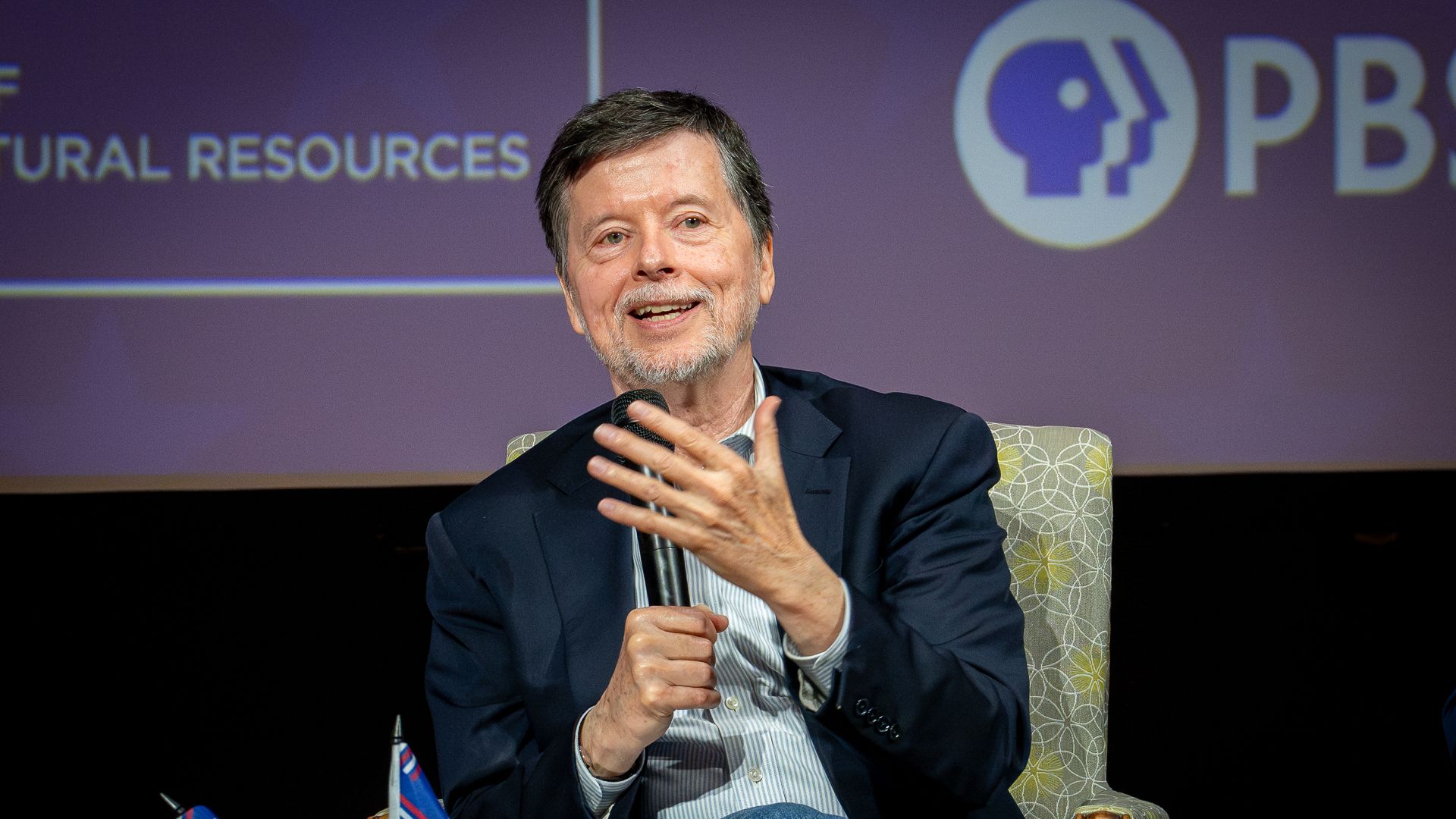
Ken Burns at the Martin Marietta Center for the Performing Arts. Photo: PBS North Carolina
Ken Burns, the filmmaker behind documentary classics like "The Civil War" and "Jazz," believes he could walk into nearly any video streaming company and walk away with a check for $30 million.
- But what they couldn't give him is the time and space that PBS has afforded him over the years — including a decade to make his film "The American Revolution," out in November.
Why it matters: Earlier this month, President Trump signed an executive order to slash funding for PBS, which helped bring Burns' documentaries to the wider public for decades.
The big picture: Burns said funding cuts are an "existential threat" to investigative work like his own, with the Corporation for Public Broadcasting providing a significant amount of funding for his films.
- It's all part of a trend to eliminate works that delve into critical analysis, he said, from firing the librarian of Congress to marking the National Endowment for the Humanities, another backer of Burns' films, for elimination.
What they're saying: "But I think PBS will survive and be thriving," Burns told Axios.
- "I think it will be a voice of sanity in the midst of a lot of cacophony that's out there."
Driving the news: Burns was recently in Raleigh to promote the upcoming release of "The American Revolution," which he called the most important event since the birth of Christ.
- He started making the film in 2015, and PBS provided support for nearly a decade to let him realize the story in all its complexity.
Zoom in: Burns promises that his new documentary will detail how messy and complicated the Revolution truly was, with brothers and friends turning on each other in bloody battles, and how men could fight for the ideals of freedom while still keeping others enslaved.
- Like his other documentaries, the film will zero in on the big names, from George Washington to Benedict Arnold, and smaller, largely unknown individuals to tell the story.
- "We're there to show that there are multiple ways of understanding an event that takes place — not just from the top down, but from the bottom up," he said.
- "Not just with bold-faced names, but with the so-called ordinary people or unknown people," he added. "Not just from the perspective of colonists, but from the perspective of a Loyalist colonist, or a Native American on the outside, or a Native American on the inside, or a freed Black, or an enslaved Black."