Who's missing at NC's legislation table: moms


Add Axios as your preferred source to
see more of our stories on Google.
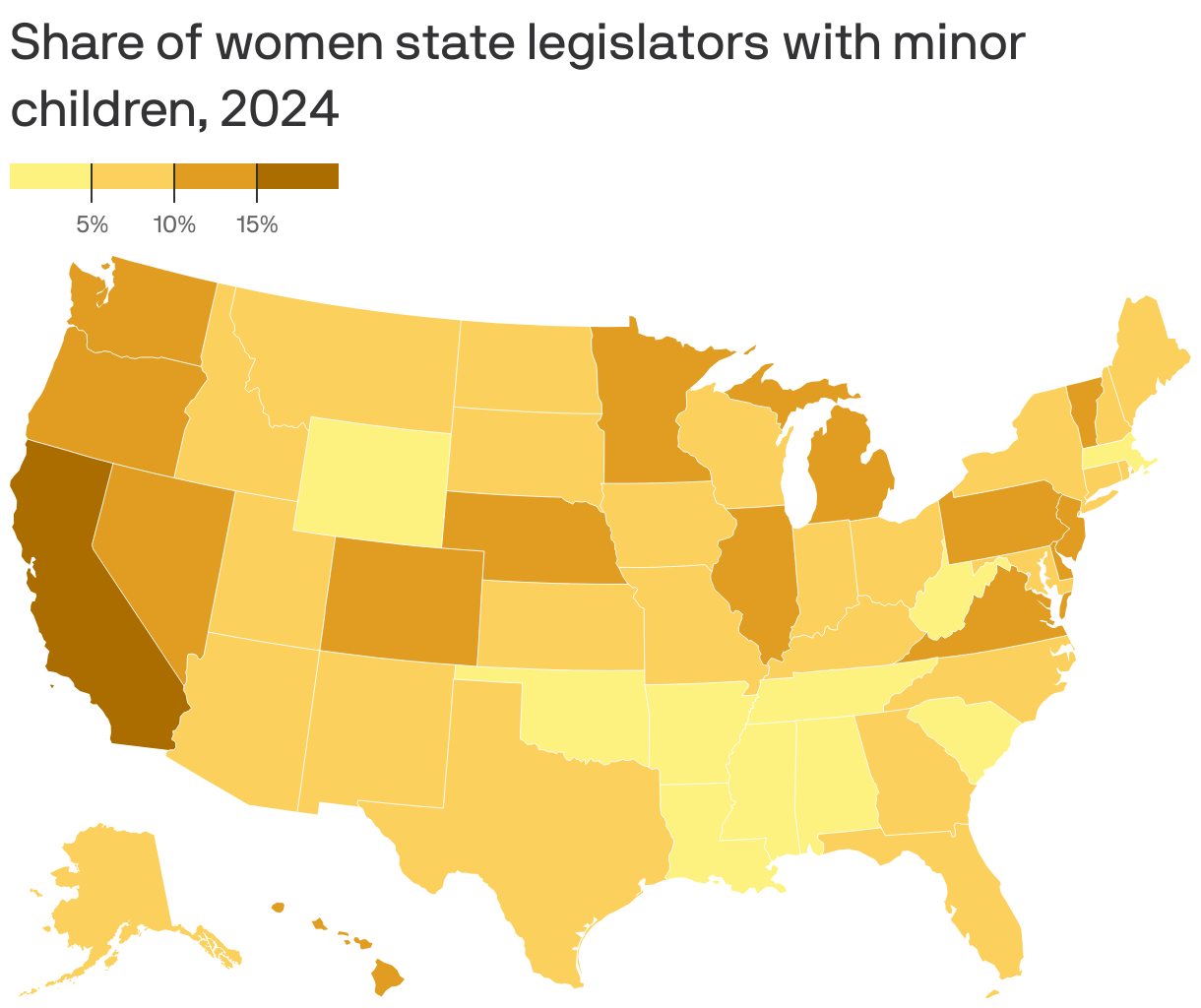
Moms of small children remain vastly underrepresented in state capitols across the country, according to a report released by the Vote Mama Foundation in September.
Why it matters: State legislatures shape policies that directly impact families, from funding child care to expanding Medicaid.
- "If you don't have parents with young children helping set the legislative agenda you're missing a whole segment of the population, and their lived experiences are not being brought to bear on decisions that are being made," Jean Sinzdak, associate director of the Center for American Women and Politics (CAWP), told Axios.
By the numbers: An estimated 85% of women become mothers by the time they hit 45. But, as of 2024, just 25% of legislators nationwide were female parents or nonbinary parents, the analysis from the Vote Mama Foundation found.
- Just 8% are mothers with children under the age of 18.
- In North Carolina, that number is just below the national average, at around 7% — or just 12 lawmakers.
Of note: That number may change slightly with January's new class of state lawmakers, however, as numerous moms won election or re-election earlier this month.
- That may include Republican Ashlee Adams, whose race against Democratic state Rep. Terence Everitt to represent Wake and Granville counties in Senate District 18 has yet to be called.
- Adams, a business owner and former nurse, is running 38 votes ahead of Everitt, per the latest numbers.
Between the lines: Serving in a state legislature can be especially difficult for parents of young children, given the need to travel to a state capital, long nights of lawmaking and low pay in states where the job is considered part-time, Sinzdak told Axios.
- "It's been a trend for a long, long time that women tend to wait until they're older to run, partially because of the caregiving responsibilities and the challenges of having young kids," she said.
Zoom in: In North Carolina, lawmakers make less than $40,000 per year, and state law offers no limits on the length of the session.
- In recent years, that's often meant lawmakers are on call all year long and must drop everything to drive to Raleigh for weekday votes.
- As a result, many state lawmakers are retired or attorneys with the flexibility to take off work — or work remotely — throughout the year.
What they're saying: Increasing pay, allowing virtual participation and providing on-site child care are a few changes Vote Mama Foundation founder Liuba Grechen Shirley says are essential to achieve gender parity and "truly family-friendly legislation."
- She would know: Grechen Shirley made history in 2018 when she successfully lobbied the Federal Election Commission to allow her to use campaign funds to cover the costs of child care associated with running for a New York congressional seat.
The silver lining: The numbers have increased by 3 percentage points since the group first collected the data in 2022. At that time, just over 5% of legislators nationwide were moms of minor kids.
- And the share of legislators who were pregnant or gave birth while serving has more than doubled, from 12 to 30.
Yes, but: There are more than 7,000 legislators serving nationwide. About 2,400 of those are women, per CAWP.
The fine print: The study's authors collected data for women and nonbinary legislators with biological children, foster children, stepchildren, and formally or informally adopted children under 18.
- Because they based their data on publicly available bios and news reports, the actual number of mothers and caregivers may be higher than reported.
The bottom line: Voters would need to elect more than 700 more moms to hit proportional representation nationwide, per the report.