"Canary in the coal mine": Black early voting lags in North Carolina

Add Axios as your preferred source to
see more of our stories on Google.
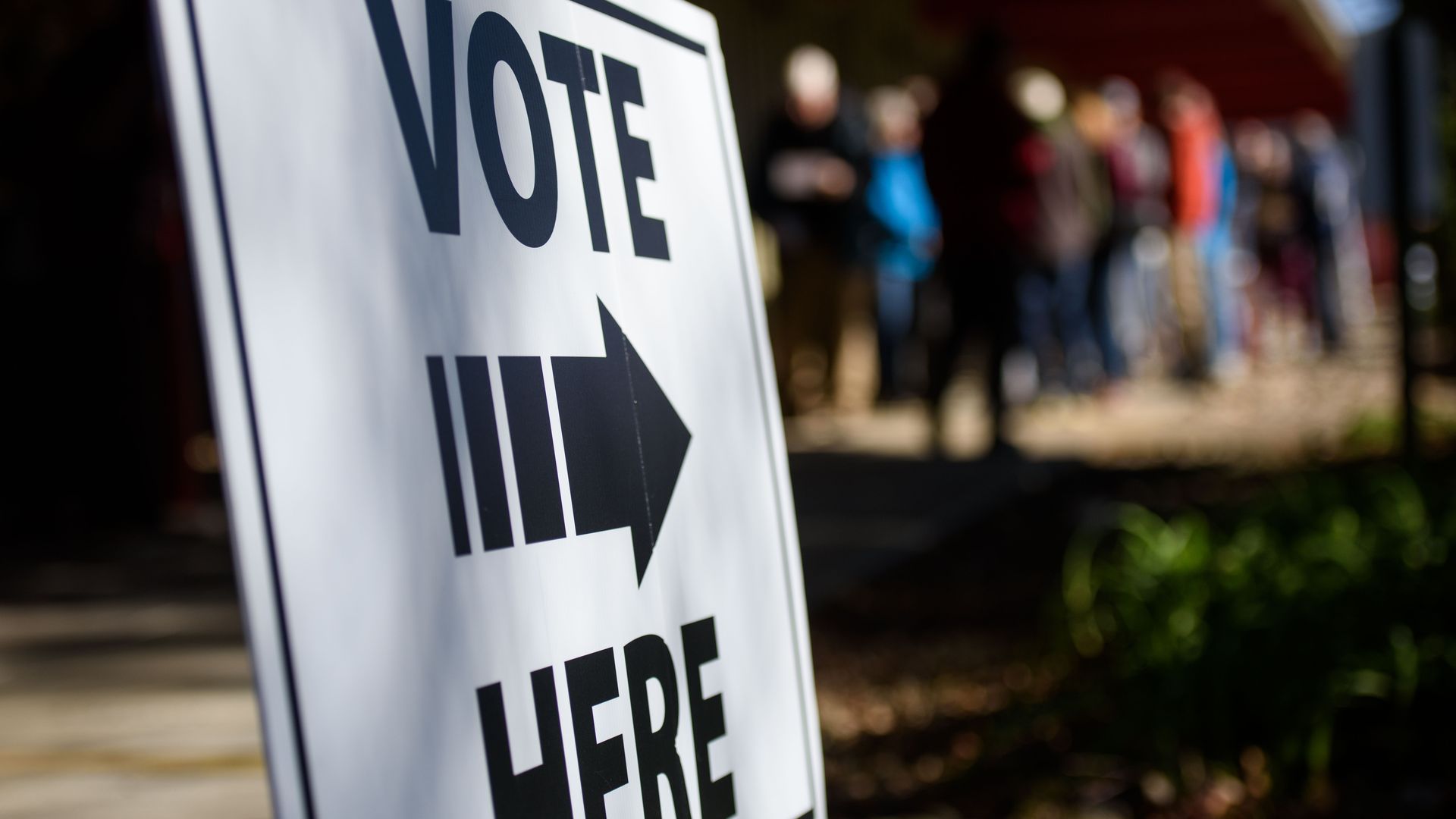
A vote here sign directs people to an early voting site as it kicked off in Black Mountain Oct. 17. Photo: Melissa Sue Gerrits/Getty Images
Black voter turnout in North Carolina is down 10% among those who cast ballots in person in the first 11 days of early voting compared to the same period in 2020, State Board of Elections data show.
Why it matters: Black voters are vital to Vice President Kamala Harris' chances of winning the race for president.
- That's especially true in battleground states like Georgia and North Carolina, which are both particularly swingy and, like most of the South, have a higher percentage of Black voters compared to the rest of the country.
By the numbers: Of the more than 2.6 million North Carolinians who have cast ballots in person in the first 11 days of early voting, just over 481,000 of them are Black voters.
Driving the news: If Black voter turnout continues to lag in North Carolina, Harris' ability to win the swing state — and potentially the presidency — could be in jeopardy.
- "This feels like a canary in the coal mine," Catawba College politics and history professor Michael Bitzer tells Axios.
The big picture: North Carolina is one of the battleground states where Black voters can have a significant impact due to their high concentration in certain areas, LaTosha Brown, co-founder of the national voting rights group Black Voters Matter, told Axios.
- Like in other key states, Black voters in North Carolina act as a "leverage vote," where a strong turnout can sway the outcome in close races. In a tight race, Black voters act like the "star players" a team depends on in crunch time, Brown said.
- "If Black voters don't come out, it's a guaranteed loss," Brown said.
Plus: A slow ripple of Black male voters from the Democratic Party to the GOP has been two decades in the making, Axios' Delano Massey and Russell Contreras write, presenting yet another challenge for Democrats in key battleground states.
The intrigue: Black North Carolina voters helped deliver the state to former President Obama in 2008. He was the first Democrat to win the presidential race in North Carolina in 20 years.
- 72% of the state's registered Black voters turned out that year, surpassing the turnout rate of white voters (69%) for the first time, per Democracy North Carolina, a nonprofit voting rights group.
Flashback: This year's lag is somewhat reminiscent of the 2022 election, Bitzer said, when Democrat Cheri Beasley ran unsuccessfully for U.S. Senate.
- "The Beasley campaign was saying, 'Oh, we'll get [Black voters] out. This won't be a problem,'" Bitzer said. "And then Black voters had a bad turnout rate in the end."
- Black turnout was 42% that year, down from 68% in 2020.
Zoom in: In Mecklenburg County, which has the most registered Black voters in the state, more than 75,300 Black voters have cast ballots early and in person so far, compared to more than 83,600 at the same point in 2020 — just under a 10% decrease.
What they're saying: "I think we've got a problem. I'm very concerned about that," Harvey Gantt, Charlotte's first Black mayor, told the Charlotte Observer recently.
- "I would have hoped the vote would have been bigger, particularly the Democratic vote. We've got a great candidate, and I'm just wondering about why that's the case."
Yes, but: In recent days, the gap between Black voter turnout this year and in 2020 has begun to narrow.
- Through last Monday, 75,000 fewer Black voters had cast ballots compared to the same point in 2020, state elections data show.
- Through Sunday, that number had shrunk to just over 54,800.
Zoom out: Democrats are running behind their 2020 voter turnout numbers for absentee and in-person early voting, too.
- Close to 1.3 million Registered Democrats had cast ballots in the first 11 days of early voting in 2020. This year, that number is just over 938,000.
- Republicans, by contrast, had cast more than 958,000 in 2020. This year, that number is almost 962,000.
What we're watching: In 2008, Black voters made up 23% of voters who cast ballots that year, despite making up 21% of all registered voters, per Democracy North Carolina.
- In 2020, 18.5% of those who voted were Black and non-Hispanic. Around 20% of registered voters were Black by comparison, per Bitzer.
- In 2022, 16.5% of voters were Black, and registration stayed the same at around 20%, he said.
- So far, Black voters make up 17.5% of the electorate this year, though they represent 20% of all registered voters.
What's next: This past weekend marked what's usually a big weekend for mobilizing Black voters to the polls, and Obama made an appearance in Charlotte Friday.
- Democrats hoped both those events would boost turnout, but Black voter turnout remains behind where it was in 2020.
Go deeper: Why Black men could be key to Harris' swing-state chances
Axios managing editor Delano Massey contributed to this report.
Editor's note: This story has been updated with the latest early voting data as of Monday, Oct. 28.