The Triangle's EV adoption outpaces most of the country


Add Axios as your preferred source to
see more of our stories on Google.
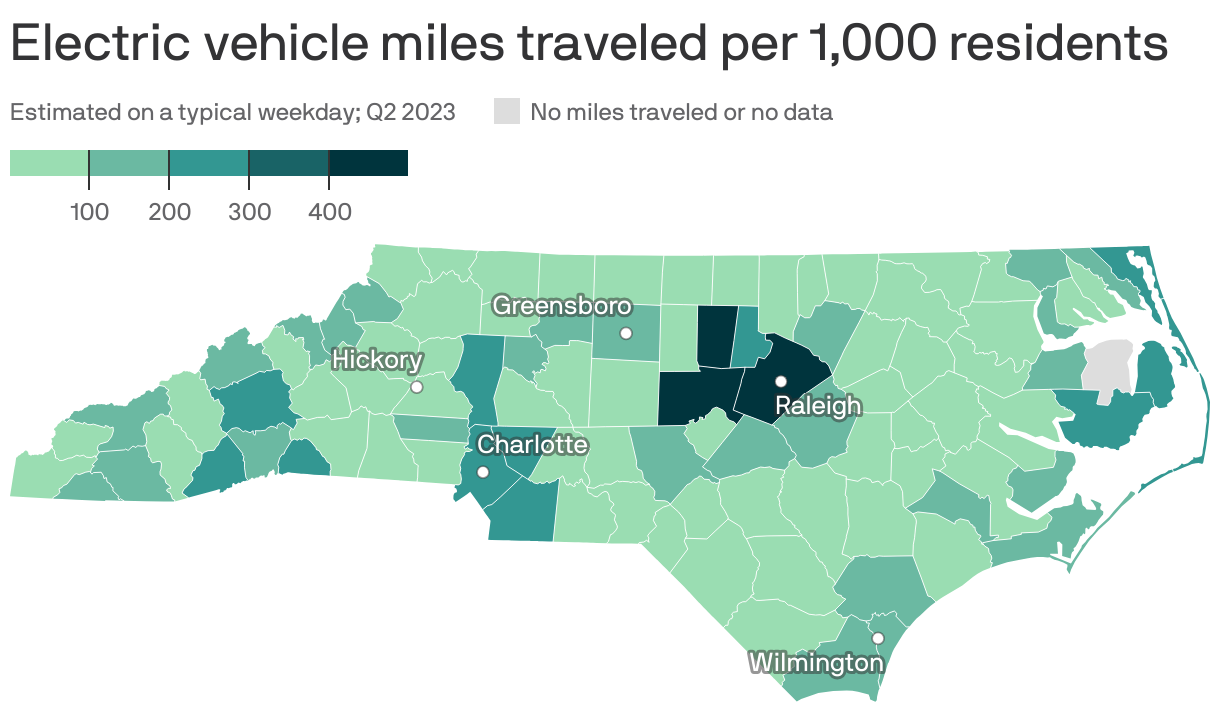
The Triangle's adoption of electric vehicles stands out not only within North Carolina but nationally.
Driving the news: Wake County saw an estimated 400 electric vehicle miles driven per 1,000 residents on a typical weekday in the second quarter of 2023, Alex Fitzpatrick and Kavya Beheraj report from data shared with Axios.
- Orange County had the highest rate in the state at 560 EV miles per 1,000 residents — the 55th highest rate for any county in the country — followed by Chatham County at 515 EV miles.
- Durham County posted 285 EV miles.
Between the lines: The national average is estimated to be around 227 miles, putting the Triangle's counties well ahead of the nation as a whole.
- The areas with the most EV activity are generally those with better-developed charging infrastructure, as well as higher-income households that can more easily afford the electric car premium.
- As an example, venture outside of the high-income area of urbanized Wake County into mostly rural Johnston County and the rate of EV miles drops to 175 miles per 1,000 residents.
How it works: The data, from mobility analytics platform Replica, is based on anonymized mobile device info, roadside sensors, transit agencies and more.
The big picture: Electric car sales are booming, but remain short of automakers' hopes and dreams as some potential buyers remain skeptical about their range, performance and cost.
- Several major automakers, including Ford and General Motors, are recalibrating their electric car ambitions after lower-than-expected sales.
- Car dealers, meanwhile, are kvetching about unsold EVs piling up on their lots, as Axios' Joann Muller reports.
Yes, but: Used EV prices are dropping fast, and automakers are doubling down on their investments in charging infrastructure to help solve the range anxiety issue.
- Mercedes, for instance, is rolling out swanky "charging lounges," and partnering with several other car makers on a separate new charging network.
The bottom line: The story this map ultimately tells? The electric car revolution is happening — it's just unevenly distributed.