Valley roadways among the most dangerous in the nation, study says

Add Axios as your preferred source to
see more of our stories on Google.

Illustration: Eniola Odetunde/Axios
Our roads in the Valley are some of the deadliest in the country, per a new traffic study.
Why it matters: The analysis, conducted by the Maricopa Association of Governments (MAG), could lead to new countermeasures to make our roads safer.
- MAG is a nonprofit dedicated to addressing regional challenges. It counts 28 Valley cities and towns, among other entities, as members.
Driving the news: Last month, MAG presented its findings from an examination of 2020-24 traffic data, comparing it with 2014-19 data.
- The study found that roadway safety in the broader Valley — which includes parts of Pinal County — is bad and getting worse.
By the numbers: Here's how the MAG area ranked out of 52 metropolitan planning organizations (MPOs), which set policy for their regions.
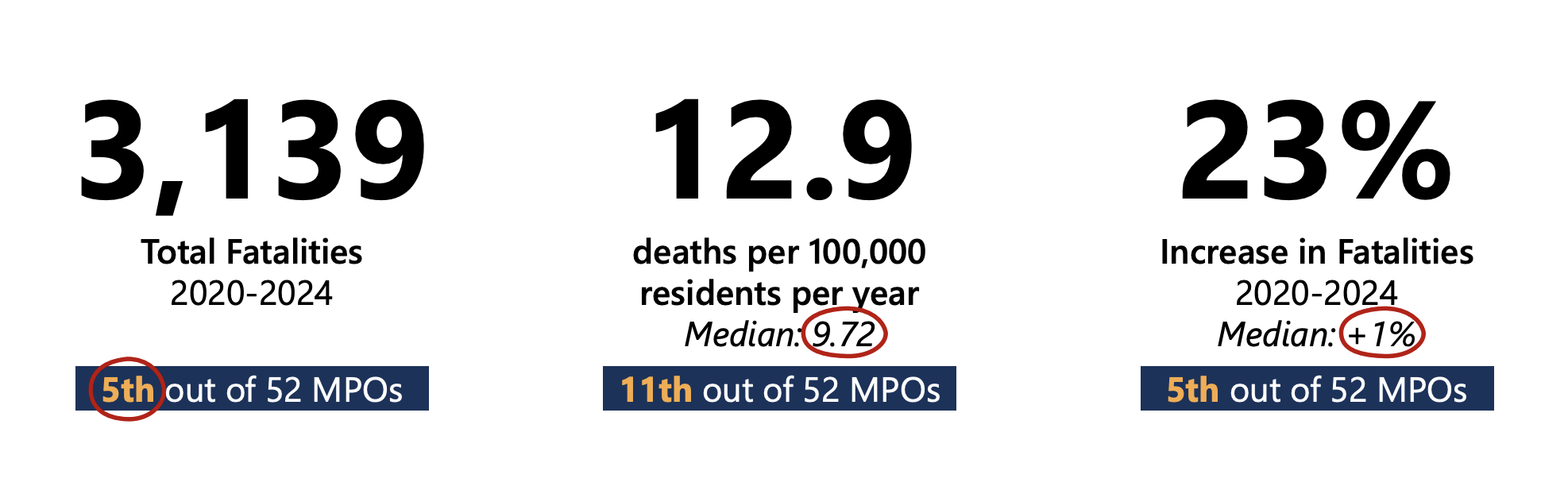
- Tucson, Memphis, Fresno and Tampa face similar traffic fatality issues, per MAG interim safety policy manager Maggie Wong.
Zoom in: 30% of fatalities involved "vulnerable road users" — think cyclers and pedestrians — and 70% occurred on non-residential roadways.
- The Valley ranked poorly in pedestrian deaths, non-residential roadway deaths and intersection deaths.
What they're saying: "Unfortunately, not many surprises," Wong tells Axios. "We know that we have a major safety issue here, but I think it really confirmed for us that intersections are going to be a major focus area."
The other side: MAG's Transportation Policy Committee member Jay Beeber — who is also the chief policy officer for the National Motorists Association — questions the study's methodology.
- The study should have based its numbers on the "gold standard" of vehicle miles traveled rather than population, Beeber tells Axios. He also says the study's five-year span obscured recent improvements in certain metrics, such as a shorter-term dip in fatalities.
- "I don't want to say purposeful, but it was to some extent a little bit one-sided in terms of everything is bad," Beeber says, "whereas not everything is bad."
Context: Wong says that the MAG study was meant only to establish a benchmark for the region compared with its peers and that future analyses will dig into what's causing the Valley's problems, particularly with intersections.
- Beeber says MAG has asked him to help with that effort.
What's next: A more granular analysis should be done by March, Wong says. Then MAG will determine policy priorities and award grants to member cities for safety improvements.
- However, it could take years for those improvements to be implemented and years more to collect enough data about whether they work, per Wong.