The Valley is in a historically dry year, but El Niño could help

Add Axios as your preferred source to
see more of our stories on Google.
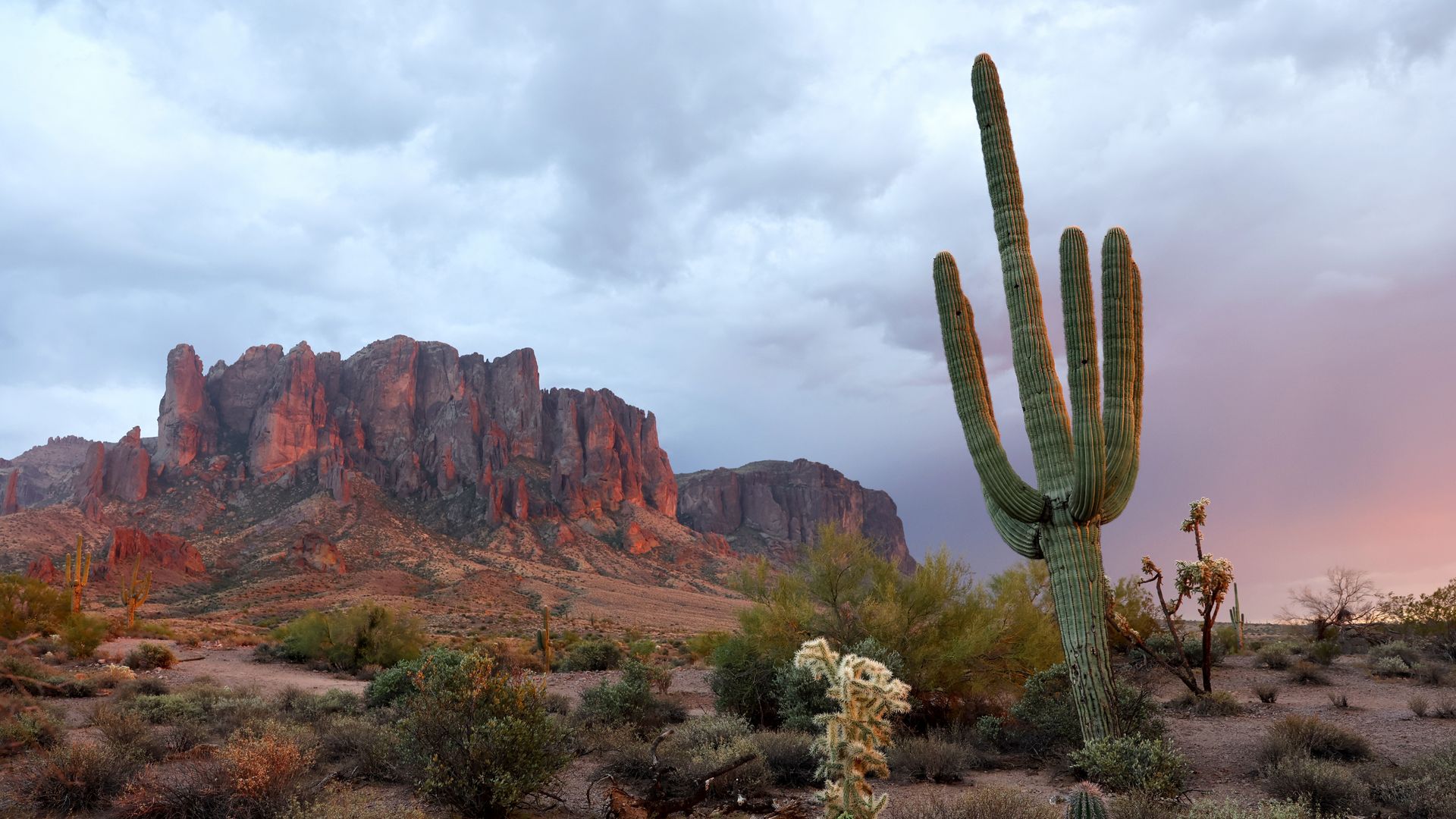
Clouds gather in the desert near Apache Junction in October 2022. Photo: Mario Tama/Getty Images
The Valley is experiencing its second-driest year on record, but things could still turn around, especially with a potentially strong El Niño on the horizon.
Why it matters: Arizona and the rest of the Colorado River basin have been wracked by drought for more than two decades, and the state is expected to take major cuts to our water allotment from the river.
By the numbers: Historical average annual rainfall at Sky Harbor International Airport is 4.37 inches, Matt Salerno, a meteorologist with the National Weather Service (NWS) in Phoenix, tells Axios.
- Through Monday, Sky Harbor has gotten .97 inches since the start of 2026.
- The only worse year on record is 1921, which saw .90 inches through Aug. 17.
Between the lines: Some parts of the Valley have seen more rainfall than that, Salerno notes, with some areas getting over an inch just in the last week or so.
Zoom in: Monsoon season precipitation has been far below average as well, with Sky Harbor only getting .65 inches of rain far compared to the normal of 1.45 inches by this point in the year.
- The average for monsoon season is 2.43 inches.
Yes, but: Last year, the Valley was below average until the monsoon season's final week, when a big increase pushed the total to 2.76 inches, per Salerno.
- "We still have time to catch up here. It's not over yet," he says.
- Monsoon season runs from June 15-Sept. 30.
What we're watching: The Climate Prediction Center has issued an El Niño advisory, and a "strong" or "very strong" El Nino seems likely.
- El Niño events have a tendency to create wetter conditions in the desert Southwest, Salerno says.
- That could mean heavier rains in the fall and winter, from September through November or possibly even January.
How it works: El Niño means Pacific Ocean surface temperatures are at least .5° Celsius above average for at about seven straight months.
- 1.5° to 2° Celsius above average qualifies as a "strong" El Niño event, while above that is "very strong," sometimes referred to as a "super El Niño," though that's not an official designation.