Supreme Court ruling could prompt suit over Arizona's Latino districts

Add Axios as your preferred source to
see more of our stories on Google.
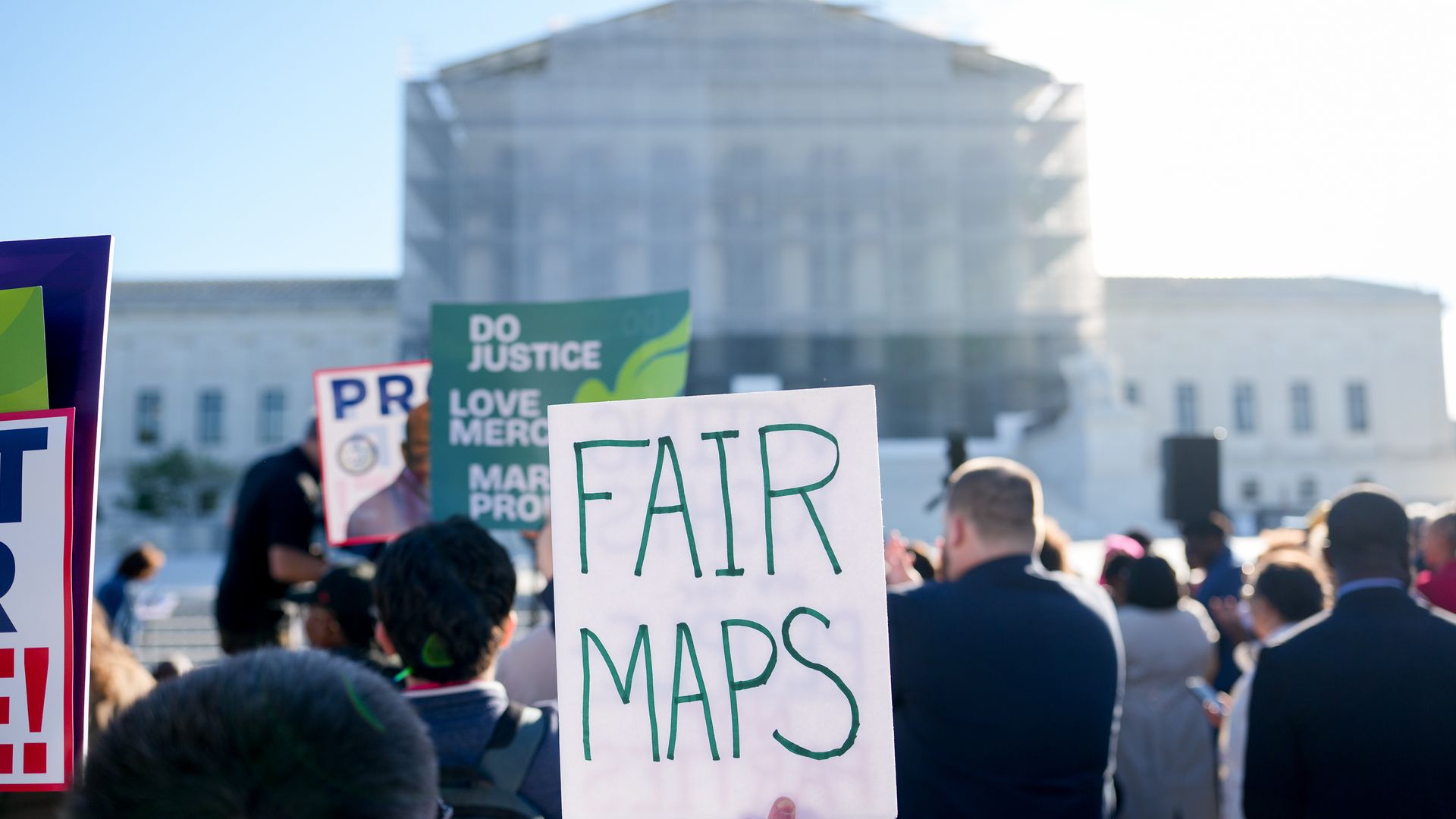
Demonstrators protest outside the U.S. Supreme Court on Oct. 15, 2025. Photo: Eric Lee/Bloomberg via Getty Images
A U.S. Supreme Court ruling that struck down Louisiana's congressional map as an "unconstitutional racial gerrymander" could prompt a lawsuit challenging Arizona's predominantly Latino districts.
Why it matters: Eliminating or diluting majority-Latino districts, which are overwhelmingly Democratic, could add Republican seats to our maps.
The big picture: Arizona has two congressional districts and seven legislative districts that are majority-Latino, along with a majority-Native American legislative district, all of which are heavily Democratic.
- From 2010 to 2020, Arizona's Latino population grew from 30% to 33%, according to the U.S. Census.
Driving the news: The Supreme Court on Wednesday rejected a Louisiana congressional map that was redrawn to meet a previous court's mandate that it include a second majority-Black district.
- It upended a longstanding interpretation that the Voting Rights Act requires districts where racial minority voters have the opportunity to elect candidates of their choice.
The latest: Senate President Warren Petersen (R-Gilbert) praised the ruling on X and said it's very likely that Arizona will go to court to "eliminate our unconstitutionally gerrymandered districts."
- Petersen told Axios he'll reach out to the House about joining forces for a possible lawsuit, and that they'll "closely review options" for potential challenges to Arizona's congressional and legislative district maps.
How it works: In Arizona, mapmaking is done by the Arizona Independent Redistricting Commission (AIRC), a bipartisan panel created to act independently of the Legislature.
What we're watching: The AIRC couldn't call itself back to redraw Arizona's maps without a court order.
- It's not feasible that a lawsuit could play out in time for that to happen for the 2026 election, so any impacts of the Louisiana ruling likely wouldn't affect Arizona until the 2028 cycle at the earliest.
What they're saying: "It's a devastating blow to the Voting Rights Act," said Maricopa County Supervisor Steve Gallardo, who helped lead a group that lobbied the AIRC for majority-Latino districts in 2021.
Between the lines: Erika Neuberg, the independent chair of the AIRC that drew the current maps, told Axios that any lawsuit would be a "waste of money."
- She argued that the commission's majority-Latino districts were drawn to meet criteria besides just the Voting Rights Act.
Yes, but: Neuberg has "deep worries" about how the next AIRC could use the Supreme Court's ruling.
Catch up quick: Ed Pastor was Arizona's first Latino member of Congress, and he spent most of his career representing south and west Phoenix-based districts similar to the current CD3.
- That seat has subsequently been held by Ruben Gallego and Yassamin Ansari.
Arizona added a second majority-Latino district in 2002, which was represented by Raul Grijalva for 22 years before his daughter Adelita Grijalva's win in a special election in 2025.