Phoenix is losing its youngest residents faster than most cities


Add Axios as your preferred source to
see more of our stories on Google.
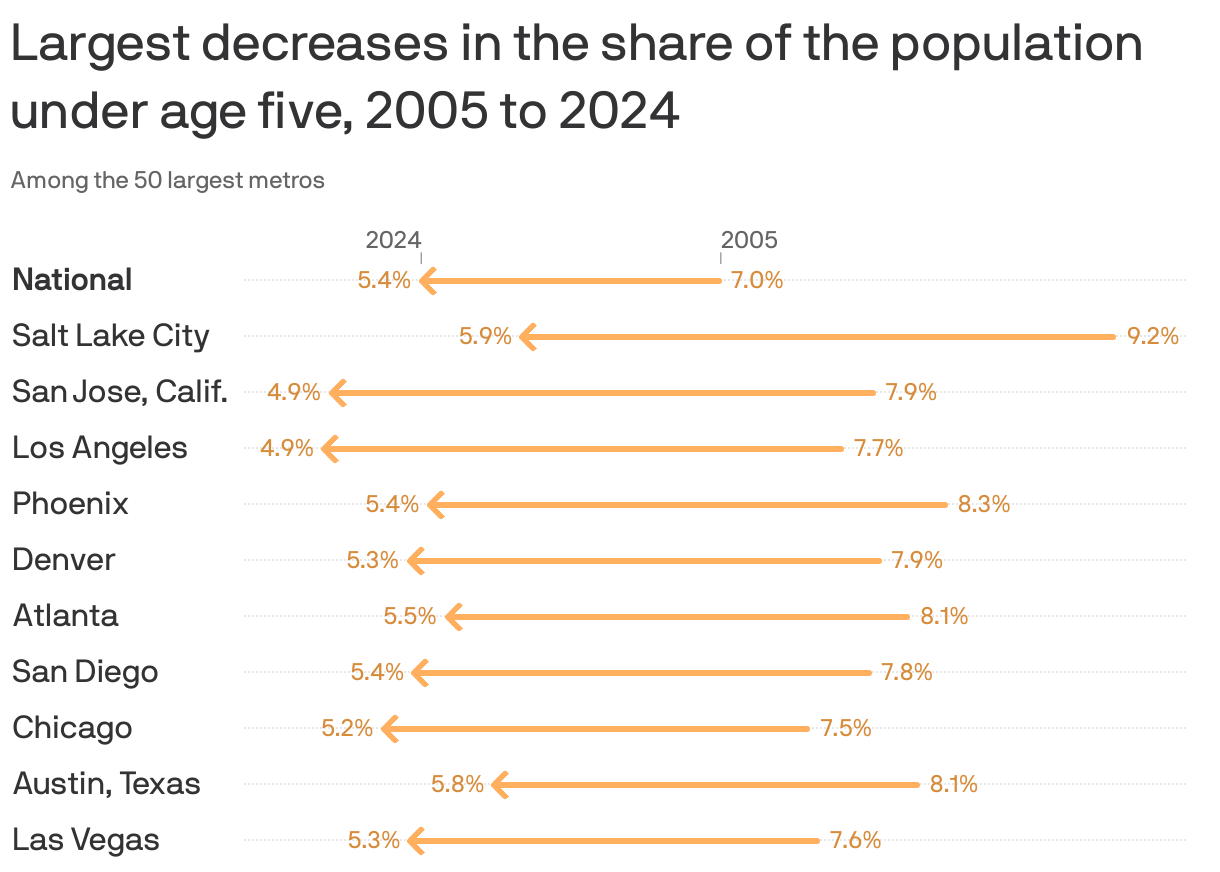
Young children's share of the population dropped across major U.S. metros over the past two decades, census data shows, with Phoenix seeing a steeper drop than most.
Why it matters: Kids' population trends can reflect cities' ability to attract, retain and support families.
- But larger nationwide factors are also at play, including birth and death rates as well as immigration.
By the numbers: Among the 50 largest metros, Salt Lake City (-3.2 percentage points), San Jose (-3pp), Los Angeles (-2.8pp) and Phoenix (-2.8pp) had the biggest dips in young children's share of their overall population between 2005 and 2024.
- That's compared to -1.6pp among the U.S. broadly, and includes children younger than 5.
State of play: The U.S. birth rate hit a record low in 2024, while life expectancy is approaching 80 following a pandemic-era dip.
- Those data points might suggest children will make up less of the overall population over time — fewer kids, more older folks.
- Yet the country grew around 1% between 2023 and 2024 — breakneck speed, as such things go — driven primarily by immigrants (including children, complicating the births vs. deaths picture).
The intrigue: The Trump administration's efforts to clamp down on and dissuade illegal immigration could affect kids' population shares in ways not yet well understood.
Threat level: Fewer children also means fewer public school students, which has led to school closures across the Valley.
- Most recently, the Kyrene and Scottsdale Unified districts announced plans to shutter several elementary and middle schools and Peoria Unified School District and Gilbert Public Schools are also considering downsizing.
What we're watching: School closures have well-documented impacts on academic outcomes, but newer research shows they also can lower housing values, raise crime rates and diminish the social fabric of a neighborhood.