American school closures can leave "eyesores" and broken community in their wake

Add Axios as your preferred source to
see more of our stories on Google.
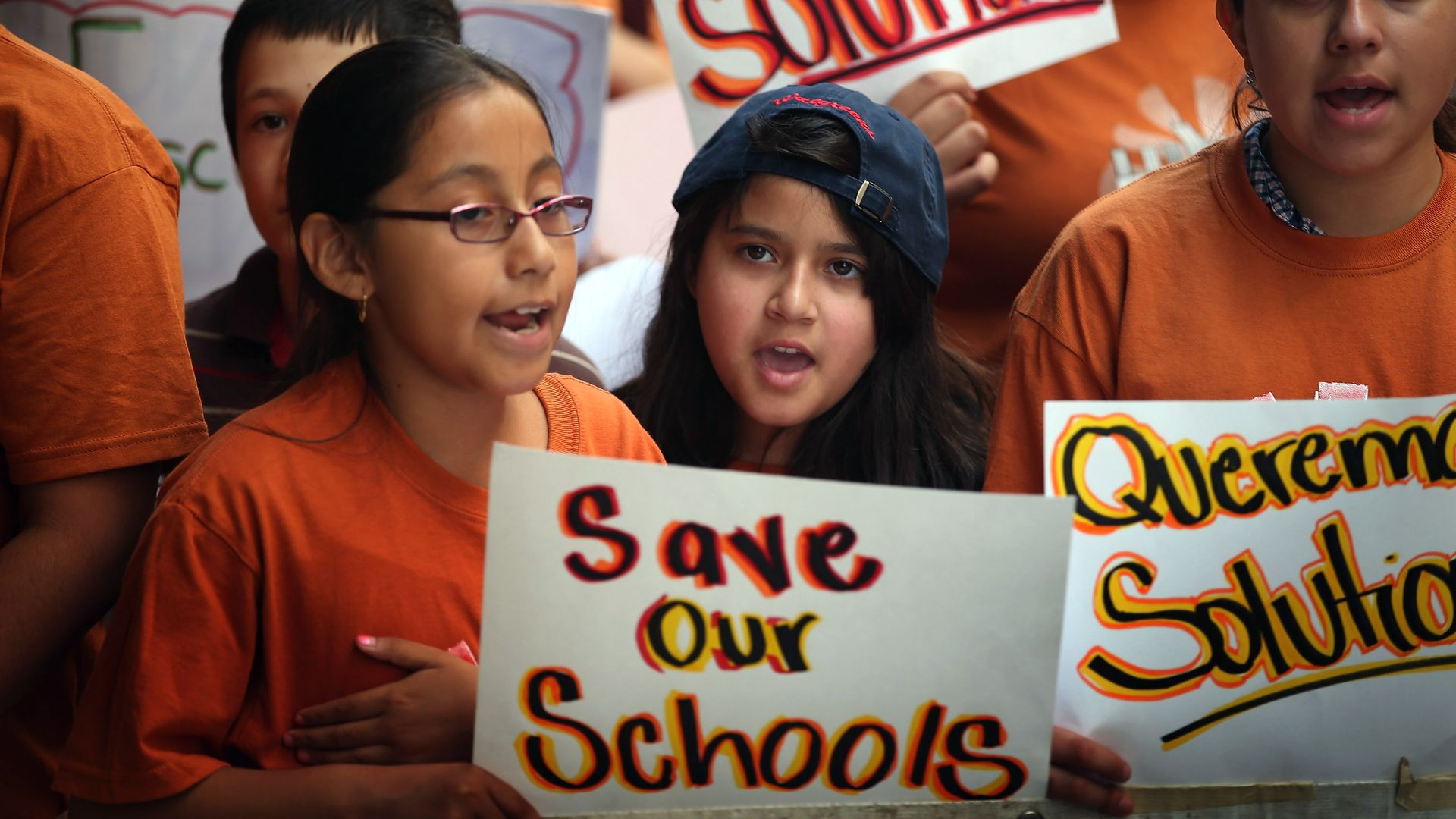
Students and parents protest in Chicago in 2013 after the city announced a mass school closure. Photo: Scott Olson/Getty Images
The role neighborhood schools once played as the center of community life is dwindling as public schools shutter across America.
Why it matters: School closures have well-documented impacts on academic outcomes, but more recent research shows they also can lower housing values, raise crime rates and diminish the social fabric of a neighborhood.
- Yet districts rarely consider their community value when deciding whether buildings should close, experts tell Axios.
The big picture: More than 5,000 public schools closed across the U.S. between 2017 and 2022, according to the National Center for Educational Statistics.
- Urban Institute research dating back to 2003 found that closures happened across urban, suburban and rural geographies and socioeconomic statuses.
Threat level: More districts may be forced to close schools after pandemic-era funding, which many institutions used to plug budget holes, expires at the end of this year, the Center on Budget and Policy Priorities cautions.
State of play: Closures are most often driven by district budget shortfalls caused by declining enrollment.
- Americans are having fewer children and parents have more charter and public school options than ever. This means fewer public school students, and ultimately less per-pupil government funding for districts.
Zoom in: The most severe impacts of closures tend to occur in poor, urban neighborhoods without recreation centers, parks, or other facilities that can absorb the role of community hub forfeited by the school, UC Davis Department of Human Ecology associate professor Noli Brazil tells Axios.
- Schools are more than just academic institutions. Neighborhood associations hold meetings in cafeterias. Gymnasiums are used as polling places on Election Day. Health clinics and food pantries offer services there on the weekends.
The intrigue: Repurposing closed buildings can mitigate the damage of a school closure, Urban Institute principal researcher Megan Gallagher told Axios.
- A decade after the closure of Kenilworth Elementary — one of the few remaining community assets in a high-poverty Washington, D.C., neighborhood — the department of parks and recreation last year converted it into a recreation center.
- Two shuttered Cleveland-area schools are in the process of being adapted into housing.
Reality check: Redevelopment is not the norm — many shuttered schools remain vacant for years, which can attract vandalism and provide a visual reminder of the loss.
- In 2013, Chicago closed 46 school buildings in the largest mass closure in U.S. history at that time. As of last year, 26 remain vacant despite lofty redevelopment promises, the Chicago Sun reported.
What they're saying: Abandoned, "eye sore" school grounds are "a signal to communities that the district is unwilling to invest in their children's success," Parents for Public Schools of San Francisco executive director Vanessa Marrero told Axios.
- The San Francisco Unified School District is closing a yet-to-be-determined number of schools next year.
What we're watching: When the Paradise Valley Unified School District outside of Phoenix decided to close three schools earlier this year, a school board member told concerned parents: "In the end, they're buildings … the community can exist anywhere."
- Yes, but: History shows that's not always true.
Axios San Francisco's Megan Rose Dickey contributed to this story.
