Data centers could boost rising electricity costs


Add Axios as your preferred source to
see more of our stories on Google.
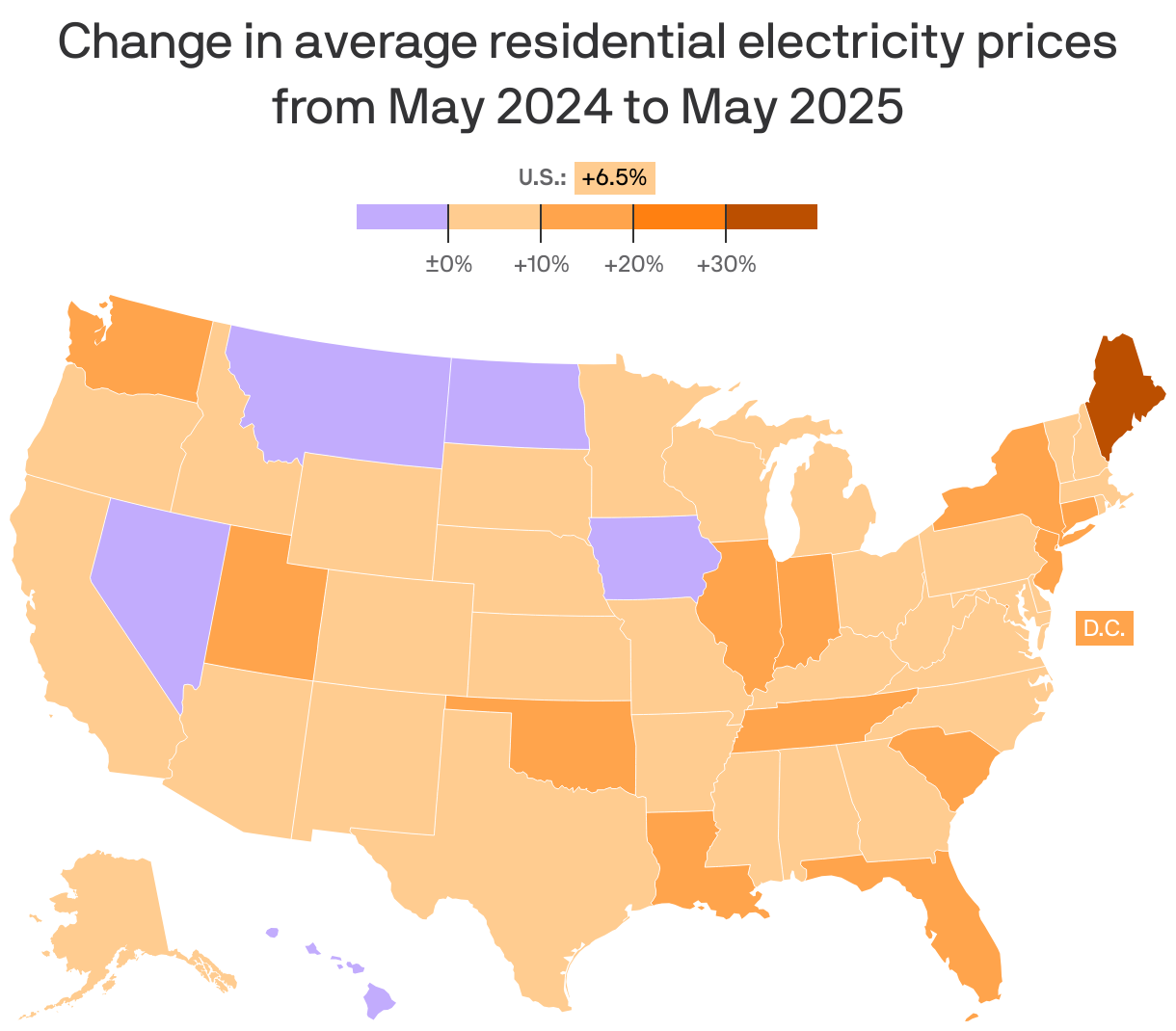
Electricity costs are rising nationwide, including in Arizona, and could get even higher for some amid the explosion in data centers powering AI and more.
Why it matters: Surging power bills could further stress many Americans' budgets as pretty much everything else also gets more expensive.
By the numbers: The nationwide average retail residential price for 1 kilowatt-hour of electricity rose from 16.41 cents to 17.47 cents from May 2024 to May 2025, per the latest available data from the U.S. Energy Information Administration, a gain of about 6.5%.
- Some states had large increases, such as Maine (36.3%) and Connecticut (18.4%), while just five states had decreases.
State of play: Arizona had one of the smallest electricity cost increases during that time, from 15.49 cents to 15.76 cents (1.7%).
The intrigue: The Corporation Commission is preparing for the strain that data centers are expected to put on Arizona's energy grid.
- Possibilities include higher energy rates for data centers to pay for the extra infrastructure and power generation facilities they could necessitate, or allowing them to generate their own power.
- Gov. Katie Hobbs vetoed legislation this year that would've waived some environmental and zoning regulations to make it easier for large industrial power users like data centers to place small modular nuclear reactors at their facilities.
- Arizona Public Service, Salt River Project and Tucson Electric Power this year announced that they're exploring the possibility of building a nuclear plant.
Zoom in: There are several plans for massive new data centers in Arizona, including a 3,330-square-foot, $33 billion "data center corridor" in Eloy, which would be among the largest in the U.S.
- Project Blue, a proposed data center in Tucson, has faced public backlash over concerns about energy and water use.
Zoom out: Electricity prices vary regionally and have many influences, including basic supply and demand, fuel rates and infrastructure costs.
- Yet many analysts point to power-hungry data centers as a driver of rising rates, especially in data center hotspots.
- That's partly because of data centers' immediate demand for energy, but also because grid operators are investing in new transmission lines and other gear to handle their expected proliferation — and passing those costs along to customers.
What's next: The Trump administration is pushing "coal, natural gas, nuclear and hydropower plants to feed AI demand," Axios' Daniel Moore reports — but is hostile to wind and solar.
- Adding generation of any kind, meanwhile, takes time and money.