Amid Arizona's therapist shortage, some young people turn to chatbots

Add Axios as your preferred source to
see more of our stories on Google.
Some young people are turning to a new free and largely unregulated tool for mental health advice: ChatGPT and similar artificial intelligence chatbots.
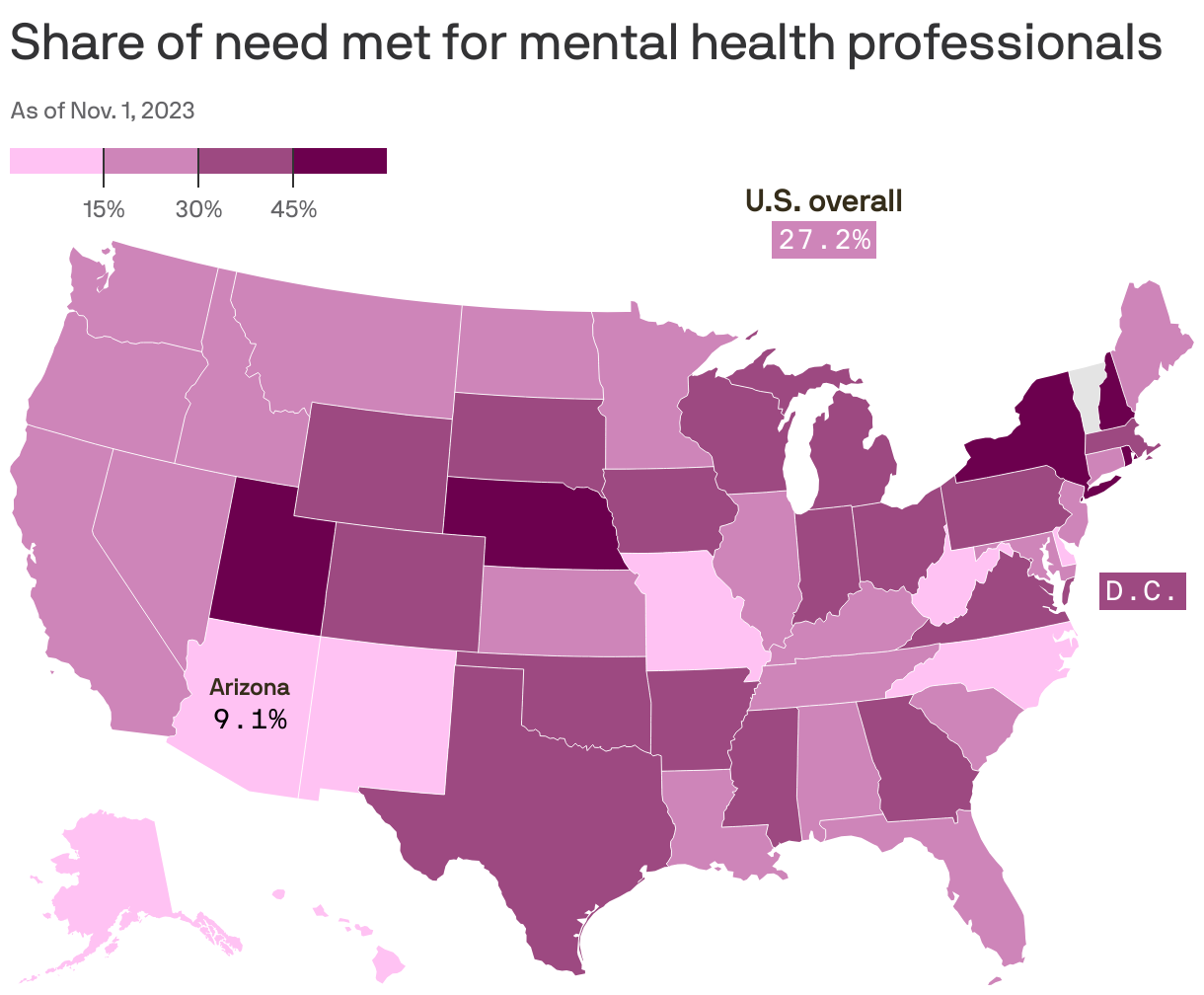
Why it matters: Arizona met only 9% of mental health care demand as of Nov. 1, per a Kaiser Family Foundation report. Young people have even higher levels of unmet mental health care needs and are more likely to experiment with new technological tools, like AI, psychologists and researchers told Axios Phoenix.
- Only 35% of Arizonans surveyed by Gallup and the Center of the Future of Arizona in 2020 said they were satisfied with the availability of mental health providers.
- Students were the least satisfied group — with 23% saying there are enough resources.
What's happening: There's an abundance of chatbots these days. Most aren't meant to be used for health advice, but that doesn't mean people won't use them for that purpose.
Between the lines: Tech and mental health professionals worry about negative or unintended consequences such as inconsistent advice, data security challenges and a general lack of human contact.
- "I think the challenge becomes that [high school students] use AI not necessarily as a substitute for school psychologists, but as a substitute for relationships in general," Arizona Association of School Psychologists president Matthew Moix said.
- A study published in Scientific Reports in April showed ChatGPT was inconsistent with moral advice and users changed their opinions based on the bot's response.
- Meanwhile, data leaks are also a risk unless you run a completely autonomous model on your computer, technology adviser Sil Hamilton of Health Tech Without Borders told Axios Phoenix.
What they're saying: Collin Newberry, a 21-year-old Yavapai Community College student, recently tried ChatGPT for mental health advice and found it to be better than a school psychologist he saw while experiencing depression as a teenager.
- "[The therapist] told me he was in a band and it was his outlet for dealing with stuff, and he essentially just talked about himself," Newberry said.
- ChatGPT, however, encouraged Newberry to set small, realistic goals, and that proved to be more effective, he said.
- Newberry said having AI is better than nothing at all, which is often the alternative for young people who don't have family or other support.
The bottom line: "Whether AI is good or bad at what it does, I think it begs a bigger question: Why is someone turning to the computer rather than a person?" says Emily Hinsberger from Devils4Devils, a peer-to-peer support organization at Arizona State University.
- College students are more likely to turn to a friend than a professional, she said. But with stigma around depression and anxiety, they may be afraid to jeopardize personal relationships, which is where AI could come in, Hinsberger says.
What we're watching: The University of Arizona is involved in a clinical trial of a tool called AIBerry, which works via telehealth to help psychologists diagnose patients by reading changes in voice tone and facial expressions.
- Meanwhile, a study conducted by MIT in 2020 found that AI "humanized" health care by automating monotonous tasks, allowing clinicians to spend more time with patients — essentially leading to "less paperwork and more heartwork," per School Psych AI founder Byron McClure.