Arizona has second-biggest birth rate drop in U.S.

Add Axios as your preferred source to
see more of our stories on Google.
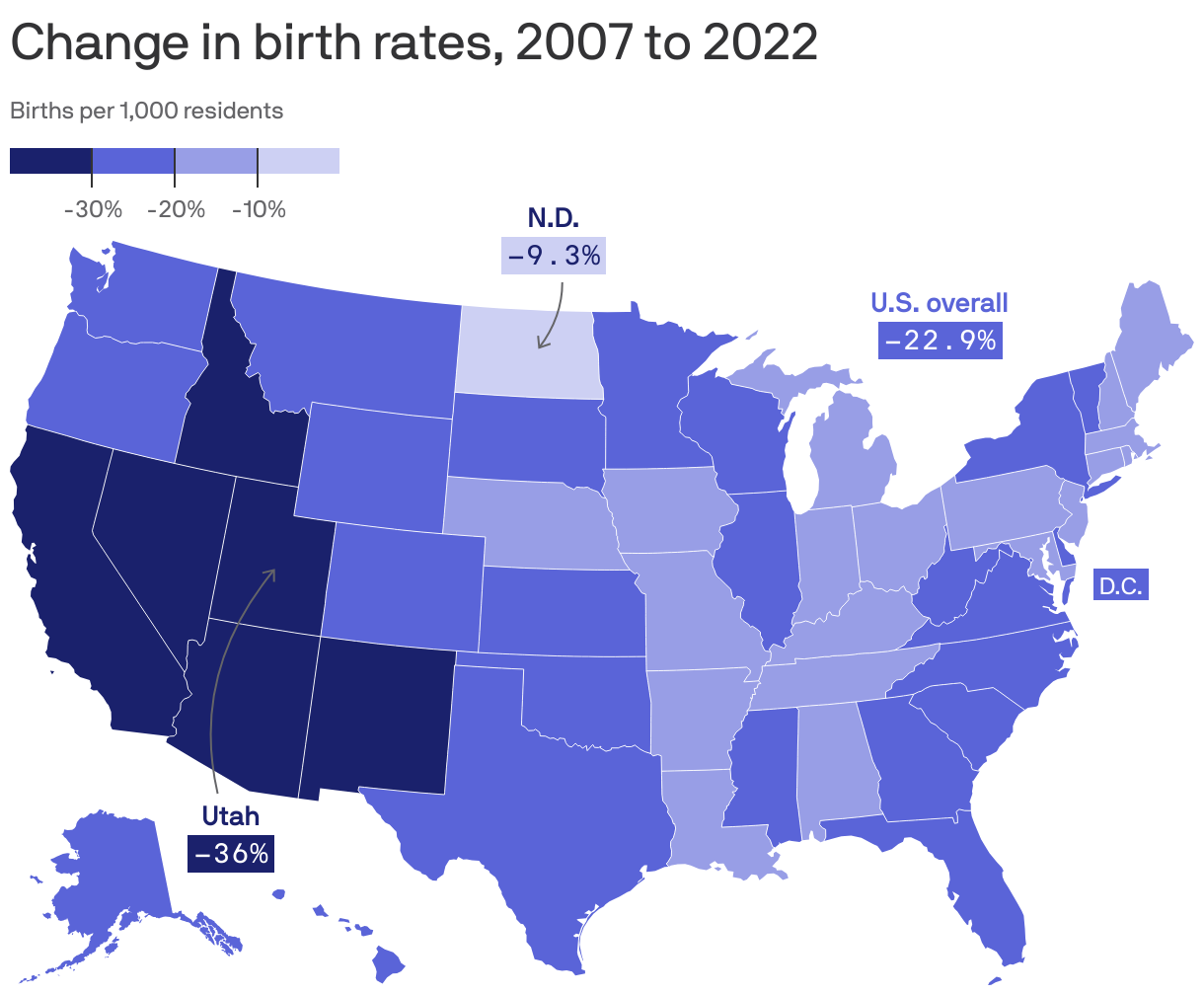
The national birth rate fell substantially between 2007 and 2022, and in almost no state did it decrease as much as in Arizona.
Driving the news: Arizona's birth rate in that period dropped 36.1%, second only to Utah's 36.2%, according to data from the U.S. Centers for Disease Control.
- That's well above the national decrease of nearly 23%, Axios' Alex Fitzpatrick and Kavya Beheraj reported.
Zoom in: In 2022, Arizona had 10.67 births per 1,000 people, the 20th lowest of the 50 states and Washington, D.C.
- We had 16.7 births per 1,000 in 2007, which was the third highest rate in the U.S.
- Nationally, there were 14.33 births per 1,000 people in 2007 compared to 11.05 last year.
- Arizona's birth rate dipped below the national rate in 2016.
Why it matters: The birth rate is a closely watched figure for myriad reasons.
- It tends to fall as income rises, meaning lower birth rates can be a reflection of greater prosperity at both the national and individual levels. (Many factors drive this, including a sense among wealthier people that they need fewer children to support them financially as they age.)
- Yet the opposite can also be true, as people who feel they can't afford children choose not to have them.
- Lower birth rates can also be an indication of better access to contraception, family planning and abortion care.


The intrigue: In the years before the COVID-19 pandemic, the national birth rate steadily declined year over year (except for a slight bump in 2014).
- While it dropped from 11.4 in 2019 to 11.0 in 2020, it remained flat in 2021 — and even ticked up slightly in 2022, to 11.1.
Yes, but: The number of births nationally increased slightly from 2021 to 2022, from 3.66 million to 3.67 million.
- The overall population, however, decreased from 333.3 million to 331.9 million. Fewer people + relatively constant number of births = larger birth rate.
- Ultimately, the COVID-era leveling-off and the 2022 uptick in birth rates may only be a "short-term deviation from an ongoing trend of considerably greater importance," as a Brookings Institution report put it.