The birth rate ticked up in 2022. Can the reversal last?


Add Axios as your preferred source to
see more of our stories on Google.
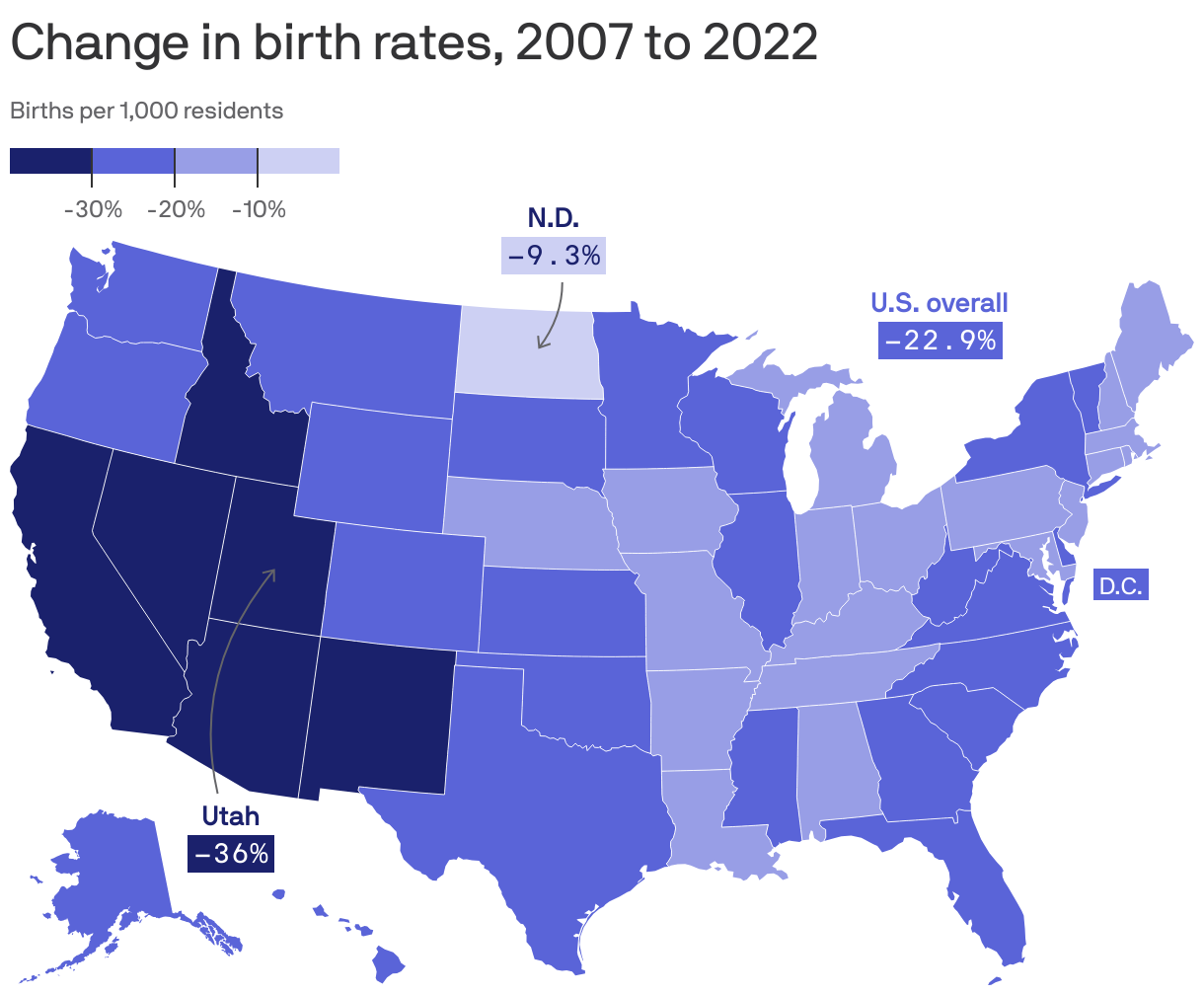
The nationwide birth rate fell significantly between 2007 and 2022, dropping from 14.3 births per 1,000 people to 11.1, or nearly 23%, per new CDC data.
Driving the news: It declined particularly dramatically in parts of the West and Southwest, with the greatest drop-offs in Utah (-36.2%), Arizona (-36.1%) and Nevada (-34.0%).
Why it matters: The birth rate is a closely watched figure for myriad reasons.
- It tends to fall as income rises, meaning lower birth rates can be a reflection of greater prosperity at both the national and individual levels. (Many factors drive this, including a sense among wealthier people that they need fewer children to support them financially as they age.)
- Yet the opposite can also be true, as people who feel they can't afford children choose not to have them.
- Lower birth rates can also be an indication of better access to contraception, family planning and abortion care.
- And they tend to be lower in societies with higher rates of women in the workforce — though that relationship is becoming increasingly complicated (it doesn't hold up as well in places with stronger parental leave laws, for example).
Yes, and: Some fear that if the birth rate dips too low, it will bring about a crisis where there are too few young people to care for an aging populace. (This is a particularly salient issue in Japan, which has among the world's oldest populations and where the birth rate fell to a record low last year.)
- That's in sharp contrast to "Malthusianism" — essentially, the fear that overpopulation will result in too many people and too few resources.
- While that theory — popular among many social scientists and policymakers in past decades, and which often underpins anti-immigration rhetoric — had faded somewhat, it's seeing a revival among some climate activists who argue the planet can no longer support a growing human presence.
Of note: Births are only one side of the population coin; deaths and immigration/emigration also play key roles.
The intrigue: In the years before the COVID-19 pandemic, the birth rate was steadily declining year over year (except for a slight bump in 2014).
- While it dropped from 11.4 in 2019 to 11.0 in 2020, it remained flat in 2021 — and even ticked up slightly in 2022, to 11.1.
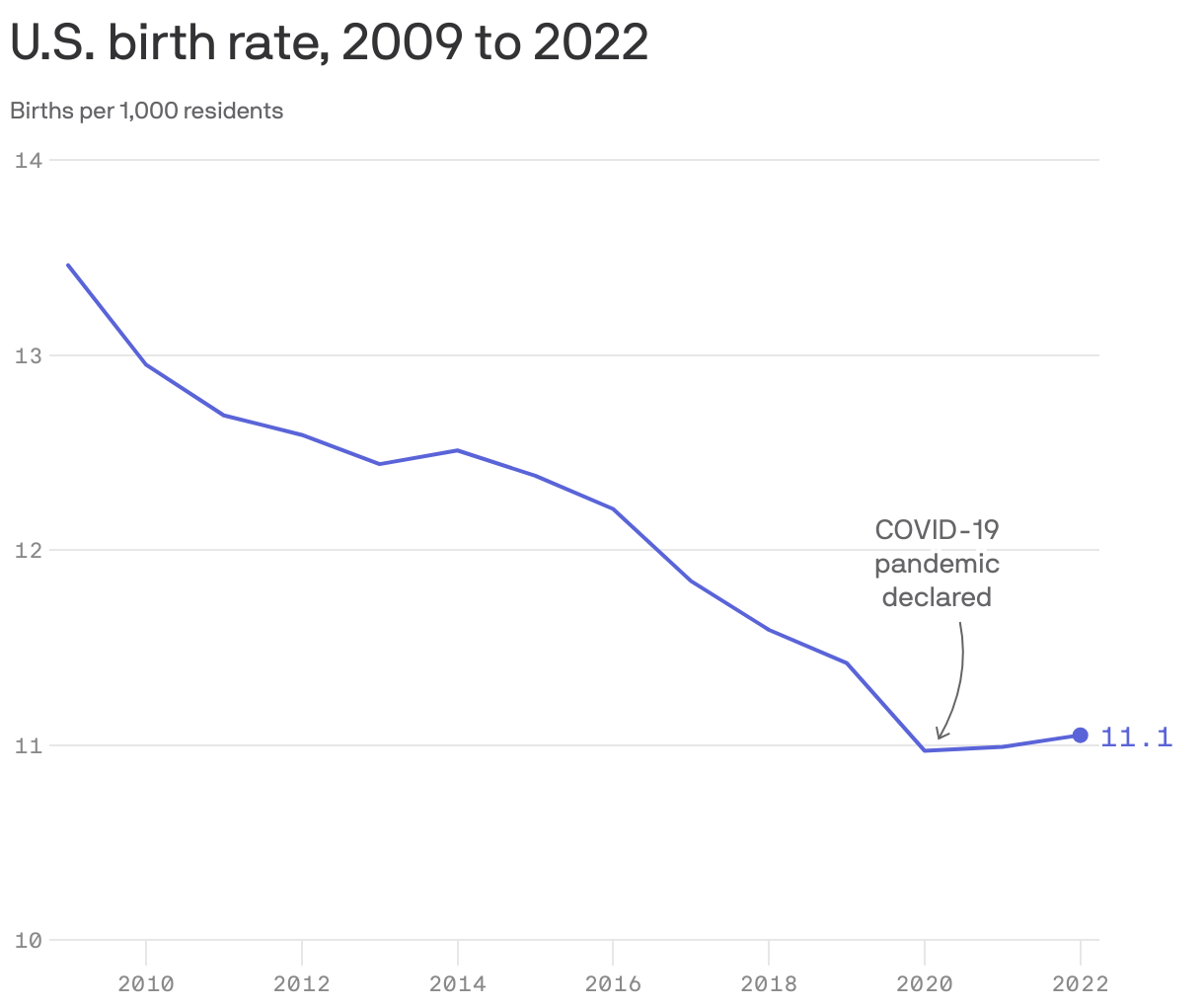
Yes, but: The number of births increased only slightly from 2021 to 2022, from 3.66 million to 3.67 million.
- The overall population, however, decreased from 333.3 million to 331.9 million. Fewer people + relatively constant number of births = larger birth rate.
- Ultimately, the COVID-era leveling-off and the 2022 uptick in birth rates may only be a "short-term deviation from an ongoing trend of considerably greater importance," as a Brookings Institution report put it.
The bottom line: It'll take a few more years before the pandemic's impact on birth rates is fully understood. In the meanwhile, it seems likely the overall rate will resume its downward trend as post-pandemic normality continues settling in.
