Pennsylvania abortions increasing after Roe v. Wade overturned


Add Axios as your preferred source to
see more of our stories on Google.
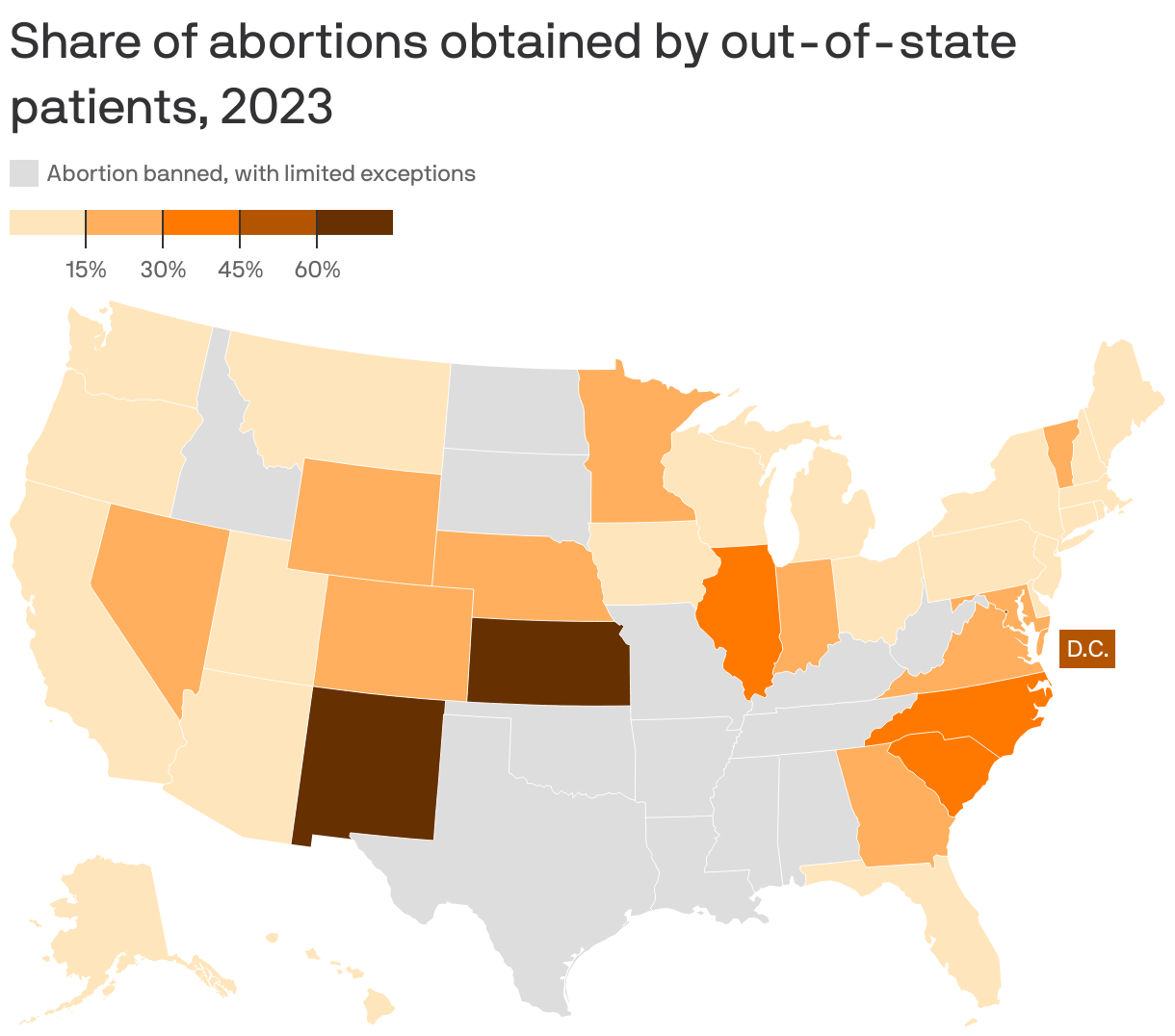
Clinics provided roughly 37,900 abortions in Pennsylvania last year, per new data estimates from the Guttmacher Institute.
The big picture: That's up more than 17% from 2020, two years before the Supreme Court overturned Roe v. Wade.
Why it matters: This week marks the second anniversary of the Dobbs decision, which has left a patchwork of abortion access laws posing heightened logistical and financial challenges for patients seeking care.
- Since then, roughly half the states have imposed restrictions of some kind on the procedure.
Zoom in: Some 2,550 out-of-state patients traveled to Pennsylvania for abortions last year.
- An estimated 400 more patients traveled to the Keystone State to obtain an abortion in 2023 compared to 2020, per the data from the institute, which supports abortion rights.
- But the percentage of abortions given to out-of-state patients has remained steady at 7% during that time.
By the numbers: People from Ohio accounted for 36% of all out-of-state abortion patients who traveled to Pennsylvania last year (or 920) — the most out of any state, per the data.
- That was followed by patients from West Virginia (600), Delaware (330) and New Jersey (230).
The other side: More Pennsylvania patients traveled to New Jersey for the procedure than any other state (2,910).
State of play: Abortion is legal in Pennsylvania up to about 24 weeks of pregnancy.
- Several restrictions exist, however, such as mandated counseling and a 24-hour waiting period.
Zoom out: Across the country, about 171,300 patients traveled out-of-state for abortions in 2023.
- As of this month, residents in 712 (22.7%) counties traveled more than 200 miles to access the procedure, per the Myers Abortion Facility Database, which is maintained at Middlebury College.
- That's a more than threefold jump over June 2021, when residents in 216 (6.9%) counties traveled the same distance.
Between the lines: People driving the furthest to get an abortion are more likely to come from congressional districts with lower incomes and more diverse populations, according to data analysis by the left-leaning Center for American Progress.