E-bike injuries surge among younger riders


Add Axios as your preferred source to
see more of our stories on Google.
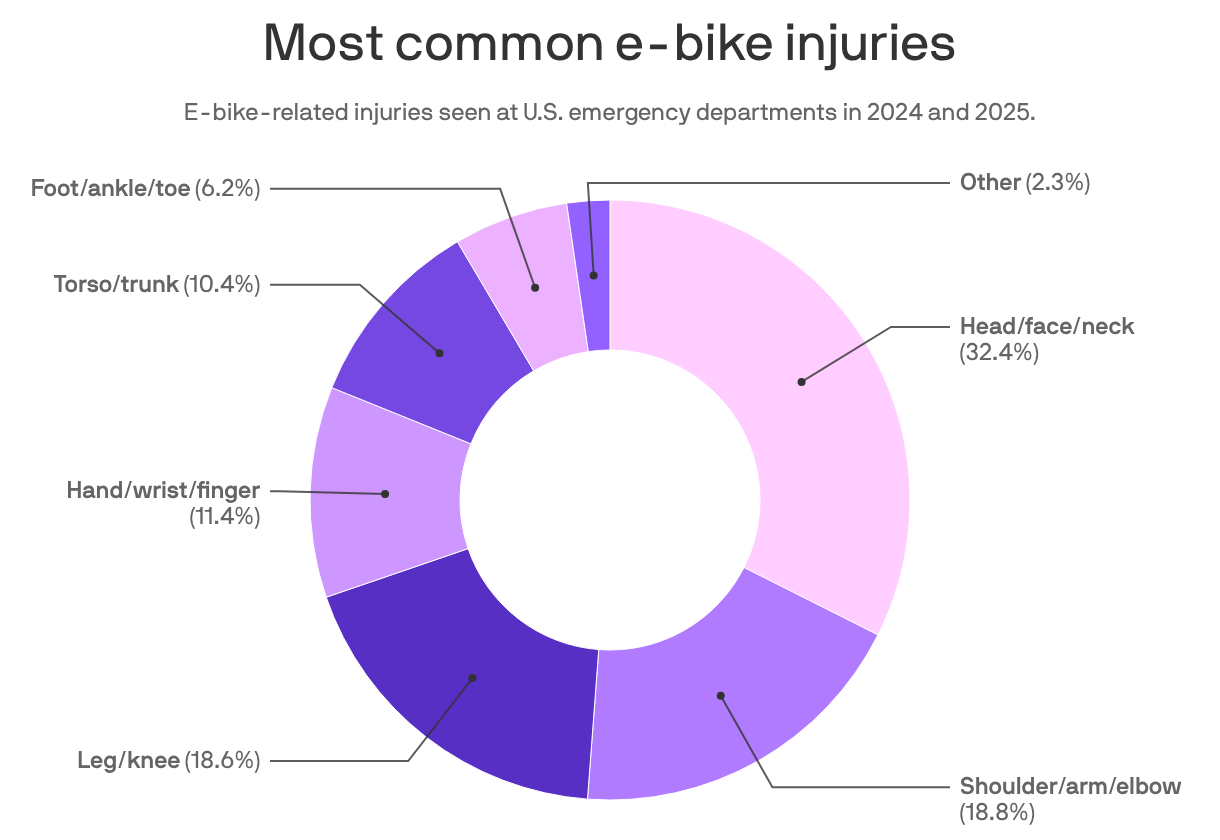
E-bike sales in the U.S. have more than quadrupled over the past five years, but a spike in ownership has meant a spike in injuries, too, especially among young people.
Why it matters: The result has been evident in emergency departments, particularly among teens and younger riders.
Go deeper: About 41% of all emergency visits for e-bike injuries in 2024 and 2025 involved patients ages 10 to 19, according to National Electronic Injury Surveillance System estimates.
- At Rady Children's Health Orange County, a southern California hospital, just one trauma visit was related to an e-bike crash in 2021. By 2025, e-bike injuries had become the leading cause of trauma patient visits.
Catch up quick: E-bikes travel faster and weigh more than conventional bicycles, making them more difficult for inexperienced riders to control and increasing the risk of serious injuries.
- E-bikes use electric motors that amplify a rider's pedaling effort. Some models include a throttle that propels the bike without pedaling.
- Youth-oriented models are electronically limited to about 20 mph, but some users illegally bypass those speed limiters, substantially increasing both crash and injury risks.
The big picture: No federal law regulates e-bike use, leaving states and local governments to set their own rules. Arkansas law divides e-bikes into three classes.
- Class 1 e-bikes provide pedal assistance up to 20 mph.
- Class 2 use a throttle to reach 20 mph.
- Class 3 provide pedal assistance up to 28 mph. Riders under 16 are prohibited from operating Class 3 e-bikes, though they may ride as passengers.
E-bikes are not considered motor vehicles under Arkansas law, so riders generally follow the same rules as bicyclists on public roads. But local governments and land managers can set stricter rules for trails and paths.
Zoom in: Rules vary in NWA depending on the trail and who manages it.
- Fayetteville allows Class 1 and Class 2 e-bikes on paved shared-use trails, including the city's sections of the Razorback Greenway, with a 15 mph speed limit.
- Bentonville has promoted e-bike use through a resident rebate program, but trail access generally depends on land-manager rules.
- Arkansas State Parks allow all three classes of e-bikes on park roads, but only Class 1 e-bikes on multi-use trails and mountain bike singletrack.
- At Ben Geren Park in Sebastian County, Class 1 e-bikes are allowed on trails, while Class 2 and Class 3 models are restricted to roads.
Worthy of your time: The American Academy of Orthopaedic Surgeons offers a list of tips to prevent e-bike injuries, including wearing a helmet every time, and putting phones and headphones away while riding.
The bottom line: E-bikes can make it easier for people to get around, especially in trail-heavy places like Northwest Arkansas. But doctors and safety officials say riders — especially teens and children — should treat them with more caution and respect than traditional bicycles.
More from Axios: Applications to open for $7M in e-bike vouchers