More families turn to surrogacy, navigating uneven state laws


Add Axios as your preferred source to
see more of our stories on Google.
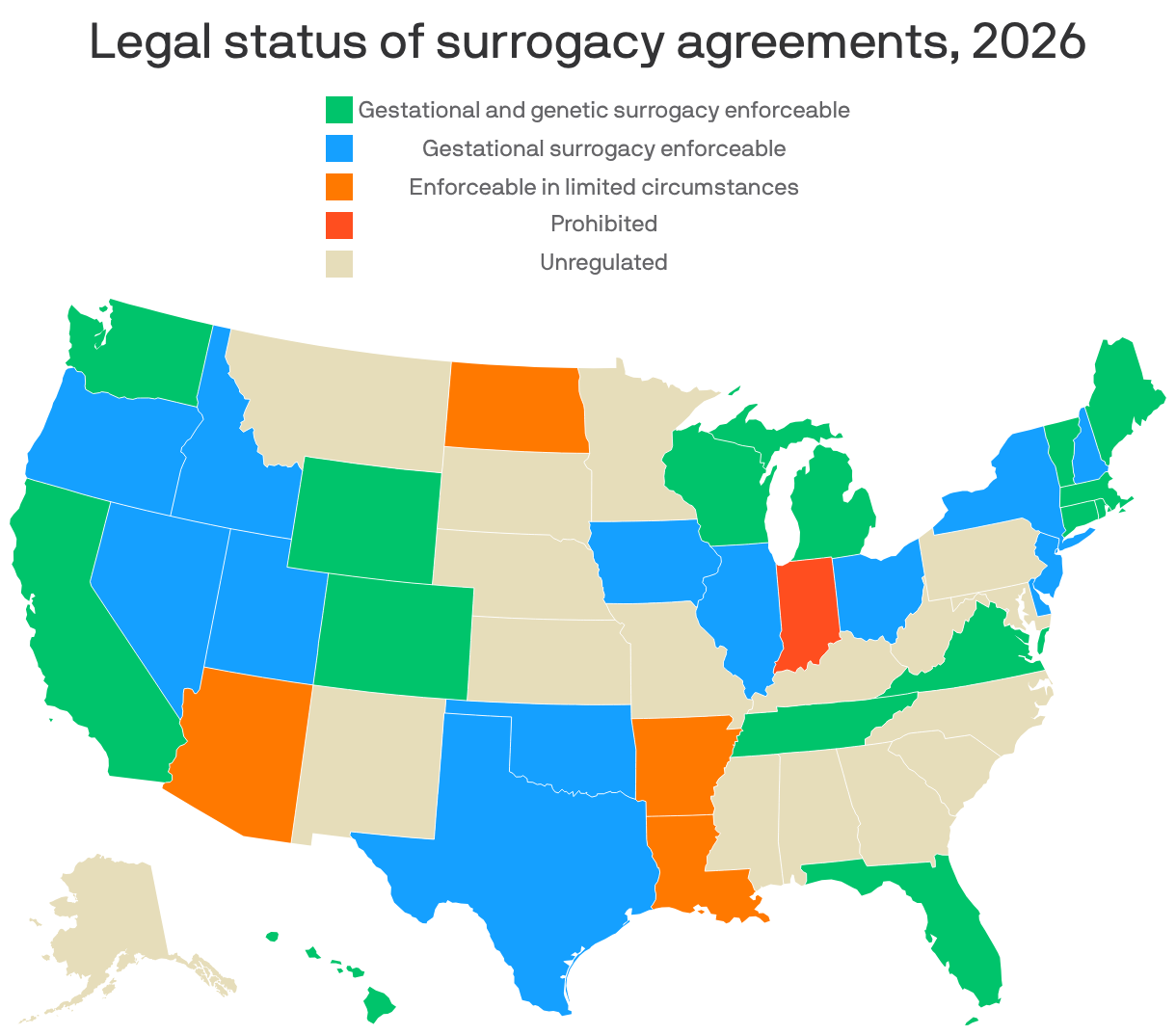
Without a federal law, surrogacy in the U.S. is governed by a patchwork of state regulations that can determine everything from whether agreements are legally binding to who is recognized as a parent at birth.
Why it matters: More Americans are turning to surrogacy to build their families, making ethical, legal and cultural tensions harder to ignore.
- U.S. clinics reported more than 11,500 gestational carrier cycles in 2023 — nearly seven times as many as in 2004, when the American Society for Reproductive Medicine began tracking the data.
How it works: A surrogate carries a pregnancy for intended parents — typically via in vitro fertilization (IVF) with an embryo that uses a donor or the intended mother's egg.
- That's called gestational surrogacy, and the surrogate can be referred to as the gestational carrier.
- It's an option for people who want biological kids but can't — or can't safely — carry a pregnancy.


Major differences between state laws include:
- How a surrogate must be compensated (if not considered "altruistic").
- Who becomes the legal parents of a child born via surrogate.
- Whether genetic surrogacy (when the surrogate uses her own egg) is even allowed.
Some highlights of what's on or not on the books in Arkansas, according to Surrogacy 360, include:
- Gestational and genetic surrogacy contracts can be enforced in court, but the law limits which intended parents can enter an enforceable surrogacy contract.
- State law does not address whether a surrogate can be paid beyond reimbursement for expenses.
- Intended parents must be married to each other to enter an enforceable surrogacy contract and can only do so when the intended father is a genetic father.
- The question of whether same-sex intended parents can enter into enforceable surrogacy contracts hasn't been explicitly addressed, but they should be able to if they are married and one is the genetic parent.
- An unmarried biological father may enter an enforceable surrogacy contract, and an unmarried woman may enter an enforceable surrogacy contract using an anonymous sperm donor.
The bottom line: Often, surrogacy agreements happen across state lines, so multiple state laws might need to be considered.