Fluoridated water reaches most in Arkansas

Add Axios as your preferred source to
see more of our stories on Google.
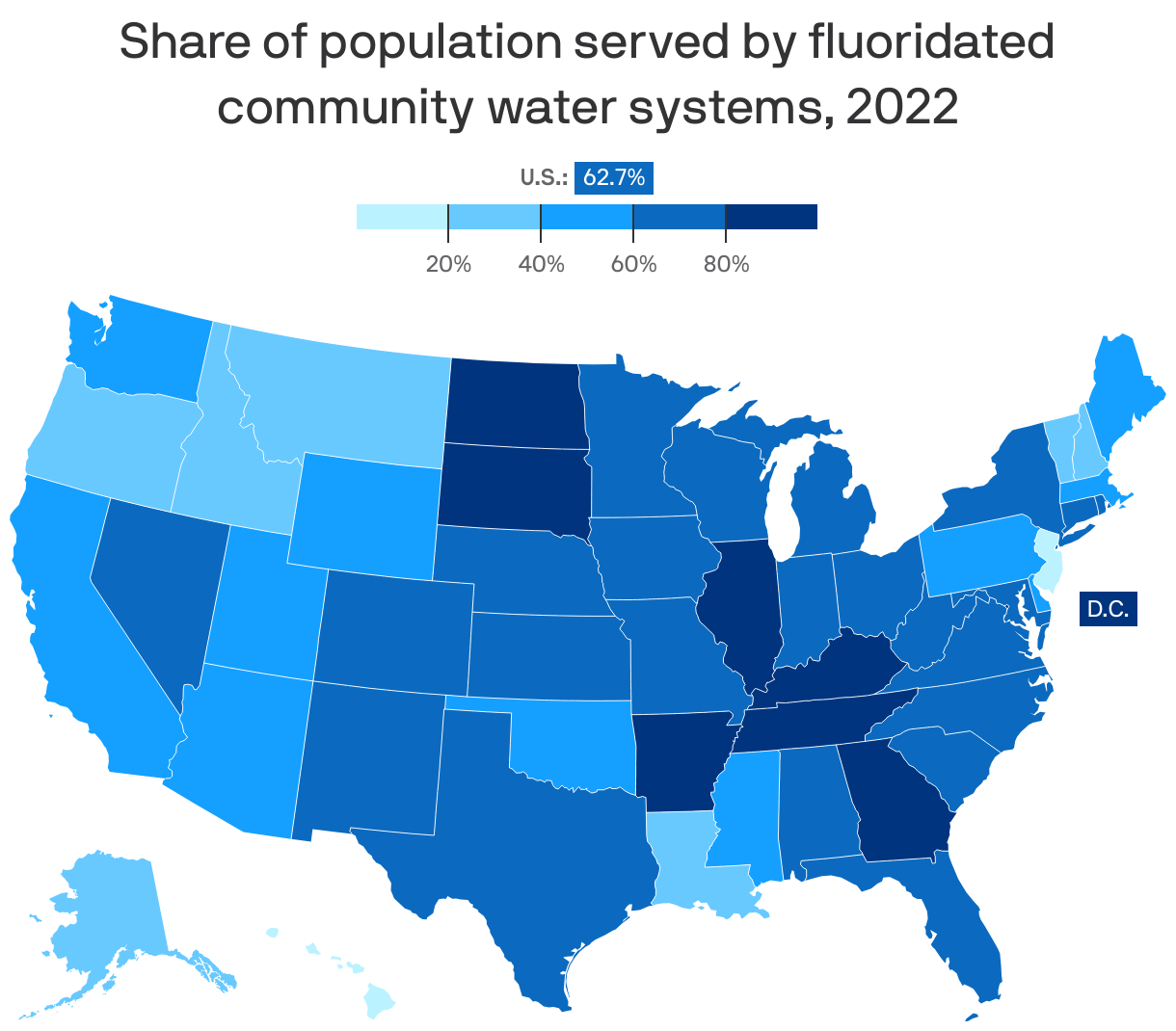
More than 82% of Arkansas' population was served by fluoridated community water systems as of 2022, the fourth-highest rate in the country, per the latest CDC estimates.
Why it matters: Fluoridation is once again becoming a political flashpoint, with Utah and Florida recently moving to ban the practice — a step encouraged by Health and Human Services Secretary Robert F. Kennedy Jr.
- Nationally, 63% of the U.S. was served by fluoridated community water systems.
The big picture: Dental and public health experts have long argued in favor of community fluoridation, wherein fluoride is added to public water supplies to help prevent tooth decay.
- "If I have new patients come into my practice, I can guess probably eight or nine times out of 10 if they've grown up in a fluoridated community" because "they don't have cavities," one pediatric dentist recently told CNN.
Yes, but: Fluoridation has long been controversial among detractors who view it as a form of government making a personal health choice.
- It's even been the subject of conspiracy theories dating back to at least the Cold War, famously ribbed in Stanley Kubrick's 1964 satire "Dr. Strangelove."
Zoom in: Bills filed in Arkansas' recent legislative session seeking to remove fluoride mandates and allow voters to decide whether fluoride is in their drinking water ultimately didn't pass.
What they're saying: Fluoride is "an industrial waste associated with arthritis, bone fractures, bone cancer, IQ loss, neurodevelopmental disorders, and thyroid disease," Secretary Kennedy claimed last year — an assessment refuted by many experts.
- "The facts are that it's an enormous public health innovation and achievement over the past century in reducing dental disease, especially in children and especially in populations that don't have access to regular dental care," Diana Winters, deputy director at the Resnick Center for Food Law & Policy at UCLA School of Law, previously told Axios' Sareen Habeshian.
By the numbers: Washington, D.C. (100%); North Dakota (90.6%) and Kentucky (89.8%) had the greatest shares of residents served by fluoridated community water as of 2022, per CDC estimates.
- Hawai'i (8.2%), New Jersey (14.4%) and Oregon (22.3%) had the smallest.
Stunning stat: "A 2015 Hawaii Department of Health study found the state has the highest rate of tooth decay in the nation among third graders," Honolulu Civil Beat reported in 2020.
Between the lines: States have a range of policies affecting their fluoridation stats.
- Some (like Kentucky) make it largely mandatory, while others (like New Jersey) leave it up to localities.
What's next: Lawmakers in several states, including Louisiana and Tennessee, are also pushing fluoridation bans, per ADA News.
- Utah public health officials are now advising residents to consider fluoride supplements amid the statewide ban on community fluoridation, Axios' Kim Bojórquez reports.
The bottom line: People without easy access to fluoridated water can still get fluoride through other means — by using fluoridated toothpaste, for example (though Texas is now investigating toothpaste manufacturers over how they market such products).
- Yet that has nowhere near the reach of drinking water piped into millions of Americans' homes and available at the turn of a spigot.