Bird flu crisis enters new phase


Add Axios as your preferred source to
see more of our stories on Google.
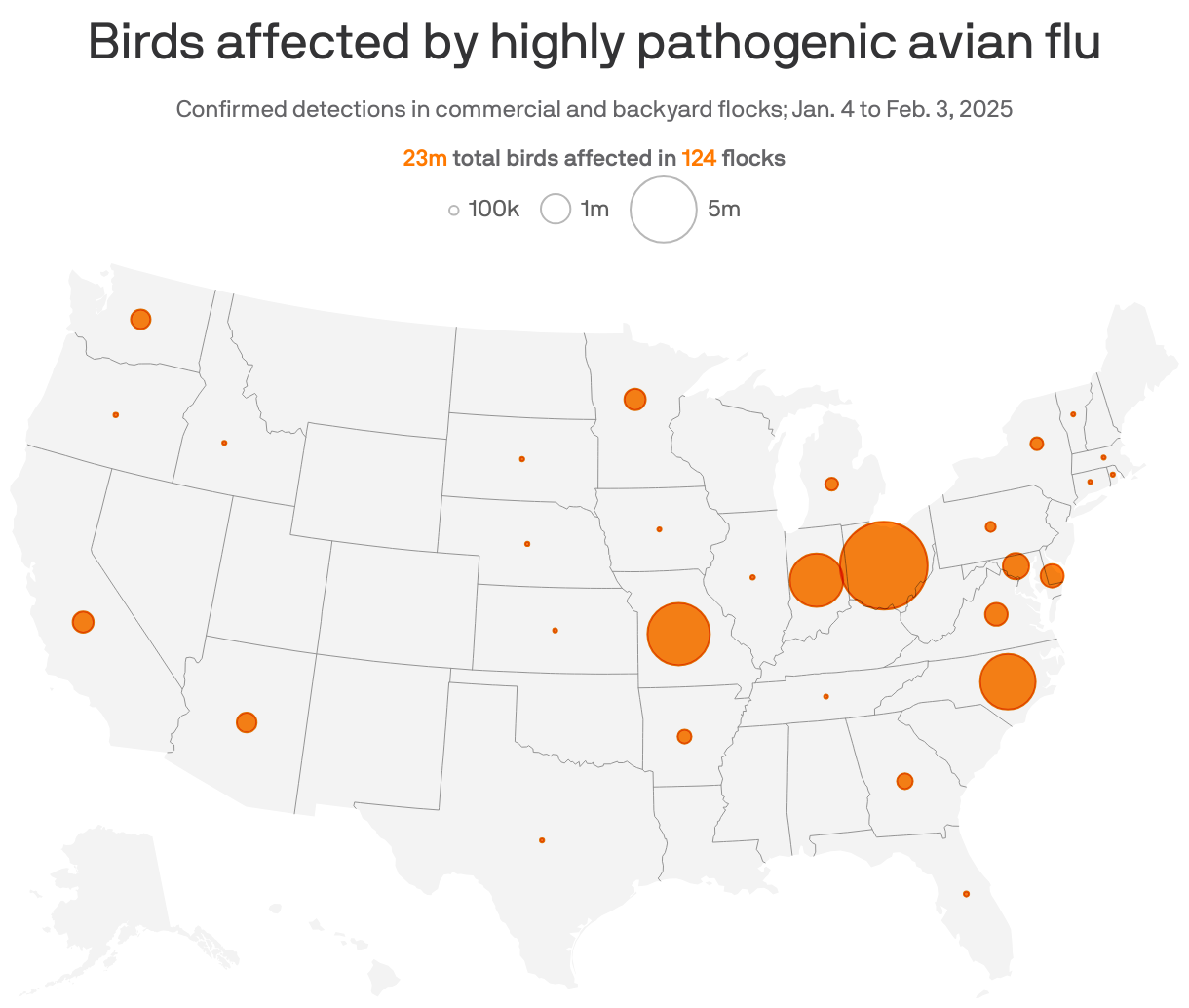
Dozens of newly confirmed cases of avian influenza (AI) in wild birds and the first verified U.S. case of a new strain of the virus are raising concern the bird flu crisis may be entering a troubling new phase.
Why it matters: While the developments don't necessarily raise the risk of a pandemic, they could create more havoc for farmers, exacerbate egg shortages and expose more gaps in government disease surveillance.
- The outbreak is intensifying as the Trump administration maintains a pause on most external federal health agency communications, including publication of CDC's Morbidity and Mortality Weekly Report (MMWR), a venerable source of scientific reports on public health.
Zoom in: Arkansas is the third-largest poultry-producing state in the U.S., harvesting more than 1 billion birds during 2022, according to WATT Poultry.
Reality check: But the state's chicken farmers have seen a relatively small impact during the past three years. So far in 2025, only two flocks totaling about 126,000 birds in Arkansas have been diagnosed with AI.
Driving the news: The Department of Agriculture last week confirmed 81 detections of highly pathogenic avian flu in wild birds collected across 24 states between Dec. 29 and Jan. 17.
Flashback: An outbreak, mostly in the Midwest, in 2015 impacted the production of table eggs and turkey meat. Though broiler chickens weren't heavily infected, exports dropped 26%. Egg exports fell 13% and turkey by 23%.
- The USDA estimated the cost to the federal government was more than $1 billion — $879 million to manage the crisis and about $200 million in indemnities for lost birds.
What they're saying: "If you look at what's happened the last eight weeks, the number of poultry operations that have gone down — and more recently, the duck operations — is absolutely stunning," Michael Osterholm, director of the Center for Infectious Disease Research and Policy at the University of Minnesota told Axios.
- "There is a lot of H5N1 out there. And we're going to see more cases in humans," he said.
- But "they're going to be single, isolated cases," he said.