It's getting easier to find a charger for your electric car

Add Axios as your preferred source to
see more of our stories on Google.
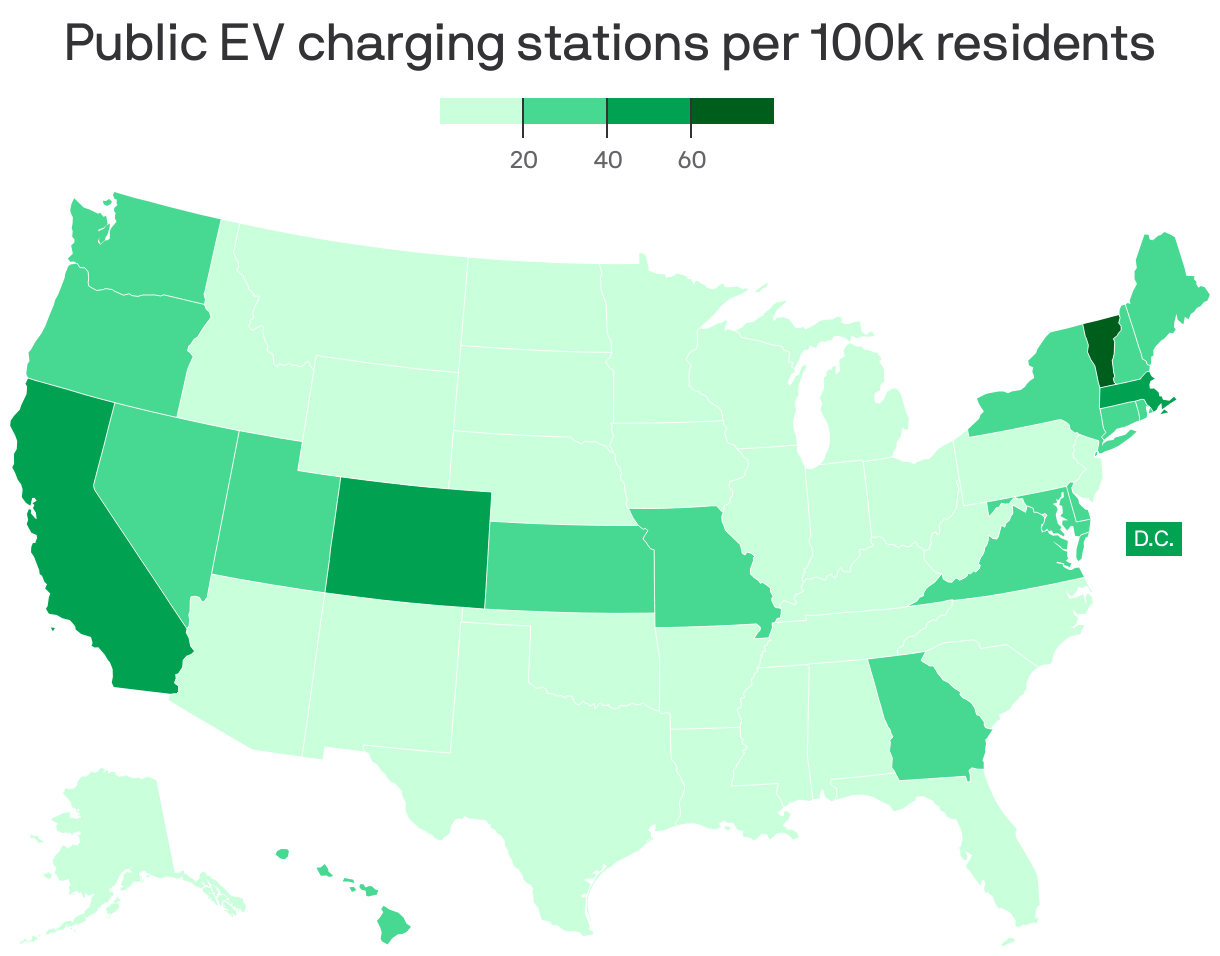
The number of public electric vehicle chargers doubled over the last four years, driven by a combination of increased private investment and a surge in government funding under the Biden administration.
Why it matters: EVs and charging have been a chicken-and-egg-problem.
- People won't buy an electric car unless they're confident they have somewhere to charge it.
- Companies won't invest in charging infrastructure without enough EV owners to plug in.
Zoom in: Arkansas has 370 EV charging stations, or 12.1 per 100,000 residents, the ninth-lowest rate in the country.
Zoom out: There are more than 207,000 publicly available EV charging ports in the U.S. today — up from around 95,000 when Biden took office in January 2021.
Yes, but: Charging might be getting easier — but the U.S. is still far short of the estimated 1.2 million public chargers that a National Renewable Energy Laboratory report says will be needed by 2030 to support expected EV sales.
The big picture: Spurring a switch from gasoline-powered cars to battery-electric vehicles was a key part of President Biden's climate agenda.
- He pushed a variety of policies — consumer EV tax credits, manufacturing incentives for carmakers and tougher tailpipe emissions laws — with the intent to make EVs account for 50% of new car sales by 2030.
- He also targeted 500,000 public chargers by 2030 — a goal supported, in part, by $7.5 billion allocated by Congress under the bipartisan infrastructure act.
The latest: President Trump, in his first day in office yesterday, signed an executive order aimed to halt much of Biden's EV policies, including funding for charging stations. Go deeper for more on Trump's energy executive orders.
Reality check: Electric vehicles sales are growing, but far off the expected pace.
- Only 8.1% of new car sales in 2024 were EVs, according to Cox Automotive. Still, that's a record 1.3 million EVs sold.
Taxpayer-funded chargers have been slow to open, but the snags are mostly due to state and local issues like permitting, utility upgrades and in some cases, politics.
- The federal government has already shelled out $4.5 billion to support about 25,000 chargers, but only 200 have opened so far.
Editor's note: Cox Automotive and Axios are both owned by Cox Enterprises.