School segregation climbs in Arkansas 70 years after the Brown decision


Add Axios as your preferred source to
see more of our stories on Google.
Fayetteville schools were among the first in the U.S. to begin integration following the Brown v. Board of Education ruling 70 years ago.
Why it matters: But even as the nation marks the anniversary and Northwest Arkansas becomes more diverse, segregation within its schools has increased slightly over the past three decades, according to the Stanford Education Data Archive.
- It's a national trend, data show. American public schools are growing more separate and unequal even though the country is more racially and ethnically diverse than ever, Axios' Russell Contreras reports.
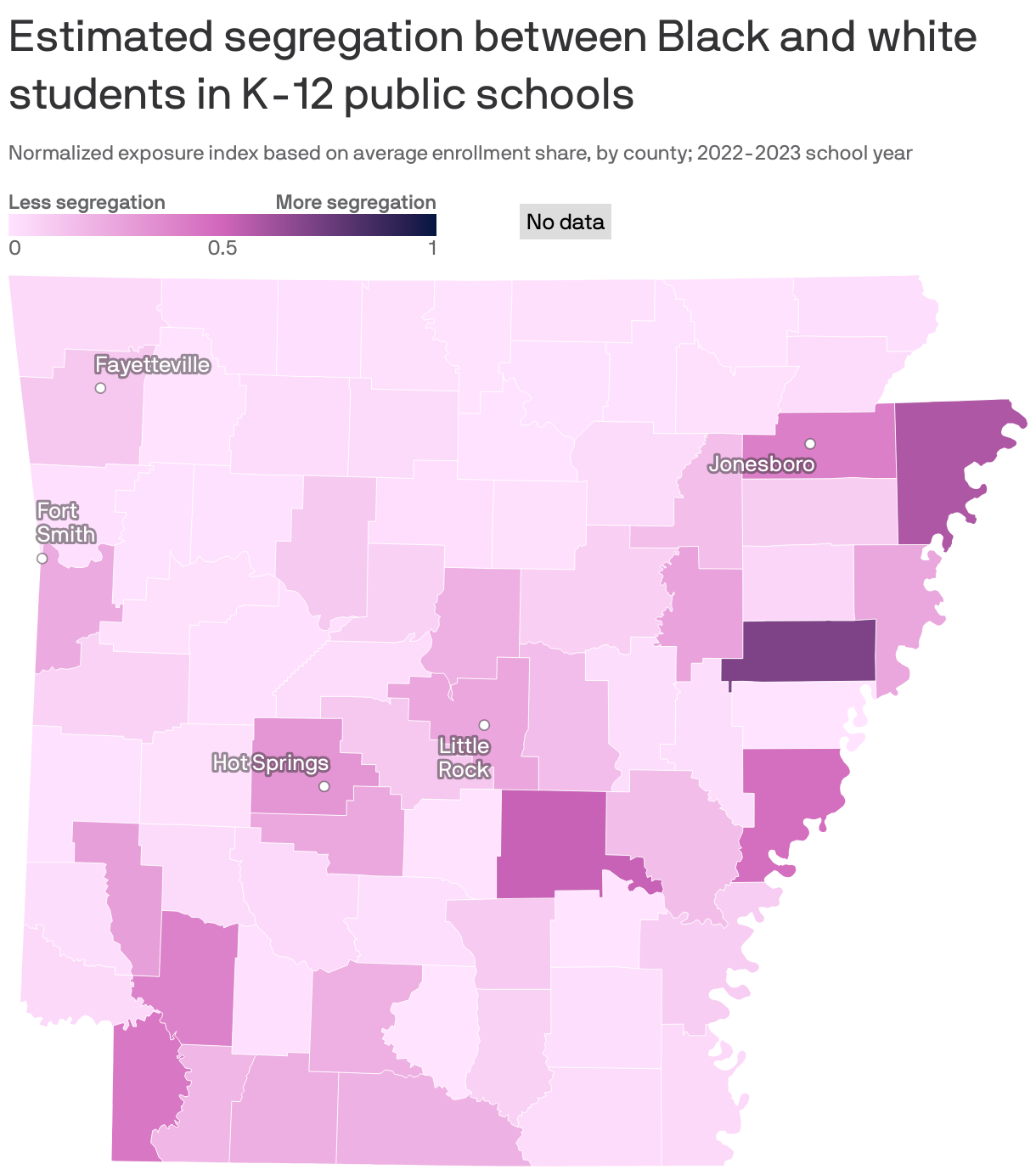
State of play: The map above shows a snapshot of Arkansas' estimated public school segregation between Black and white students during the 2022-23 school year.
- It's worth noting there's generally less segregation in counties with fewer Black and Hispanic residents, per the 2020 census.
- Often, these are rural areas with fewer choices for schools.
Zoom in: Segregation in Benton and Washington counties doubled on the Stanford index — from 0.05 to 0.10 — from 1991 to 2022.
- During that time, the white population in NWA dropped from more than 95% (1990) to about 71% (2021).
- Meanwhile, the Black population grew from 0.8% to 2.5%, while the Hispanic population swelled from 1.3% to 17.3%.
Stanford's index ranges from 0 to 1, where 0 implies no segregation (identical proportions of Black and white students) while 1 implies complete segregation (no diversity).
The bottom line: The resegregation of America's public schools coincides with the rise of charter schools and school choice options, and as civil rights groups have turned away from desegregation battles, Contreras writes.
- Segregated schools disproportionately hurt Black and Latino students since those schools tend to have fewer resources, more teacher shortages, higher student-to-school counselor ratios, and fewer Advanced Placement class options.
What we're watching: It remains to be seen what effect, if any, Gov. Sarah Huckabee Sanders' education reform under the LEARNS Act will have on the future of school segregation in Arkansas.
Fayetteville — First in class
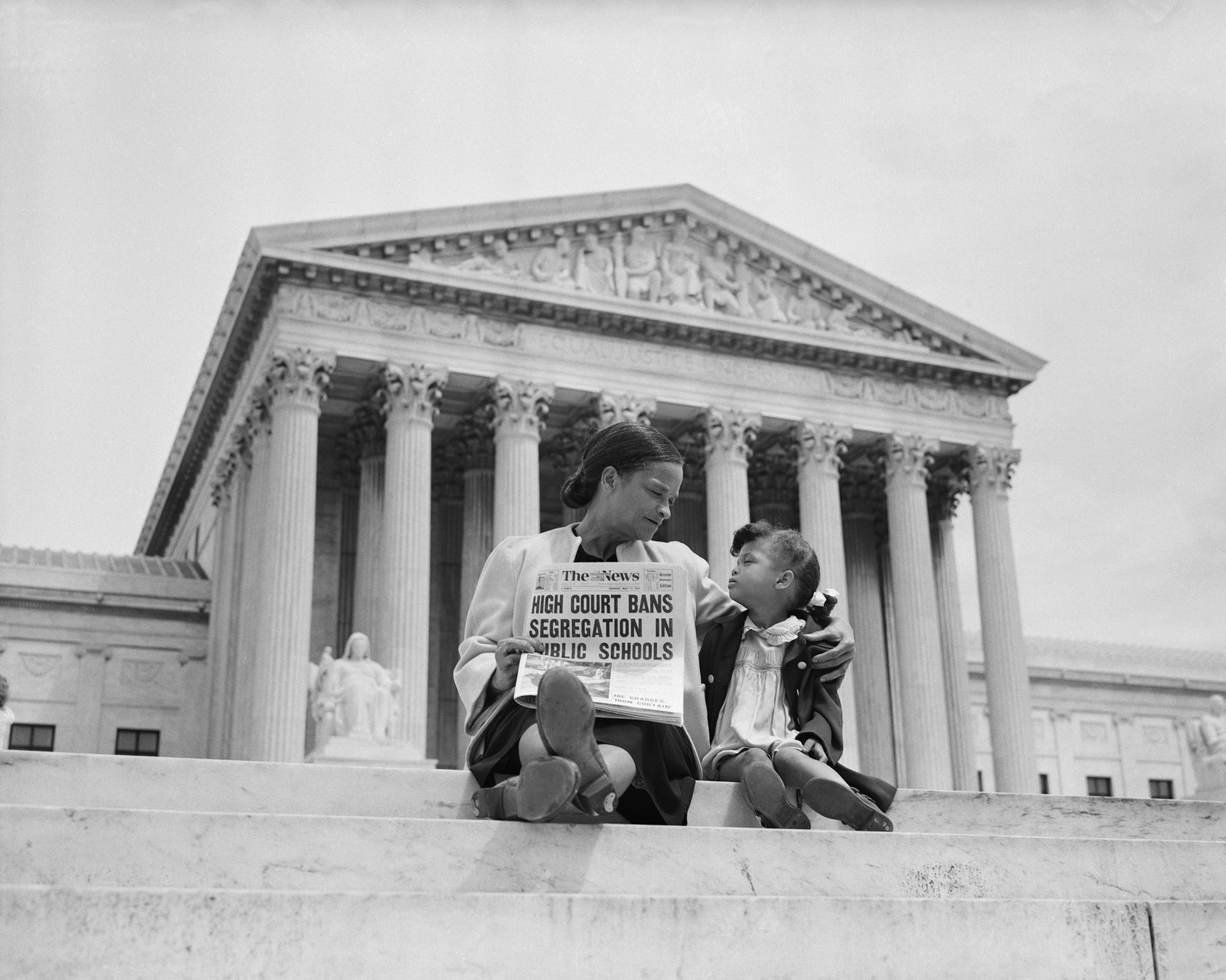
The integration of Little Rock's Central High School drew national attention — and the National Guard. But three years earlier, the first Black students to attend Fayetteville's previously all-white school largely reported it as a nonevent.
Why it matters: It's believed that Fayetteville High School was the first located within the former Confederacy to begin integration, doing so on Sept. 10, 1954.
- Seven Black students attended the school that year.
Flashback: Virginia Smith Denton, told 40/29 News in 2021 she felt welcome among her new classmates and teachers.
Yes, but: She didn't feel safe stopping in Bentonville, Farmington or Springdale at the time.
- Infamously, Springdale was a "sundown town," where Black people were threatened with their lives after dark. Incidents of intimidation also were reported in Rogers and Bentonville, according to the Encyclopedia of Arkansas.
- In 1919, Siloam Springs advertised itself as all-white.
The bottom line: Denton's grandchildren attended Fayetteville High School.