Mapped: How much it costs to charge an EV in Arkansas

Add Axios as your preferred source to
see more of our stories on Google.
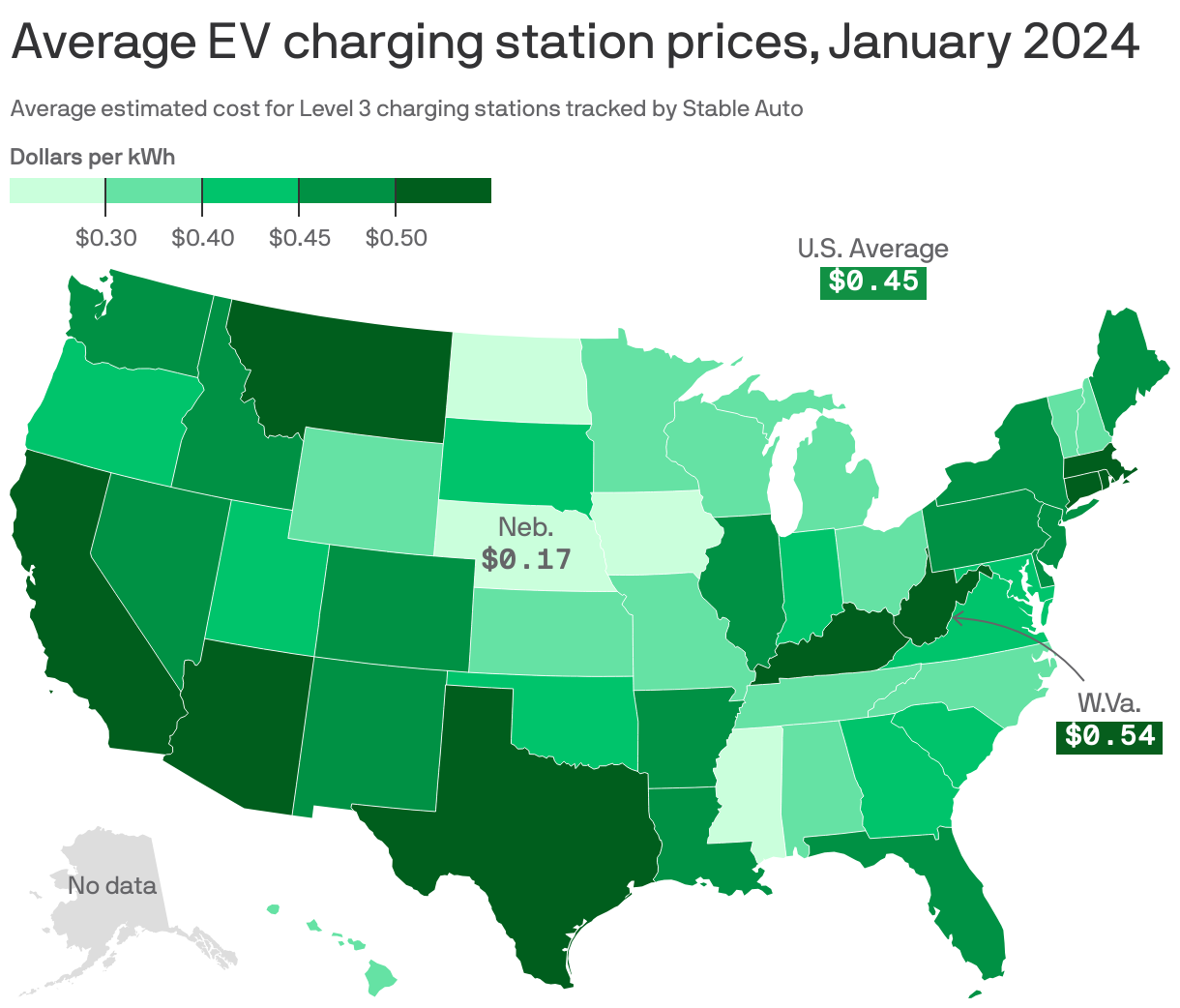
Charging an electric vehicle in Arkansas costs a bit more than the national average.
By the numbers: It costs an average of $0.47 per kilowatt-hour (kWh) to charge an electric car at a public charging station in Arkansas, Axios Pro: Climate Deals' Alan Neuhauser reports from data gathered by Stable Auto, an EV charger software developer.
The national average is $0.45 per kWh.
Context: A typical EV with 300 miles of range usually takes 75-100 kWh to go from empty to full.
The big picture: Charging an electric vehicle costs three times as much at a public charging site in West Virginia than in Nebraska — a gap that suggests EV charging companies are still figuring out how to price a top-off.
Zoom in: West Virginia, Connecticut, Arizona, Massachusetts and Kentucky have the most expensive charging stations, according to Stable Auto's survey of about 9,000 level-three, fast-charging stations in January.
- Prices in those states ranged from $0.52 to $0.54 per kWh.
- Nebraska, Mississippi, Iowa, North Dakota and Kansas were the cheapest, with prices spanning $0.17 to $0.31.
What's happening: Charging networks like Electrify America, EVgo and ChargePoint consider a host of factors in setting their charging prices — not the least being the local electricity rate.
- Cheap electricity in the Midwest, for example, may explain discounts in Nebraska, Iowa, North Dakota and Kansas, which aren't exactly hotbeds of EV adoption.
Yes, but: The big gap in prices suggests something is amiss, Stable argues.
- The older a charging location, for example, the closer it hews to $0.40 to $0.50.
- Gasoline prices, of course, also differ across state lines, but not as greatly as EV charging rates.
What they're saying: "Prices are probably set incorrectly and don't reflect underlying supply-demand," Stable CEO Rohan Puri tells Axios.
- "There is still a lot of price herding in the industry, with players, by and large, setting their prices based on what other nearby chargers have set their prices at."
What we're watching: More networks in the past six months have started adopting Tesla's variable-pricing model, which accounts for the site location, time of day and amount of power a station is delivering.