Climate change is making Northwest Arkansas summers even hotter

Add Axios as your preferred source to
see more of our stories on Google.
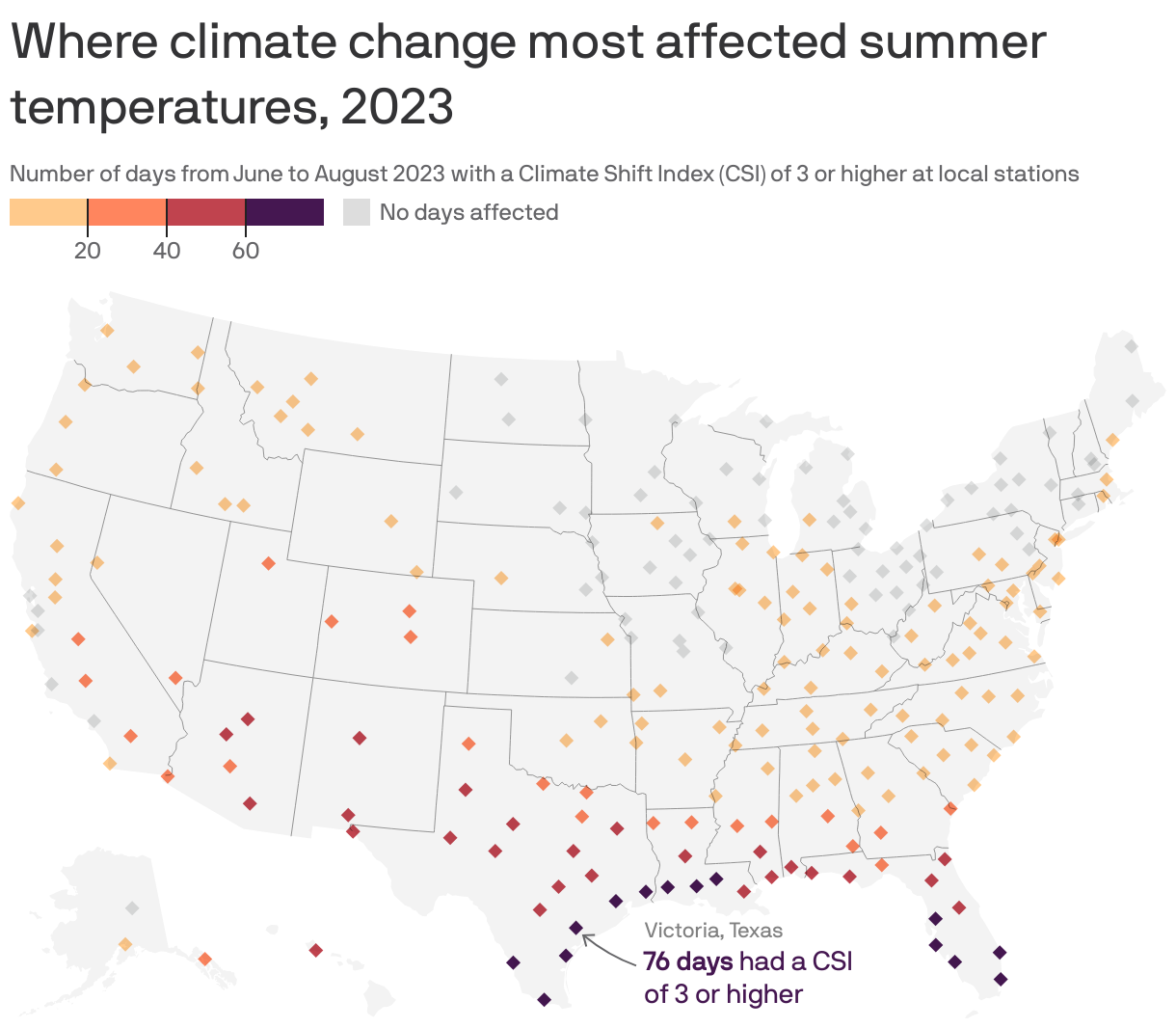
Northwest Arkansas experienced seven days this summer with scorching temperatures made at least three times more likely by human-caused climate change, per a new Climate Central analysis.
- That's 8% of the season's 91 days.
Zoom out: 326 million people — or 97% of the U.S. population — experienced at least one summer day with temperatures notably influenced by human-caused climate change in 2023, per Climate Central, a climate research and communications nonprofit.
Zoom in: In 45 of the 244 U.S. cities the group analyzed, at least half of all summer days had temperatures made at least twice as likely by climate change.
- The three U.S. (and territories) cities with the most summer days with temperatures driven by climate change: San Juan, Puerto Rico (90 days); Victoria, Texas (80); and Lafayette, Louisiana (74).
The big picture: This is a U.S.-focused version of a similar global analysis Climate Central published last week, which found that nearly half the world's population experienced temperatures made more likely by global warming this summer.
- Meanwhile, Earth just experienced what was likely its hottest summer on record, with a global average surface temperature about 0.65°C (1.17°F) above the 1991-2020 average for June through August.
How it works: Climate Central's analysis is based on the group's Climate Shift Index (CSI), which compares observed or forecast temperatures with simulations of the same weather conditions minus excess atmospheric greenhouse gases.
- The idea is to compare real-world conditions with what might have been the case without human-caused climate change.
- A CSI of 3, for example, means human-caused climate change made a given daily average temperature three times more likely.
The bottom line: Rapid attribution analyses like this one drive home a key point: Climate change is having significant present-day impacts felt by millions across the country and the planet.