We tried it: A workshop to learn Louisiana Creole, Kouri-Vini

Add Axios as your preferred source to
see more of our stories on Google.
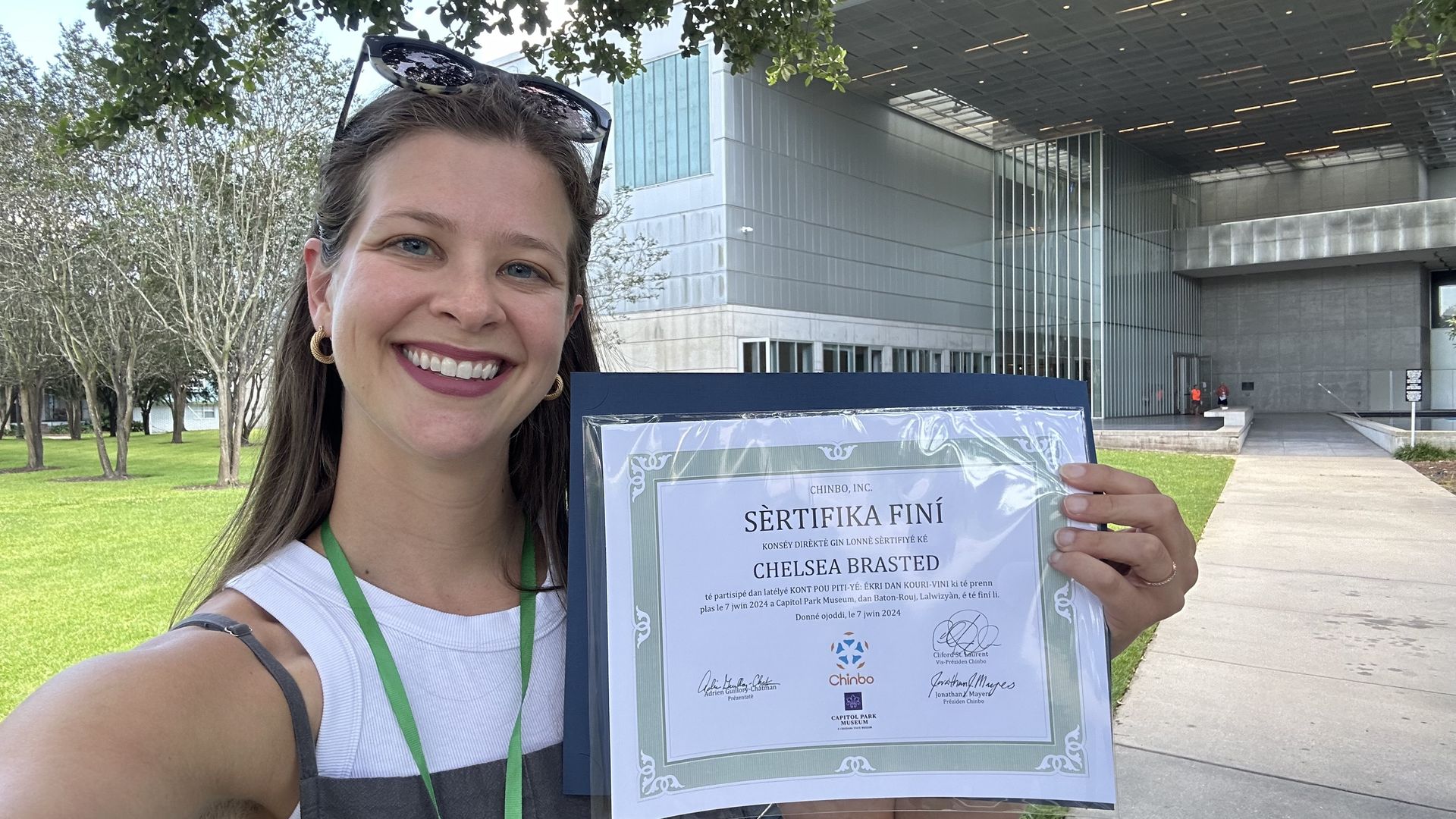
Feeling very accomplished and a little bit smarter after finishing a day learning Kouri-Vini at the Capitol Park Museum. Photo: Chelsea Brasted/Axios
For a week at the beginning of June, a Capitol Park Museum classroom filled with laughter and encouragement as students spanning decades sought to learn Louisiana Creole.
Why it matters: Also known as Kouri-Vini, the endangered, once-banned language, is getting a fresh shot at survival as activists and educators get more people speaking it.
Zoom in: Growing up in New Orleans without native parents, I once had a monolithic understanding of Louisiana's French heritage.
- For a long time, I thought "Cajun French" was one thing, and the French spoken in France was another, and that was about it.
- But the truth is so much more complex — and far richer — than that.
- To get a closer look, I signed up to take a Kouri-Vini workshop in Baton Rouge, and though no one can master a language in a single day, I left energized to learn more.
Reality check: "Kouri-Vini is actually indigenous to Louisiana," writes Clif St. Laurent, a language advocate who helped lead the week's workshops, for French language newspaper Le Louisianais.
- The Creole language was born from the linguistic space between French colonizers and people who were enslaved.
- The connection created "a sister language of Louisiana French," not a derivative, St. Laurent says, once spoken by a majority of the state.
- In fact, as activist and artist Jonathan "radbwa faroush" Mayers explains it, Kouri-Vini even predates Le Grand Dérangement, the monumental moment when Acadians were expelled from the Northeast and eventually settled in southwest Louisiana.
Friction point: Despite having once been spoken so widely, the language fell out of favor as mainstream Americanization took hold, even at times being banned from use in schools and outlawed by Louisiana lawmakers who viewed its speakers as less-than.
- Elders would often refuse to teach new generations the language out of fear children would be looked down upon by those in power.
- That's how workshop leader, scholar and author Adrien Guillory-Chatman grew up.
- "I grew up hearing the language spoken by my family every day though they did not encourage my siblings and I to speak it," she tells Axios New Orleans.
- But, through connections on social media and careful study, Guillory-Chatman, like a growing number of others, has reclaimed the language for herself.
What she says: "Though the language almost missed my generation, the Louisiana oral storytelling traditions did not," she says. "Now, I can pass these stories to future generations in the language of our ancestors."
By the numbers: It can be hard to get a formal count on how many people speak it today, though one estimate pegs the Kouri-Vini-speaking population between 3,000 and 10,000.
- The Census, for example, does have language coding for "Louisiana Creole French" and "Cajun French," but most estimates seem to include them in a broad French category — and that inaccurately conflates them into the same linguistic history.
- Plus, it's not uncommon for a person to self-identify their language as "Cajun French" even though it bears more similarity to Kouri-Vini, St. Laurent writes.
The Baton Rouge workshop spanned five days, with an option to drop in for the final day.
- That's how I ended up standing in front of near-strangers reading a children's story I'd written that morning in another language.
- It was a blessing and a curse to have some high school French rolling around my brain, but that stopped being helpful after my memories of occasional similar-sounding verbs ran out.
- It was silly, it was sloppy, and I'm sure my distracted reading kept me from noticing the cringes on the faces of the more experienced speakers in the room, but it was undeniably fun and fascinating.
Learning Kouri-Vini "fills in a lot of blanks from when I was growing up," says Henry Johnson, a participant who grew up in the 7th Ward who keeps finding new words within everyday New Orleans parlance, like "beaucoup," with Creole history.
- A song he heard during the workshop also sparked a memory of his grandmother. "That jogged that memory of her singing a song to me in Creole," he says. "It felt really nice. It felt like my family was closer to me."
- Memories like those were beautiful reminders of what's at stake in preserving and perpetuating this language.
- And that's why children's stories, like one Guillory-Chatman created, are such a perfect place to start.
What's next: Mayers, Guillory-Chatman and St. Laurent used the Baton Rouge workshop as a pilot program with hopes to continue offering Kouri-Vini education.
Go deeper:
- See "Mitoloji Latannyèr/Mythologies Louisianaises" at the Capitol Park Museum, an exhibition Mayers curated to explore the state's French, Creole, and Tunica languages.
- Hear common words and phrases in Kouri-Vini.
- Read "The Hungry Caterpillar" in Kouri-Vini.