NES failed to follow its own communication plan after ice storm

Add Axios as your preferred source to
see more of our stories on Google.
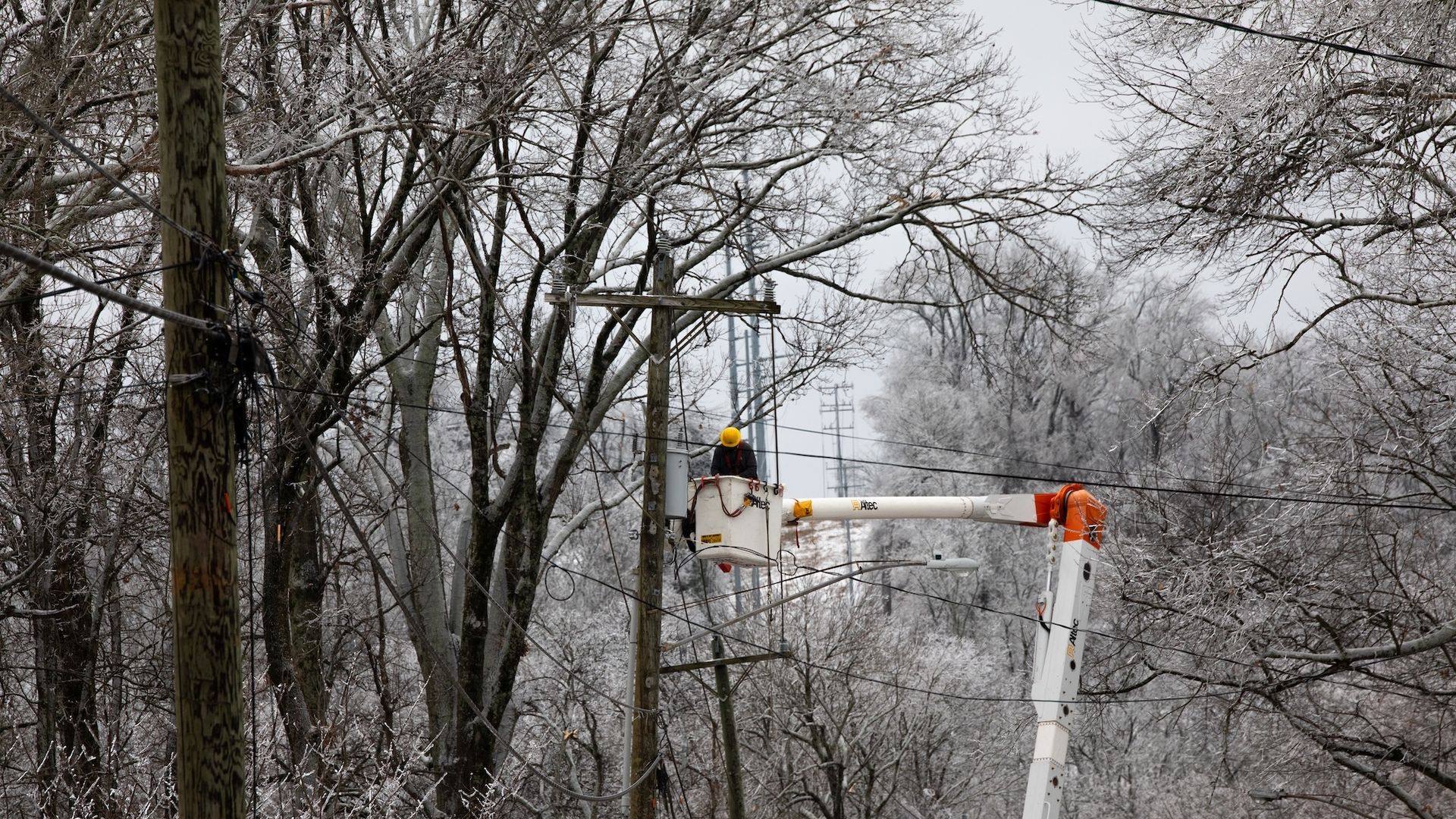
A linemen makes a repair in Nashville following the Jan. 25 ice storm. Photo: Matt Masters/Anadolu via Getty Images
In the thick of January's ice storm, when hundreds of thousands of residents wanted to know when their power would be restored, the Nashville Electric Service failed to follow its own storm response communication plan that called for speedier answers.
Why it matters: NES has been hammered by public officials and residents who have accused the utility of slow-walking information after over 230,000 customers lost power.
- The utility has acknowledged its shortcomings. But newly acquired public records show the scale of the communication breakdown.
Friction point: A 19-page planning document called the "NES Storm Response Comms Process," acquired by Axios in a public records request, directs agency officials to tell customers very quickly about when it expected to achieve total restoration.
- "Within 24 hours of sustained, mass outages, NES to provide an indication of predicted timing for total restoration," the document says.
- The storm left half the city without power on Jan. 25, but NES didn't provide a predicted timing for total restoration by ZIP code until Jan. 31
Between the lines: During the six-day gap, displaced residents were staying in hotels, with loved ones and in city-run shelters wondering when they would be able to go home.
Zoom in: The document details how NES plans to communicate during a mass outage, including suggested social media posts and even how its top officials would agree to media interviews.
Zoom out: NES failed to follow another key part of its response plan by pivoting to less frequent media updates in the days after the storm. The plan called for hourly updates.
Flashback: As the restoration dragged on, Mayor Freddie O'Connell led a chorus of critics who said NES failed to communicate well.
- O'Connell created a commission, led by former Mayor and Gov. Phil Bredesen, to investigate the city's and NES's storm response.
What she's saying: Metro Councilmember Emily Benedict, one of the loudest critics of NES's storm response, said she wants the city investigation to review "the communications thoroughly to ensure improvements are made."
- Benedict, who called for NES CEO Teresa Broyles-Aplin to be fired, said the information NES did share in real time was of little use to residents who were waiting to return home.
- "The public wanted clear, specific answers about when power would be restored to their homes and businesses, not just evidence of process," she said.
The other side: Through a spokesperson, NES described its storm response document as "best-case scenario planning for how to provide updates during a power outage." The rare nature of the ice storm exceeded the scope of that plan.
- "As the impacts of Winter Storm Fern became apparent and more in line with a system rebuild, our teams began activating a crisis communication response in coordination with NES leadership to provide accurate and timely updates to customers," the NES statement reads.
The big picture: Since the storm, NES has admitted its communications were lacking.
- In a Feb. 28 email to the Metro Council, NES said it is "reviewing communication protocols to improve frequency, clarity, and transparency, including how uncertainty and evolving conditions are communicated during large-scale outages."
- "NES will conduct a comprehensive review of its storm-related communications and outage information tools," NES said in its message to council. "This involves internal coordination, external messaging, and outage map performance to ensure accurate and timely information is provided during storm events."