Policy targeted by GOP has been on Nashville's books for years

Add Axios as your preferred source to
see more of our stories on Google.
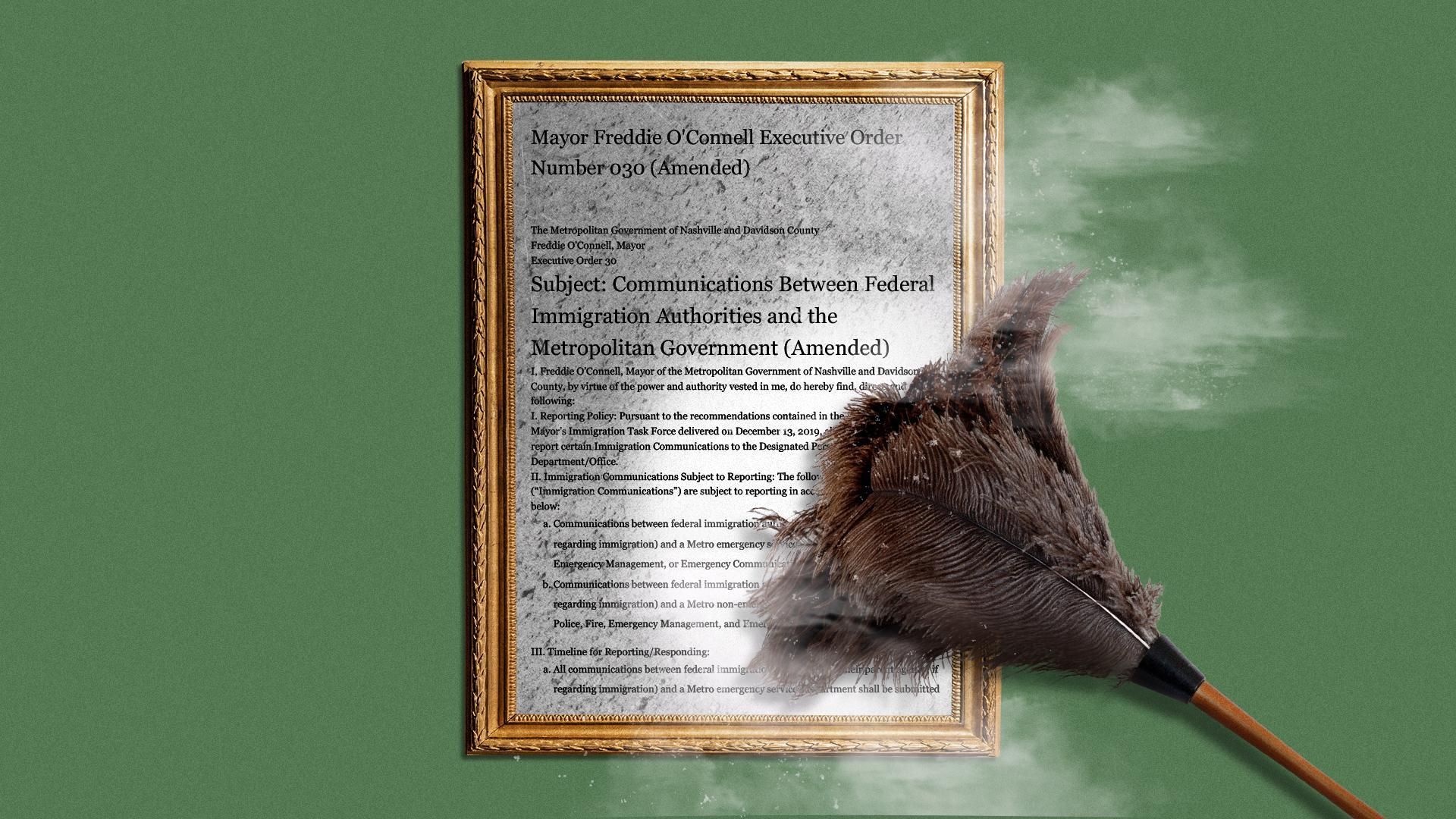
Illustration: Lindsey Bailey/Axios
The Metro policy that has recently enraged Republicans and spurred federal investigations has been on the books in some form for nearly six years with the backing of three different mayors.
Why it matters: The executive order, which requires city employees to report interactions with federal immigration officers, is old. But it has attracted new scrutiny as the Trump administration pushes nationwide immigration crackdowns.
The big picture: That mirrors a national trend. Democrats in several states and cities have faced intense Republican pushback for speaking out against Trump's immigration policies.
- "We've certainly seen scrutiny from the state on issues in the past. What's new is the reaction, and in some ways overblown reaction, from the federal government," Nashville Metro Councilmember Burkley Allen, who's served in the council since 2011, tells Axios.
Flashback: Nashville Mayor David Briley signed the first version in 2019, in the heat of a reelection campaign. It required Metro employees to report interactions with federal immigration officials within three days.
- Those interactions were compiled in monthly reports to the Mayor's Office of New Americans.
Zoom in: The initial order also called for the legislature to repeal a new law that blocked local governments from creating sanctuary city policies.
- State officials, including House Speaker Cameron Sexton, criticized the order and threatened to withhold state grants.
Briley's justification for the order centered on the fear created by increased immigration enforcement during President Trump's first term.
- "Many Nashvillians are afraid to leave their homes because they fear being arbitrarily separated from their families," he said in 2019.
Yes, but: After Briley lost his reelection bid, new Mayor John Cooper shelved the original executive order and formed a task force to craft a new one.
What happened next: Cooper later signed a retooled version that didn't touch on sanctuary city policies. It kept a reporting requirement for interactions with immigration officials. The reporting deadline was three business days.
- "Our city agencies cannot be expected to use its limited resources to do the work of the federal government, and it is my administration's goal to help build a Nashville that works for everyone," Cooper said at the time.
- The task force said they modeled their recommendation after a similar policy in Austin, Texas.
And then: After Mayor Freddie O'Connell was elected in 2023, he signed off on Cooper's version of the executive order. It was essentially copy-and-paste.
Catch up quick: The old policy remained in place and under the radar until last month, when a sweeping federal and state operation led to 196 arrests in the Nashville area.
- Following the uproar from the operation, O'Connell changed the required reporting timeframe for emergency agencies to one day. That drew new criticism of the long-standing policy.
Friction point: Tension in Nashville escalated when the city included the names of some federal agents in a public report on immigration communications. The O'Connell administration said it was a mistake and quickly redacted the names.
- Republicans seized, accusing the city of doxxing ICE agents.
The latest: U.S. Rep. Andy Ogles successfully pushed for two congressional committees to investigate.
U.S. Sen. Marsha Blackburn said the executive order sought to "obstruct ICE operations in Nashville and tip off criminal illegal aliens to avoid apprehension and detention." She called for a Department of Justice investigation.
The other side: O'Connell said he signed the updated order to ensure officials got up-to-date information, not to alert people that ICE raids could be coming.