Christianity's prevalence in Tennessee has shrunk over time, a new study finds


Add Axios as your preferred source to
see more of our stories on Google.
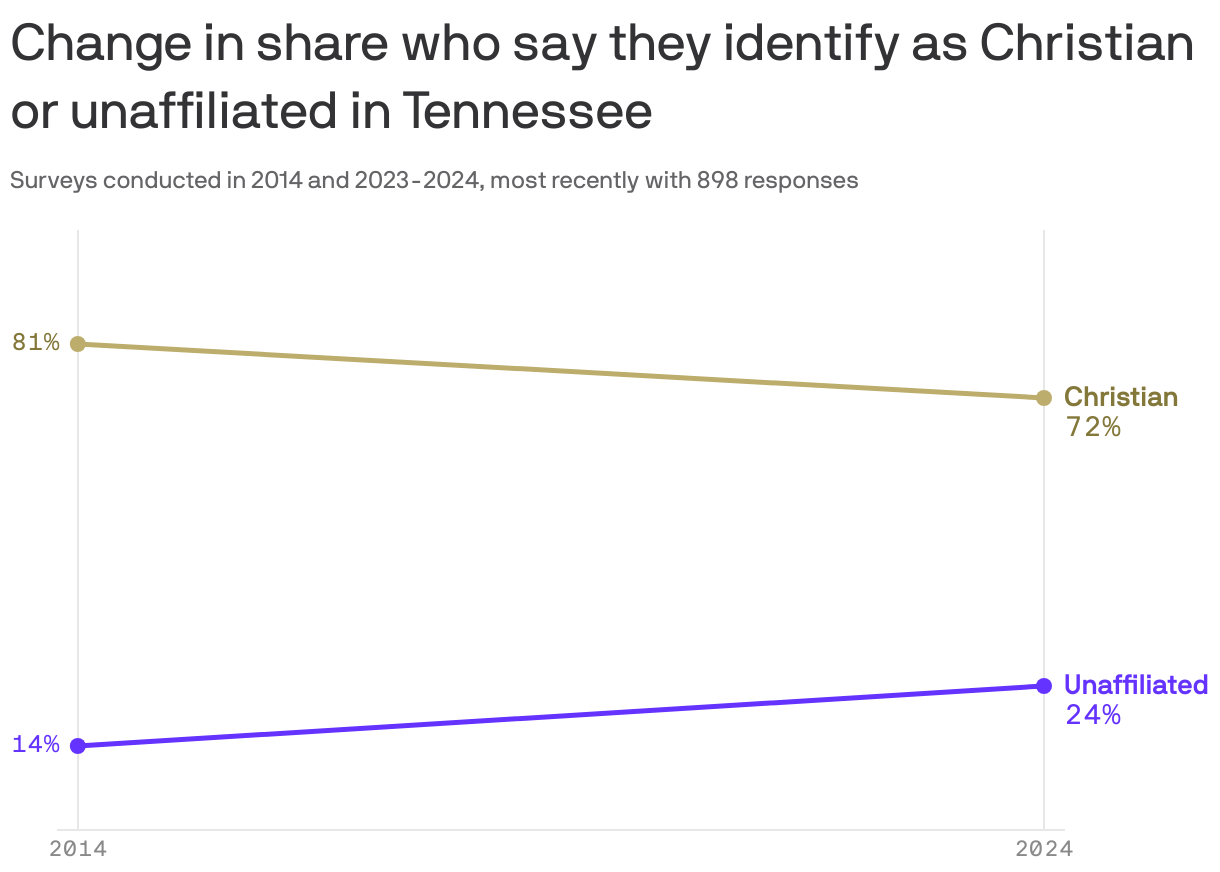
Fewer Tennesseans identify as Christian, according to a new Pew study, and the number of people who don't identify with any religion is growing.
Why it matters: The trend in Tennessee is in line with a nationwide shift.
What they're saying: "This is a broad-based social change," says Alan Cooperman, the director of religion research at the Pew Research Center.
- "We've had rising shares of people who don't identify with any religion — so-called 'nones' — and declining shares who identify as Christian, in all parts of the country, in all parts of the population, by ethnicity and race, among both men and women, and among people at all levels of the educational spectrum."
Caveat: The so-called "secular surge" has plateaued since 2020, and the national decline in Christianity seems to have leveled off, showing "relative stability in the last few years," according to the researchers.
By the numbers: 72% of Tennessee residents identified as Christian in 2024, according to Pew's Religious Landscape Study. That's down from 81% in 2014.
- Meanwhile, nearly one in four residents say they are not affiliated with a religion, up from 14% in 2014.
Between the lines: The trend away from religion is driven in large part by Gen Z and younger millennials, according to the study.
The big picture: The long-term national trend shows a declining share of Christians, from 78% in 2007 to 62% in 2024. At the same time, the population of "nones" surged.
Zoom in: Focusing in on the last five years of national data shows how that trend could be slowing, at least for now. Since 2019, the Christian share of adults nationwide has hovered between 60% and 64% rather than continuing to fall lower.