How Musk and Ramaswamy could cut federal jobs in Nashville


Add Axios as your preferred source to
see more of our stories on Google.
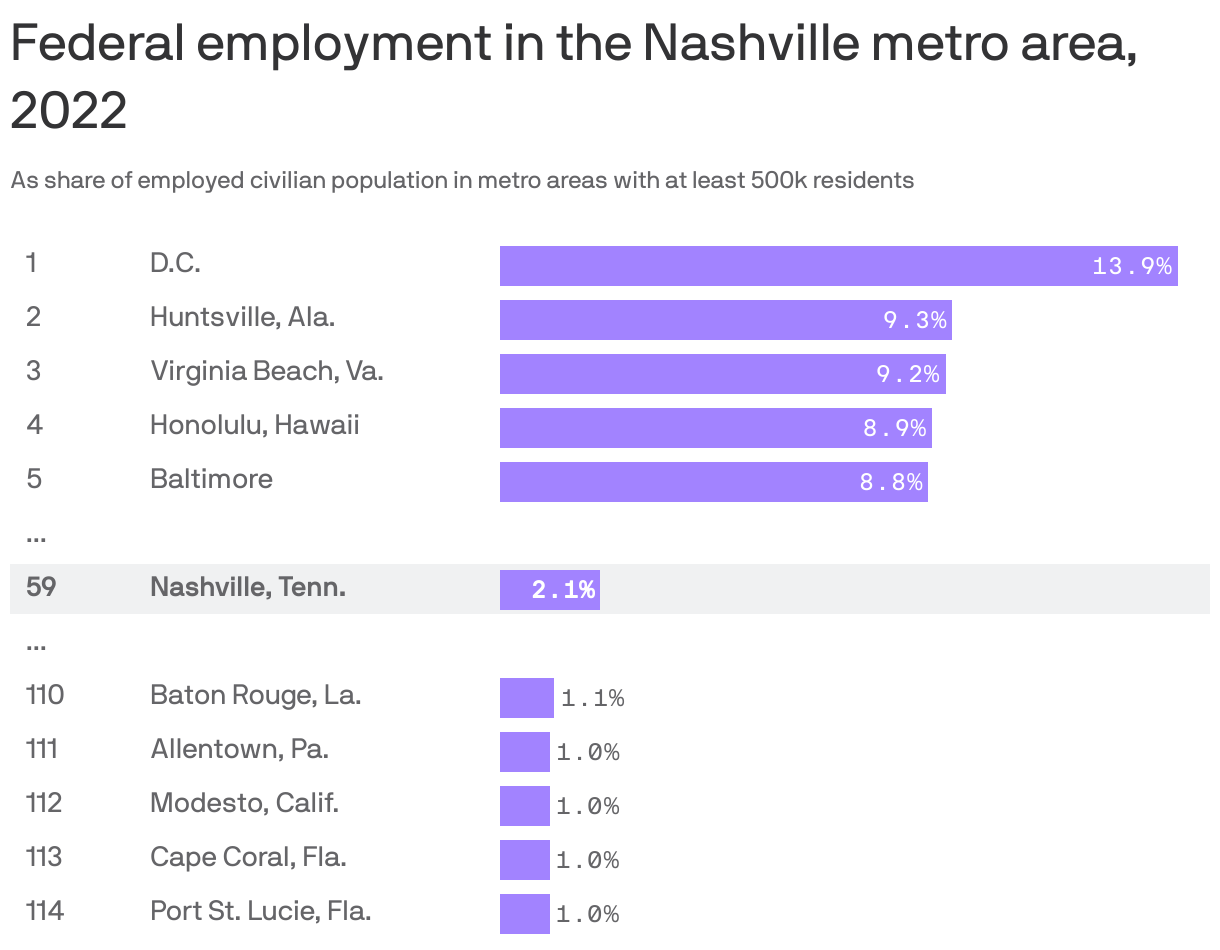
Cities across the country, including Nashville, could soon see job cuts by a key employer: the federal government.
Why it matters: President-elect Trump tapped Elon Musk and Vivek Ramaswamy to lead the new Department of Government Efficiency (DOGE). The two have vowed "mass reductions."
- "We expect certain agencies to be deleted outright," Ramaswamy told Fox News last month. "We expect massive cuts among federal contractors and others who are overbilling the federal government."
- Last year, when he was running for president, Ramaswamy pledged to immediately fire 50% of "federal bureaucrats."
By the numbers: About 2.1% of Nashville-area workers were federal employees in 2022. That's 22,675 out of 1.1 million employed people, according to Census Bureau data.
- That total includes employees at the Nashville VA Medical Center, the U.S. Army Corps of Engineers, air traffic controllers, postal workers and federal court staff.
Zoom in: Federal employees make up bigger portions of the workforce in cities with large military installations, like Clarksville, which is near Fort Campbell.
- In Tennessee's 7th Congressional District, which includes Clarksville and parts of Nashville, there are nearly 13,700 federal employees. That amounts to 3.7% of the district's civilian workforce.
- Other parts of Tennessee with a higher concentration of federal employees include Oak Ridge and the Memphis area.
How it works: Sources tell Axios Musk wants to use AI and crowdsourcing to hunt for waste, fraud and abuse. Musk said it would "send shockwaves through the system, and anyone involved in government waste, which is a lot of people!"
Follow the money: The average annual pay for a federal employee is about $106,000, per ZipRecruiter.
- The U.S. has about 2 million civilian employees across U.S. states and territories, a 2024 Congressional Research Service report states.
- Cutting that workforce in half, as Ramaswamy has suggested, could save the government about $100 billion annually.
Reality check: It will be hard for the Trump administration to make deep cuts. Members of Congress generally are allergic to cutting hometown jobs and government services.
- "If Congress doesn't have the guts to do those things that they're talking real big about, it's just a waste of time," U.S. Rep. Tim Burchett (R-Tenn.) said last week after meeting with Musk and Ramaswamy, noting that most of his colleagues support federal spending he opposes.
- "That's going to be the problem."
The bottom line: The aspiration of trillions of dollars of savings will run headlong into the unspoken governing theory of both parties, write Axios' Jim VandeHei and Mike Allen: It's easier and more popular to give than to take away.