How COVID-19 changed Indy: 5 impacts, 5 years later


Add Axios as your preferred source to
see more of our stories on Google.
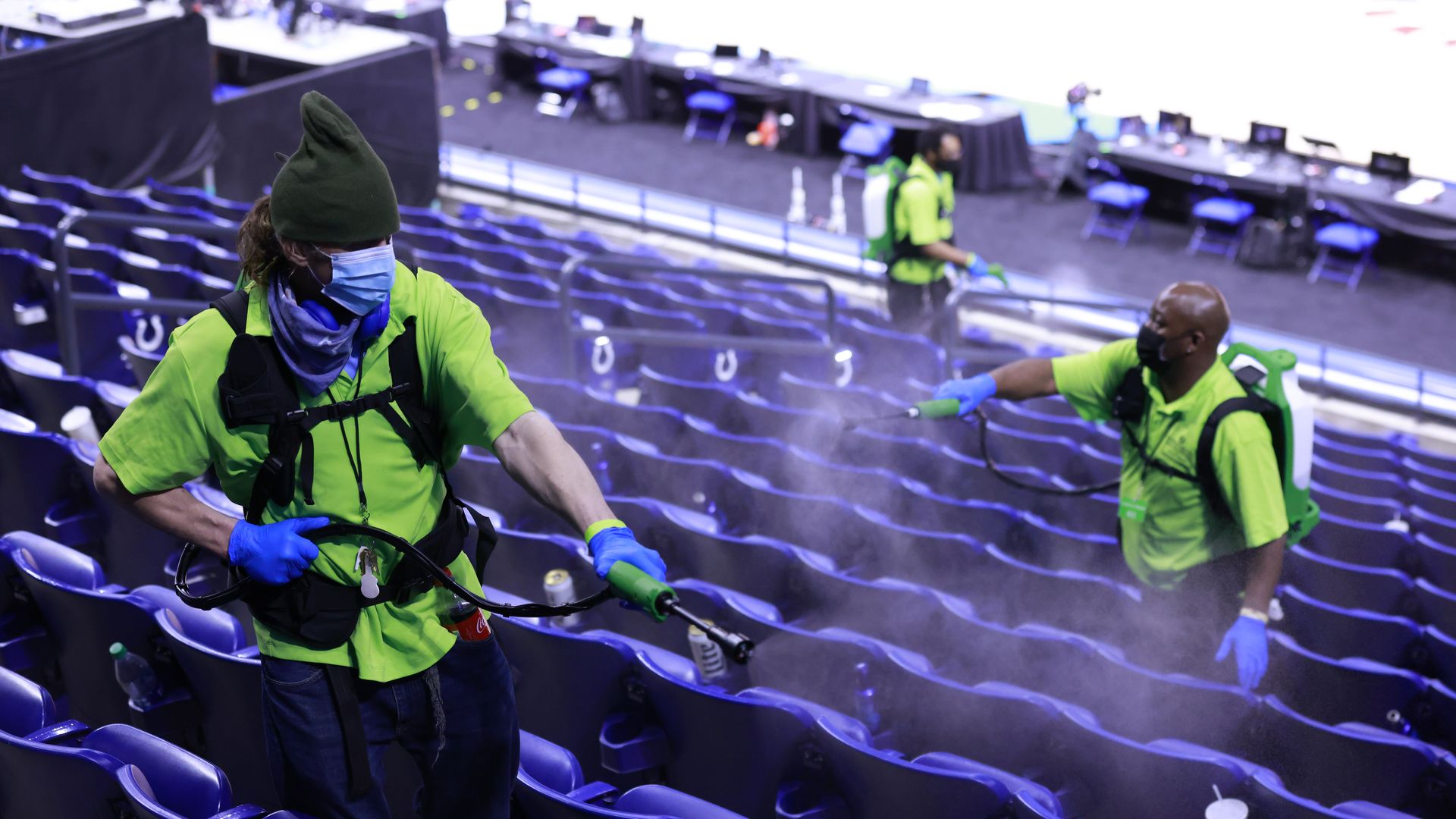
Crews disinfect the seats of Lucas Oil Stadium after a Purdue versus Ohio State game in March 2021. Photo: Justin Casterline/Getty Images
Five years ago, the COVID-19 pandemic disrupted nearly every aspect of daily life, forcing shifts in public health policy, remote work and education — changing the course of our city.
Why it matters: Reflection can help us evaluate and prepare for possible future pandemics.
Flashback: President Trump declared COVID a nationwide emergency on March 13, 2020, issuing travel bans due to public health concerns.
- Five years ago this week, Indiana reported its first COVID death.
- Gov. Eric Holcomb ordered the closure of bars and restaurants to in-person dining, closed schools, issued a ban on utility shutoffs, evictions and foreclosures, and delayed the May primary election.
- By the next week, Holcomb would effectively shut down the state, ordering Indiana residents to stay home unless they were conducting "essential business."
Threat level: Nearly 29,000 Hoosiers have died from COVID-19 since 2020, according to the CDC.
Zoom in: The pandemic affected all parts of our lives, but we're taking a look at how it impacted five areas in particular: public safety, tourism, education, social life and real estate.
Public safety
The pandemic collided with nationwide police brutality protests that peaked in Indianapolis with the fatal police shooting of Dreasjon Reed in May.
- By summer, IMPD implemented a new use of force policy that emphasized de-escalation and banned chokeholds.
By the numbers: The rise in violence that coincided with the pandemic hit young people especially hard — 44 kids ages 19 and under were shot and killed in 2023, more than in any previous year.
- 2023 also saw IMPD report 18 people shot by officers, the most in nearly a decade.
The latest: The department is working to understand the uptick in police shootings and make policy changes as needed.
- IMPD leaders also have their sights set on officer recruitment and wellness to address an officer shortage following five years of staffing losses fueled in part by COVID.
🧠 Like it: A greater focus on mental health.
🕊️ Leave it: Losing young lives to gun violence.
Tourism/downtown
With travel and tourism on hold, people started to rethink spaces created for visitors and Indy had a big one — the Mile Square.
State of play: Experiments with car-free spaces during shutdowns have led leaders to consider ways to make more of them — either temporarily or permanently.
- Think: SPARK on the Circle and the Georgia Street makeover.
The latest: Since full-scale events returned, our tourism industry has seen great success by playing host in a way that is hyper-local.
- Downtown Indy Inc. president and CEO Taylor Schaffer previously told Axios that each big moment we share in the years following the pandemic "give Central Indiana residents a reason to fall back in love with downtown."
⛔️ Like it: Car-free Monument Circle.
🎸 Leave it: Empty storefronts.
Education
There were few aspects of life the pandemic disrupted more than K-12 education.
Flashback: Schools closed statewide in March 2020 and didn't reopen until the fall.
- Even then, some waited months longer before reopening for in-person instruction, and many continued to offer in-person instruction on a part-time basis for much of the following year.
Between the lines: The sudden shift to online learning exposed just how great the digital divide was for some. Whereas IPS was sending home paper packets, other districts were already one-to-one with devices.
- It sped up the rate at which schools acquired devices, adopted digital learning platforms and put more emphasis on ensuring equitable access to reliable internet and high-quality digital learning tools.
The latest: Though the pace of learning has just finally returned to pre-pandemic norms for most students, it's not enough to reach pre-pandemic proficiency levels, and standardized test scores stagnated last year.
🗺️ Like it: E-learning for connecting with new cultures, topics and places.
☃️ Leave it: E-learning for inclement weather. #SaveSnowDays
Social life
COVID exacerbated a loneliness epidemic that had been building for decades.
- We'd already started communicating differently — hello, dating apps — and the shift to almost entirely online interaction taking the place of in-person interaction did us very few favors.
Yes, but: COVID also forced us to talk — a lot — about its impact on our deteriorating mental health and ways to combat it.
Once vaccinations were widely available and gathering restrictions lifted, a renewed interest in meeting up IRL spurred more social opportunities in the Circle City.
- From book clubs to run clubs, BFF speed dating to singles pitch nights, it seems like our social lives are bouncing.
💕 Like it: Senior speed dating — love is for all ages! Pick-up services available from more grocery stores and restaurants.
📵 Leave it: Swiping right. QR code menus.
Real estate
The pandemic made mixed-use amenities all the rage and forced employers to consider the value of office space as remote work surged.
Between the lines: Developments like the Bottleworks District and The Stutz have emerged as mixed-use superstars post-pandemic, but local office vacancy rates continue to exceed the national average.
- Indianapolis experienced one of the nation's largest surges in remote work adoption over the past decade.
Yes, but: Our housing market remains hot, thanks to comparatively affordable starter homes and a rising outlook for home value appreciation.
- The projected typical home value in Indianapolis today is $222,887, up from $147,325 in March 2020, per Zillow.
💡 Like it: Creative reuse of office spaces.
💰 Leave it: Home prices locking out first-time buyers.