Wildfires cast haze, pose danger to central Indiana


Add Axios as your preferred source to
see more of our stories on Google.
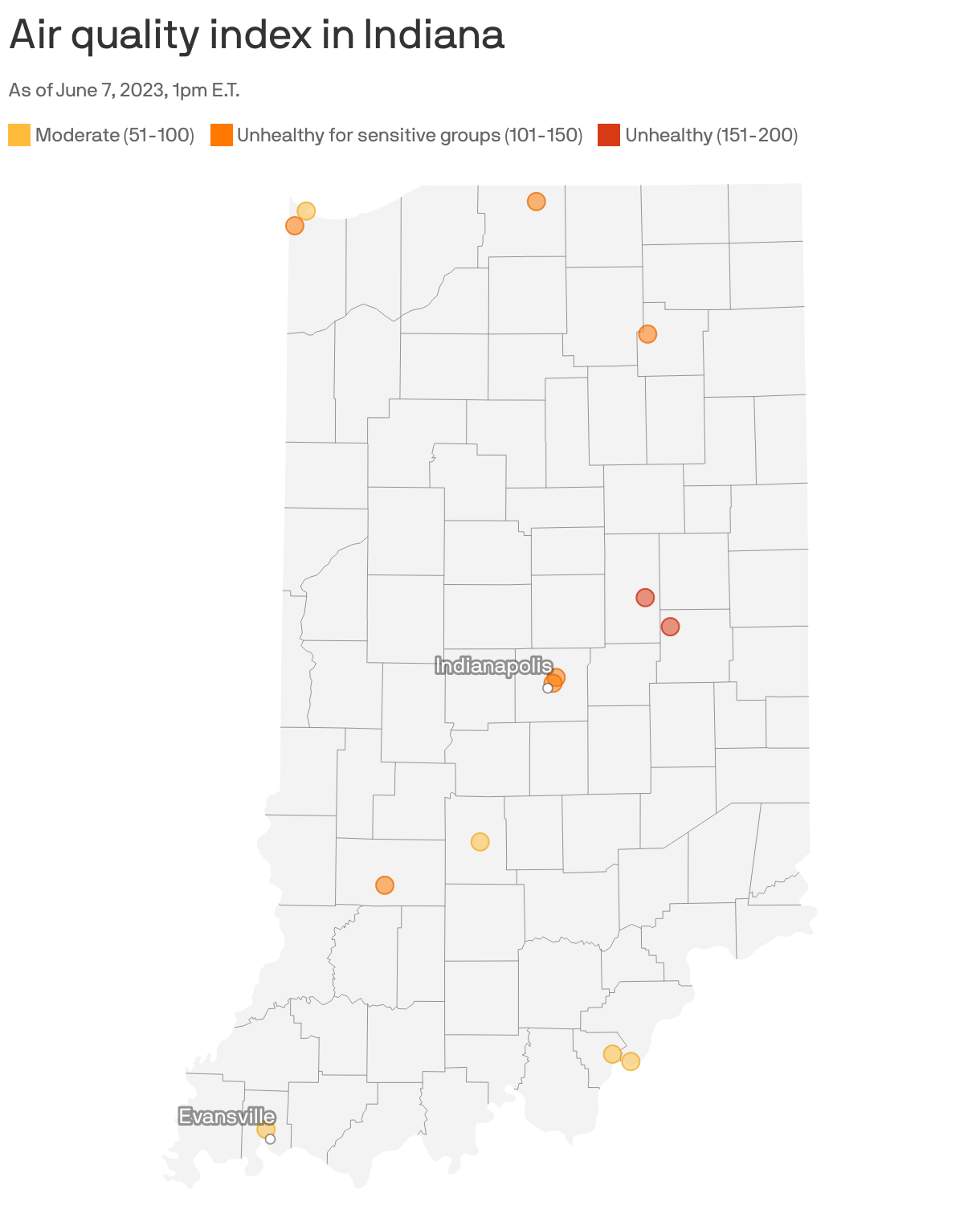 Open embedded content from datawrapper.dwcdn.net
Smoke from wildfires blazing across Canada cast a haze over downtown Indianapolis this week and pollution levels climbed to unhealthy levels throughout central Indiana, triggering air quality alerts for millions of Hoosiers.
Why it matters: Breathing in unhealthy levels of smoke and other air pollution can increase a person's risk of developing lung and heart conditions, according to the Environmental Protection Agency.
- It can also exacerbate preexisting lung and heart conditions and can trigger asthma and heart attacks.
- Air pollution contributes to almost 11,000 deaths in the U.S. annually, according to a 2021 estimate, while a 2022 study estimated that it contributed to at least 1.8 million excess deaths in 2019.
Driving the news: Though the effects are far greater in the northeastern U.S., Hoosiers in central Indiana are experiencing the worst air quality in decades.
How it works: Air pollution is solid and liquid particles, called aerosols, from many different sources — like vehicle exhaust or emissions from industrial facilities — that become suspended in air.
- The main component of wildfire smoke is particulate matter less than 2.5 microns (PM2.5) in diameter, which is far smaller than the diameter of human hair and fine beach sand.
- Particles less than 10 micrometers (PM10) in diameter are the most concerning air pollutant — they can be inhaled into the deepest part of the lungs and can potentially enter a person's bloodstream, according to the EPA.
By the numbers: PM2.5 and PM10 are one of the five main major pollutants that are measured to determine an area's air quality, which is reported using the EPA's Air Quality Index.
- An AQI of 0 to 50 is considered "good" air quality, while 51 to 100 is considered "moderate" quality.
- Any value above 100 is considered to be unhealthy, especially for sensitive groups of people, such as those with lung diseases, older adults, children and teenagers, and people who are active outdoors.
- At levels between 151 and 300, everyone is recommended to either reduce or avoid intense activities outdoors, while values between 301 and 500 are considered "hazardous" and everyone should avoid all physical activity outdoors.
Zoom in: Air-monitoring stations throughout central Indiana recorded pollution levels above 150 several times this week. On Thursday, levels were still being recorded in the 100-130 range.
- The forecast is expected to drop to below 100 over the weekend.
Zoom out: The U.S. National Weather Service issued air quality alerts for a swath of the northeast and parts of the East Coast this week.
- Early data suggests this has been the worst air quality event in New York City since EPA AQI records began in 1999, Axios' Andrew Freedman reports.