Climate change will cost Harris County billions by 2050

Add Axios as your preferred source to
see more of our stories on Google.
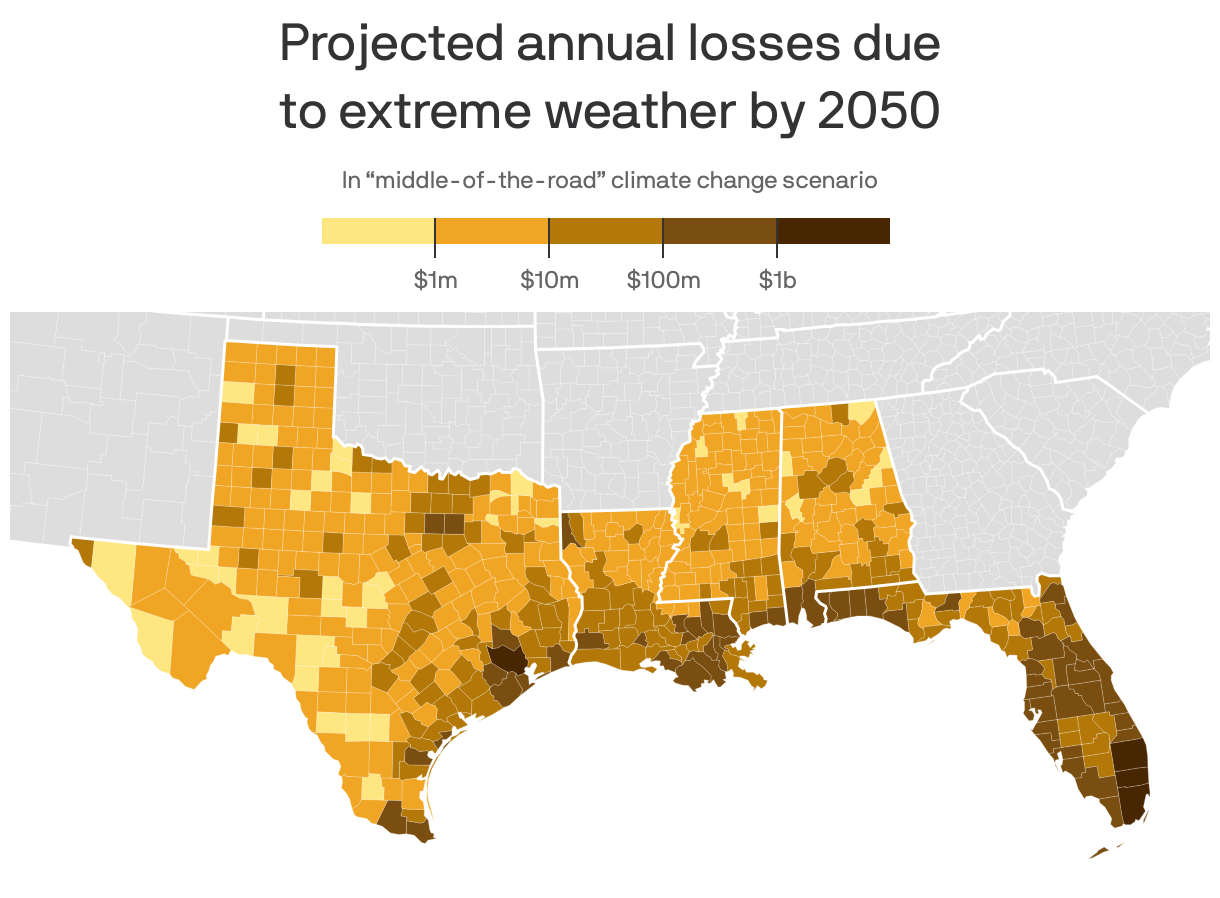
The Gulf Coast is facing billions of dollars in yearly property damage by 2050 due to extreme weather tied to climate change, per a new analysis.
Why it matters: Harris County stands to pay the most by 2050, about $2.6 billion annually.
Catch up quick: Multiple studies show how human-caused climate change has made recent hurricanes more potent and destructive.
State of play: Damage from extreme weather will cost $32 billion annually across Texas, Louisiana, Mississippi, Alabama and Florida by 2050 in a "middle of the road" climate change scenario, per a new Urban Institute analysis using FEMA data.
- That's more than double the projected $15 billion when not accounting for climate change.
How it works: The Urban Institute's analysis is based on FEMA's Future Risk Index, which estimated future costs associated with coastal flooding, extreme heat, wildfires, hurricanes and drought, in 2024 dollars.
- FEMA published the tool last December. It's since been taken down amid the Trump administration's purge of publicly accessible federal data and info about climate change.
What they're saying: The researchers chose a more moderate emissions scenario because it's actionable and realistic for policymakers, Sara McTarnaghan, principal research associate at the Urban Institute, tells Axios.
- "But there's also the importance of thinking about not just one climate future, but planning for the certain uncertainties."
- McTarnaghan also notes that long-term projections like this one can't account for impossible-to-predict changes, like new climate adaptation and resiliency efforts or migration.
Between the lines: Money can help quantify extreme weather's toll, but can't tell the whole story.
- "The full cost of disasters, including their effects on people's health and well-being and on the economy, are much higher," as the report puts it.
What's next: The Trump administration's efforts to dramatically reduce FEMA's disaster assistance role have yet to be tested by a major hurricane in Gulf Coast states.
- Those states have long relied on federal help and funds to recover from major storms.