Texas sees drop in Black medical students


Add Axios as your preferred source to
see more of our stories on Google.
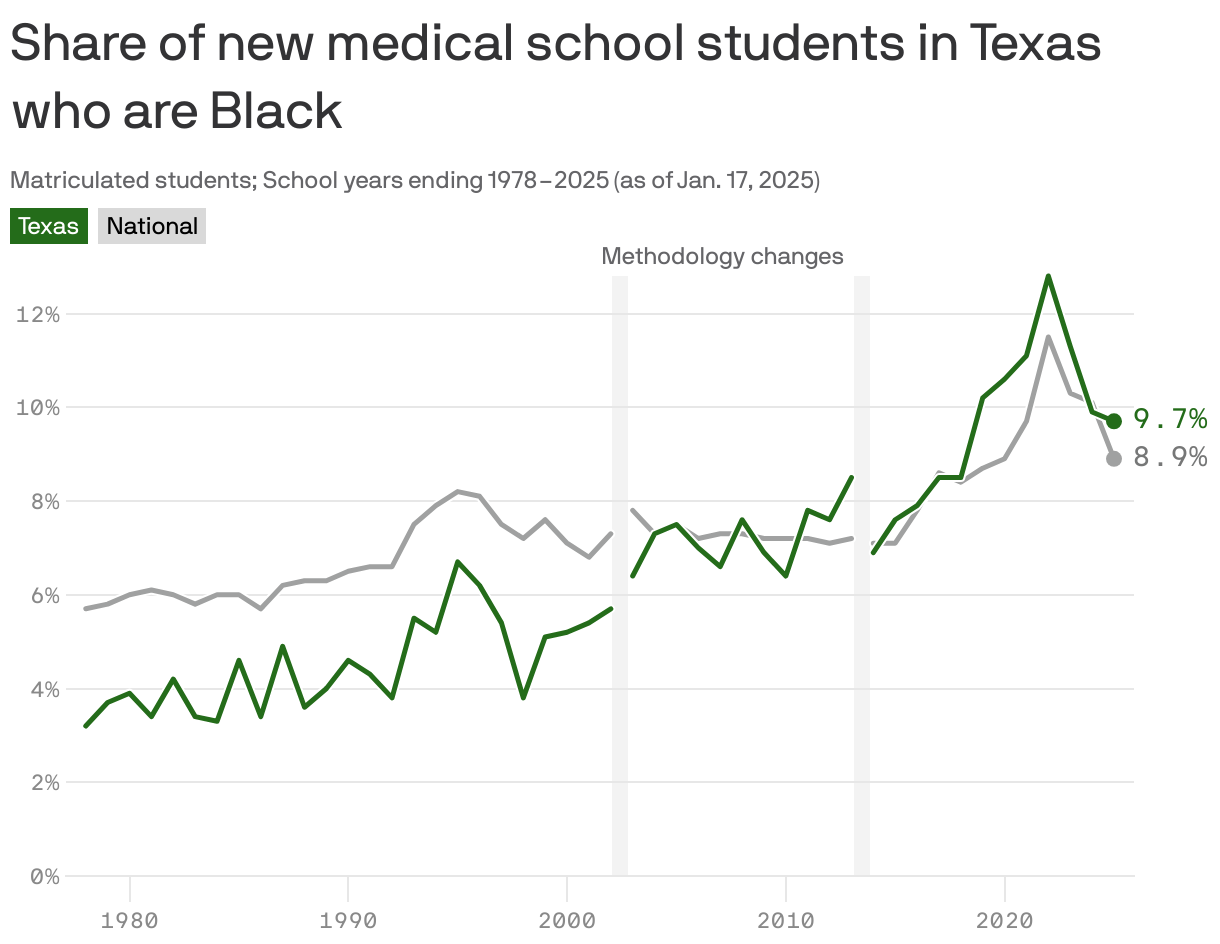
The number of first-year Black medical students has dropped sharply in Texas, new data shows.
Why it matters: Students who represent minority populations are more likely to provide better care for those populations when they become doctors, Chinwe Efuribe, a Hutto pediatrician who runs mentoring programs with the Austin Black Physicians Association, tells Axios.
What they're saying: "We're more likely to be working in the community, more likely to participate in community health fairs and more likely to be involved in relationship building — and that leads to increased life expectancy and better health outcomes generally," Efuribe said.
- Doctors from similar backgrounds might have a better sense of what questions to ask patients and what cultural factors are at play with health challenges, Efuribe said.
By the numbers: There are 195 Black medical students in Texas this year, down from 248 at the start of the 2021-22 academic year, according to the Association of American Medical Colleges (AAMC), which has collected data on this topic since 1978.
- Less than 10% of Texas medical students are Black. By comparison, 13.6% of the state population is Black.
Yes, but: Black medical student enrollment at Baylor College's School of Medicine in Houston increased from 46 out of 721 students (6.4%) in 2021-2022 to 64 out of 831 students (7.7%) in 2024-2025.
Flashback: Baylor College of Medicine established pipeline programs with its affiliated schools to attract and recruit more students of color. In 2020, School of Medicine Dean Jennifer Christner emphasized the importance of a diverse physician workforce.
- "Patients who have doctors who look like them tend to follow advice more and can be healthier," Christner said.
Zoom out: Medical school student enrollment is also down nationally, following the Supreme Court decision to strike down affirmative action in higher education.
Between the lines: The decline in Black medical school enrollment highlights how policies addressing systemic inequality aren't deeply embedded, as their removal quickly affects admissions, says Israel Herndon, a UT graduate researcher in African and African Diaspora Studies.
The intrigue: The declines are "much larger than we would expect," even taking the Supreme Court decision into account, Norma Poll-Hunter, senior director of the Association of American Medical Colleges' human capital portfolio, tells Axios.
The bottom line: "Every doctor brings with them a unique perspective to the profession, and when certain populations are not fully represented, this means that there are certain questions, approaches, and care that are missing from the field," Herndon says.