Charted: Texas' rise in same-sex marriages


Add Axios as your preferred source to
see more of our stories on Google.
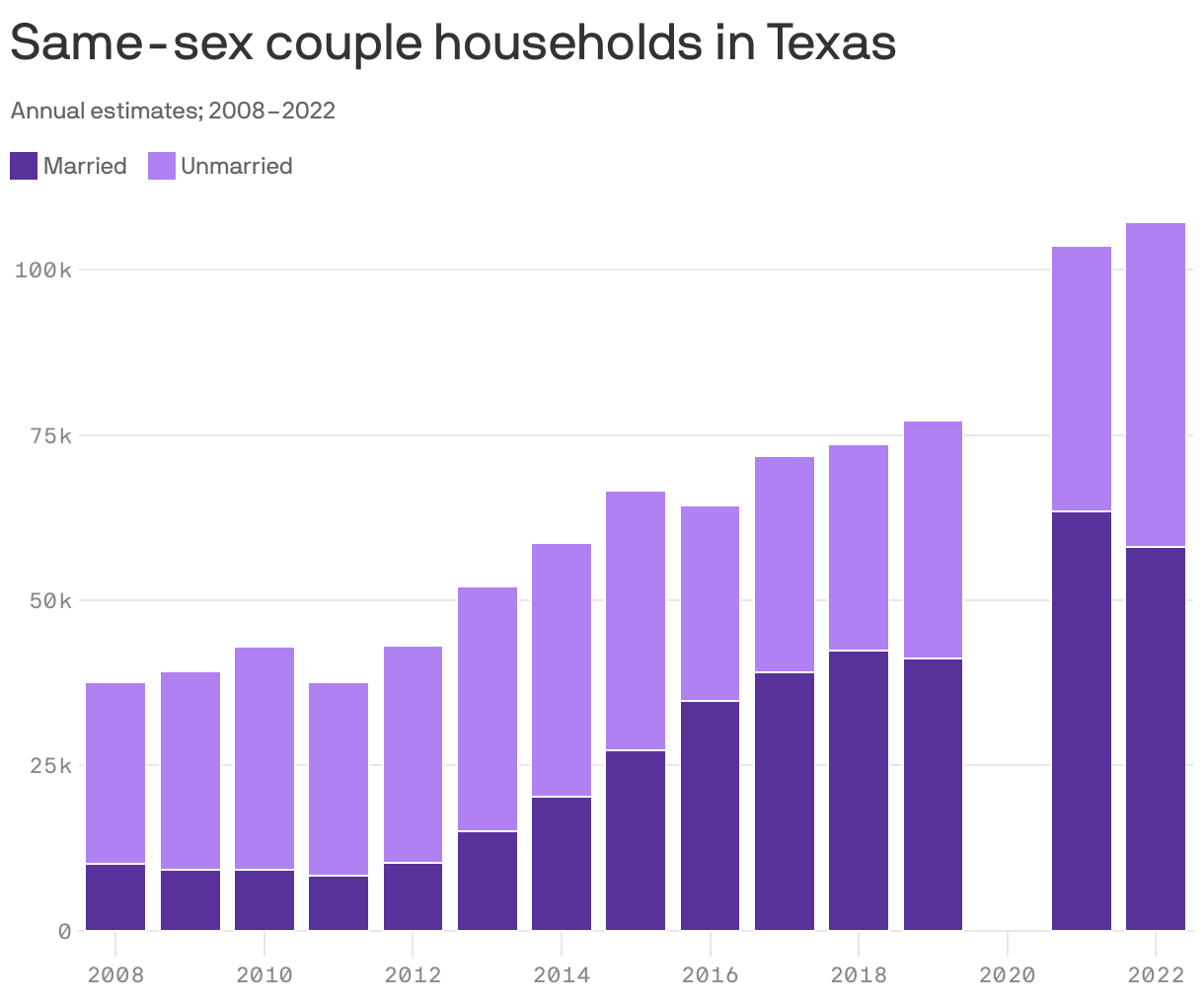
The number of same-sex households in Texas has increased dramatically since the U.S. Supreme Court legalized same-sex marriage nine years ago Wednesday.
Why it matters: Same-sex marriage has become a fact of life in Texas, even as the state Republican Party continues to push back against gay marriage and parenting.
Flashback: The landmark Obergefell v. Hodges decision on June 26, 2015, struck down all same-sex marriage bans across the country, including the one in the Texas Constitution.
Zoom in: In 2022, there were 107,252 same-sex couple households in Texas, and 54.2% of them were married, according to a new U.S. Census Bureau report.
- That's up from 58,654 same-sex couple households in 2014, the year before gay marriage was legalized across the country. At that time, 34.6% were reported to be married.
Zoom out: Nationally, there were about 1.3 million same-sex couple households in 2022, per the latest American Community Survey (ACS) data, compared with about 783,100 in 2014.
- There were about 740,800 married same-sex couple households in 2022, up from about 334,900 in 2014.
- 58% of same-sex couple households were married in 2022, compared with 42.8% in 2014.
Massachusetts was the first state to make same-sex marriage legal, in 2004.
Caveat: There's no 2020 data here because the COVID-19 pandemic interfered with the Census Bureau's collection efforts.
The intrigue: The Census Bureau has struggled to accurately count same-sex marriages.
- The ACS in 2019 began specifically asking about same-sex spouses and unmarried partners in American households, a tweak meant to improve data collection efforts.
- The Census Bureau is now experimenting with new questions about sexual orientation and gender identity in an effort to better count and understand a historically overlooked group.
Reality check: While Obergefell v. Hodges protected the right to marry at the federal level, lawmakers in many states, including Texas, are still seeking to curtail LGBTQ+ Americans' rights.
- The U.S. Supreme Court, meanwhile, ruled last year that businesses can refuse service to same-sex couples on religious objection grounds.
- The Texas Supreme Court is poised to decide the fate of a Waco justice of the peace who refused to marry same-sex couples.
Yes, but: Anti-LGBTQ+ legislative efforts appear to be stalling out nationwide.
- "There's a lot of hope right now," Human Rights Campaign president Kelley Robinson tells Axios. "Our opposition is overreaching. They are attacking not only our community, but our kids."
The bottom line: Obergefell had a massive impact on millions of Americans' lives, even as the battle for true equality goes on.