Scoop: Detroit carsharing pilot delivers rentals by remote control

Add Axios as your preferred source to
see more of our stories on Google.
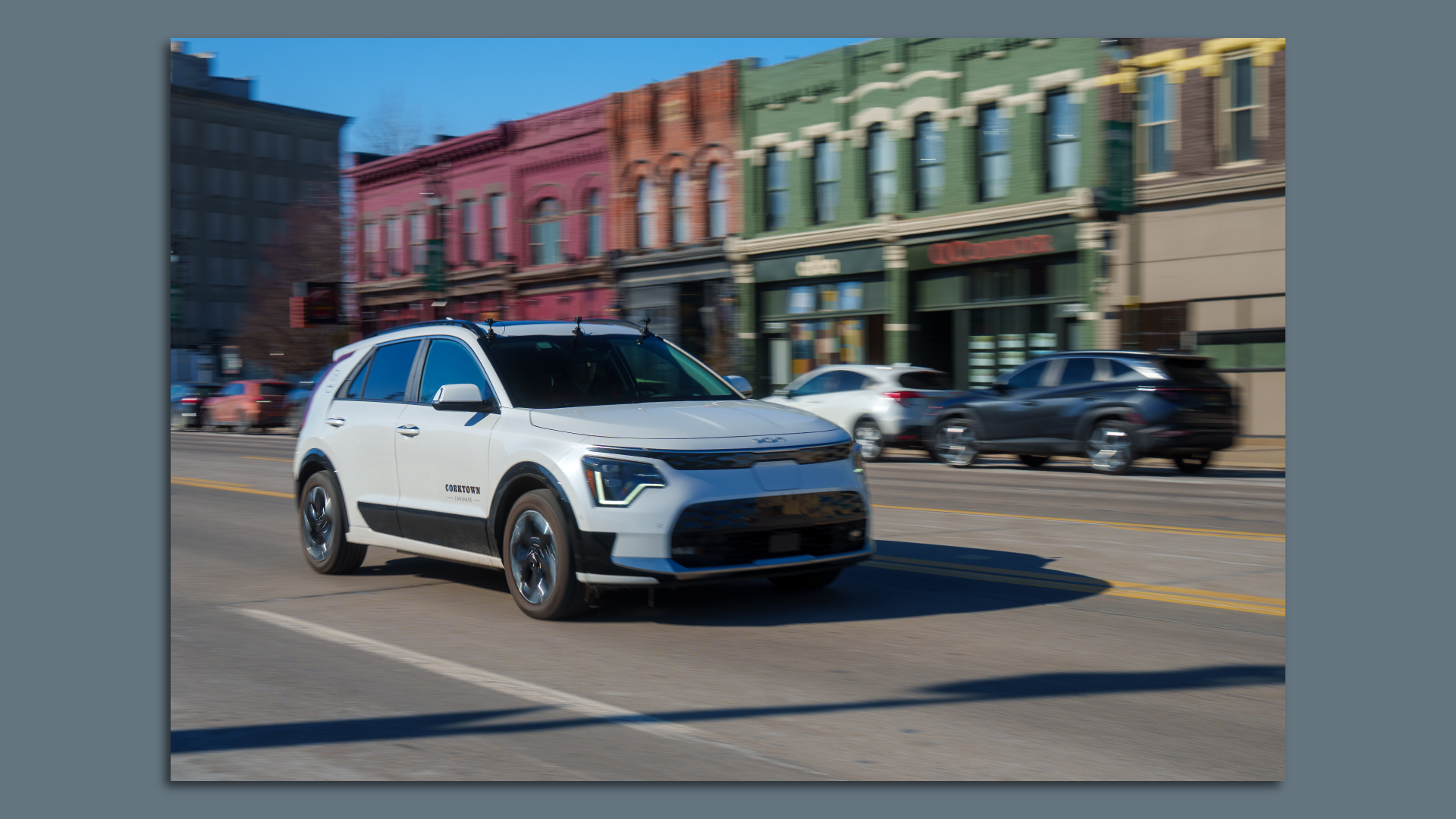
Corktown Carshare is piloting a remote-driven rental car service in Detroit. Photo courtesy of Corktown Carshare.
A carsharing pilot program in Detroit is exploring whether rental cars delivered by remote drivers could help improve transportation access for city residents.
Why it matters: Many urban residents don't have access to a car, which can mean missed medical appointments, limited job opportunities and even difficulty getting groceries.
- Public transit isn't always convenient, Uber can be expensive and carsharing companies like Zipcar require large, distributed fleets.
Tele-operated carshare could be more convenient, by enabling people to summon a car from a vehicle depot on demand.
- An empty car would come to you, then you'd hop in and drive away. When you're finished, a remote driver would guide it back to a depot.
- In Las Vegas, a couple of tele-op carsharing services are already operating, including Vay, which is expanding its fleet to 100 vehicles, and Halo.
- The services aim to reduce traffic jams and parking headaches while boosting EV utilization.
Zoom in: Corktown Carshare, operating in Detroit's Transportation Innovation Zone (TIZ) near Michigan Central Station, is a partnership between Sway Mobility and Mapless AI.
- It's funded by the State of Michigan's Office of Future Mobility and Electrification and NextEnergy.
- The goal is to demonstrate the benefits of tele-operated electric vehicle carsharing, and to create a blueprint for similar programs in other cities.
Reality check: For now, the pilot is extremely limited. There's just one vehicle operating in a two-square-mile area in Corktown, and participation is limited to a small group of early testers.
- But it's typical of the types of mobility experiments under way at Michigan Central's Newlab innovation hub.
How it works: The test car — an electric Kia Niro — is outfitted with four cameras and a roof-mounted lidar system.
- The cameras provide a 360-degree view around the car to a remote driver controlling the vehicle in Pittsburgh, 300 miles away.
- The "driver" is sitting at a desk, with four video monitors, a steering wheel and pedals for acceleration and braking.
Signals are transmitted to the car over ordinary cellular networks, which raises the potential for latency issues — a dropped signal, even for just a second, could have serious safety consequences.
- Mapless AI Co-founder and CEO Philipp Robbel says their system links multiple cellular networks together for redundancy to prevent that from happening.
- "We've had zero issues with latency in the TIZ," he said, even during big events like the Detroit auto show when cellular networks can become saturated.
- If there is a connectivity issue, the system automatically shifts into a "fail-operational mode" and will bring the vehicle to a safe stop, he said.
💭 Joann's thought bubble: I let Christian, a Mapless AI employee in Pittsburgh, remotely drive me around Corktown on a recent morning. (A safety driver, Jason, was with me in the driver's seat, but didn't touch the wheel.)
- Traffic was light, and except for dodging an occasional pedestrian, the ride was remarkably smooth and seamless.
- The only dicey moment occurred when Christian had to remotely guide my car through the narrow space between a parked car and an idling truck in front of Michigan Central. No sweat.
What to watch: After a three- to six-month pilot, Sway Mobility CEO Michael Peters envisions a larger fleet of tele-operated EVs for hire and new charging depots around the city.