How local news outlets fail to serve Black audiences

Add Axios as your preferred source to
see more of our stories on Google.
Illustration: Shoshana Gordon/Axios
As the news industry has shrunk, so has the number of Black reporters — especially in Detroit.
- Longtime journalists say there aren't as many Black reporters leading coverage on the city's most important issues as there were in the '80s and '90s.
Why it matters: Black Americans aren't optimistic that news coverage about their communities will improve anytime soon, a new study from Pew Research Center suggests.
- Media outlets vowed to hire more diverse staffs after the murder of George Floyd, Axios' Russell Contreras and Sara Fischer write. But three years later, those commitments have done little to transform Black Americans' perceptions of news media.
Details: Almost two-thirds of Black Americans (63%) say news about Black people is often more negative than news about other racial and ethnic groups, the survey found.
- Half say coverage often lacks important information, and 43% say the coverage largely stereotypes Black people.
- About four in 10 (39%) say they come across news that is racist or racially insensitive extremely or fairly often.
- Just 14% of Black Americans are highly confident that Black people will be covered fairly in their lifetimes.
Zoom in: "The golden age of Black journalism in Detroit was 30 years ago, a time when none of us even thought it was the golden age," Ken Coleman, a legislative reporter for Michigan Advance, tells Axios. "The [1995 newspaper] strike happened and a lot of people didn't go back and found new careers."
- Coleman, who led the Michigan Chronicle and served as segment host of the "American Black Journal" on Detroit Public Television, remembers being surrounded by Black reporters when he started covering the city in the '90s.
- "You had Kim Trent at the News, you had Dan Holly at the Free Press, Darren [Nichols] was right there, too. There was Susan Watson, Roger Chesley, Greg Bowens came over from the Flint Journal a year or two later," Coleman says.
What they're saying: When Detroit hosted the National Association of Black Journalists conference in 1992, Gannett took out a full back-page ad in the Detroit News showcasing its Black journalists.
- "It was a full 8x11 filled with half-column photos; there were probably 30 people," Coleman says.
- "There were more Black people in the newsroom in 1992 and '93 than there are in 2022 and '23. We were always taught that the Civil Rights Movement had always created advances, we'd be moving forward, not backward."
Between the lines: Some local Black journalists take on higher-paying roles in PR, some go on to work for the mayor's communications office and others leave their hometowns for higher-paying reporting gigs in larger markets.
- "At times, Detroiters need to get away and branch out and use the skills they learned here to flourish across the nation," Free Press columnist Darren Nichols tells Axios.
- "We can't ignore that young people are coming out of college with so much debt, it's difficult for them to take the very small salaries it takes to grind in this business," Nichols says.
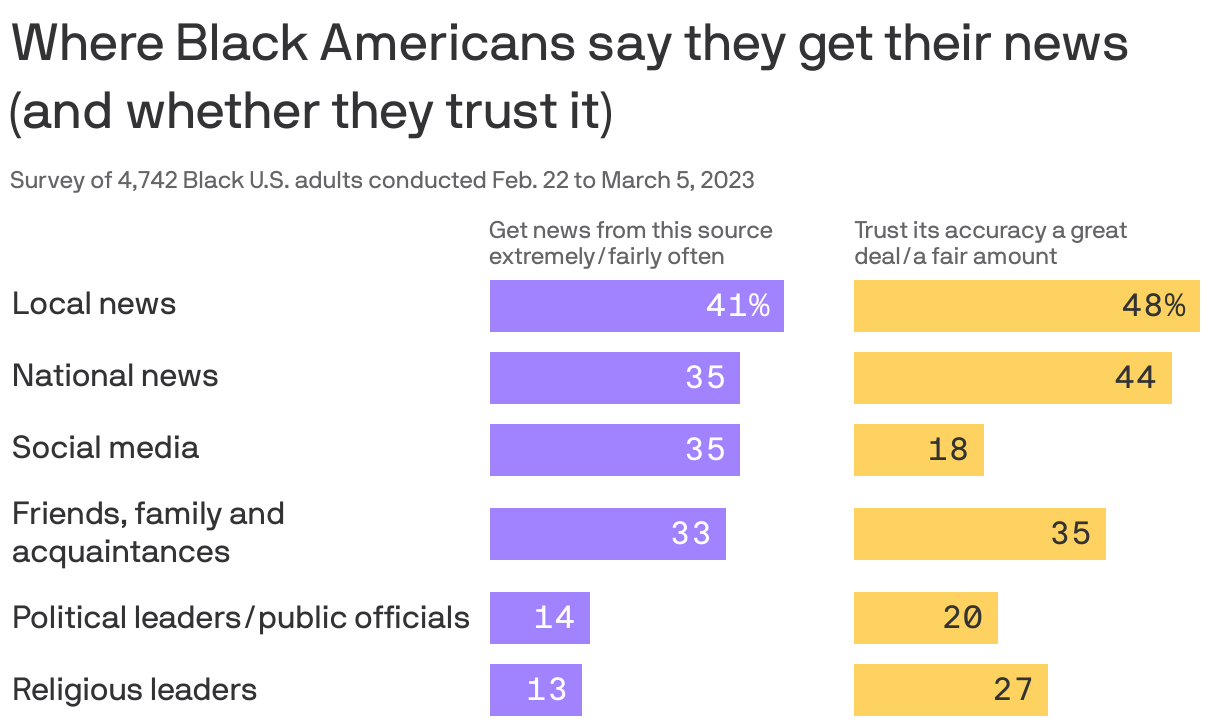
Of note: Substantial shares of respondents in the Pew survey say that including more Black people as sources (54%) and hiring more Black newsroom leaders (53%) and journalists (44%) could improve what they see as flawed coverage.
- Nearly half of Black Americans think that Black journalists do a better job than other journalists at covering issues related to race and racial inequality (45%), and at understanding them (44%).
- Nichols says media consumers in Detroit can feel the lessening of Black voices.
- "Readers can tell when you look at the coverage of both papers on a day-to-day basis. It's the reason why Fox 2 is the people's champ of TV news among the African American community in Detroit," Nichols said.
The big picture: More newsrooms are elevating Black Americans to the top of the masthead and executive suites, but the Pew data suggests there hasn't been meaningful enough progress made to convince Black Americans much has changed.
- In May, the Free Press hired Nicole Avery Nichols to lead the paper after two years as the editor-in-chief of Chalkbeat.
- The Detroit News last month promoted longtime Pistons beat writer Rod Beard to lead its sports section as sports editor.
Zoom out: Since 2020, ABC News and MSNBC have named Black female presidents.
- Several of the largest metropolitan newspapers, such as the Los Angeles Times, the Dallas Morning News and the Houston Chronicle, are now led by Black executive editors. Until recently, the editors of the Miami Herald and The New York Times were both Black.
- A slew of digital-first publications, such as HuffPost, The Cut, Harper's Bazaar and Allure, are all now led by Black female editors. Last week, British Vogue named its first Black woman editor, replacing the company's first Black editor, who stepped down earlier this year.
- Upstarts such as Capital B in Atlanta and AfroLA in Los Angeles have launched to cover community news from a Black perspective.
The bottom line: "I don't think it's going to get better and that's the challenge," Coleman says. "That's why organizations like NABJ, who will advocate for us, are so important."