Black Americans see bias in media despite changes, survey says


Add Axios as your preferred source to
see more of our stories on Google.
Black Americans say news coverage about Black people is often more negative than news about other residents, and few are optimistic that will change soon, a new survey finds.
Why it matters: Media outlets vowed to hire more diverse staff after the murder of George Floyd, but three years later, those commitments have done little to transform Black Americans' perceptions of news media.
By the numbers: Almost two-thirds of Black Americans (63%) say news about Black people is often more negative than news about other racial and ethnic groups, a Pew Research Center survey released Tuesday said.
- Half say coverage often lacks important information, and 43% say the coverage largely stereotypes Black people.
- About 4 in 10 (39%) say they come across news that is racist or racially insensitive extremely or fairly often.
- Just 14% of Black Americans are highly confident that Black people will be covered fairly in their lifetimes.
The intrigue: Substantial shares say that including more Black people as sources (54%) and hiring more Black newsroom leaders (53%) and journalists (44%) could improve what they see as flawed coverage.
- Nearly half of Black Americans think that Black journalists do a better job than other journalists at covering issues related to race and racial inequality (45%), and at understanding them (44%).
The big picture: More newsrooms are elevating Black Americans to the top of the masthead and executive suites, but the Pew data suggest there hasn't been meaningful enough progress made to convince Black Americans that much has changed.
- Since 2020, ABC News and MSNBC have named black female presidents.
- Several of the largest metropolitan newspapers, such as the Los Angelos Times, the Dallas Morning News and the Houston Chronicle, are now led by Black executive editors. Until recently, the editors of the Miami Herald and The New York Times were both Black.
- A slew of digital-first publications, such as HuffPost, The Cut, Harper's Bazaar, and Allure, all all now led by Black, female editors. Last week, British Vogue named its first Black women ditor, replacing the company's first Black editor, who stepped down earlier this year.
- Upstarts such as Capital B in Atlanta and AfroLA in Los Angeles have launched to cover community news from a Black perspective.
Yes, but: While some progress has been made in terms of editorial leadership, it's less clear to the extent in which those efforts are trickling down to newsrooms broadly.
- The News Leaders Association suspended its decades-old, annual newsroom diversity survey in 2019 in response to dwindling participation rates. It opened the survey up again in 2021 but didn't publish the results, citing data discrepancies. In 2022, it published its first complete survey since 2019, but participation still lagged, coming in at a near-historical low.
The intrigue: Much of Pew's survey asks respondents about their attitudes towards the media broadly, and doesn't specify Black attitudes towards the media based on medium, such as television, radio or print.
- Diversity milestones in the news media tend to be felt most heavily on television, where a journalist's race is more visible than via a print or digital byline.
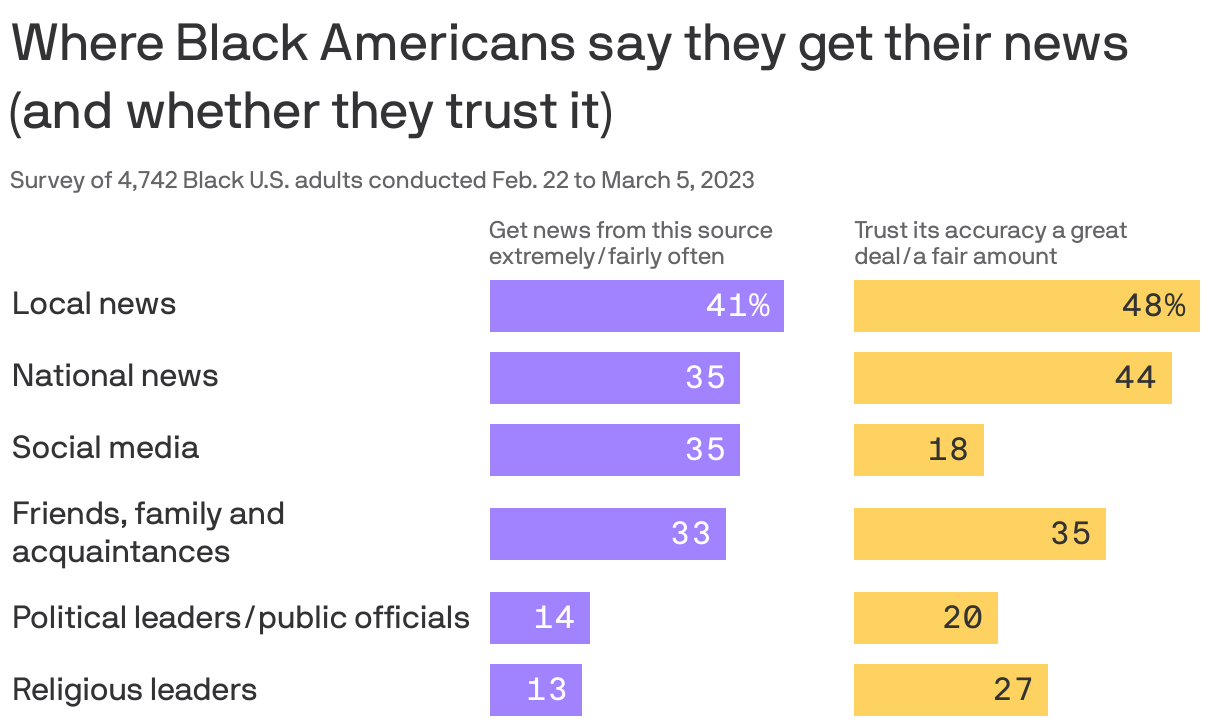
Between the lines: Given the lack of representation felt by Black respondents to the survey, most said they rely most heavily on social media for news.
- Around 35% say they get news and information extremely or fairly often from social media, but only 18% say they trust the accuracy.
Methodology: The Pew Research Center survey of 4,742 U.S. Black adults was conducted from Feb. 22 to March 5, 2023, and nine online focus groups of Black Americans facilitated between July and August 2022, using the Center's American Trends Panel and Ipsos' KnowledgePanel.
- The margin of sampling error is +/- 2.1 percentage points at the 95% confidence level, for results based on the entire sample.
