Ohio's political gender gap extends to donations


Add Axios as your preferred source to
see more of our stories on Google.
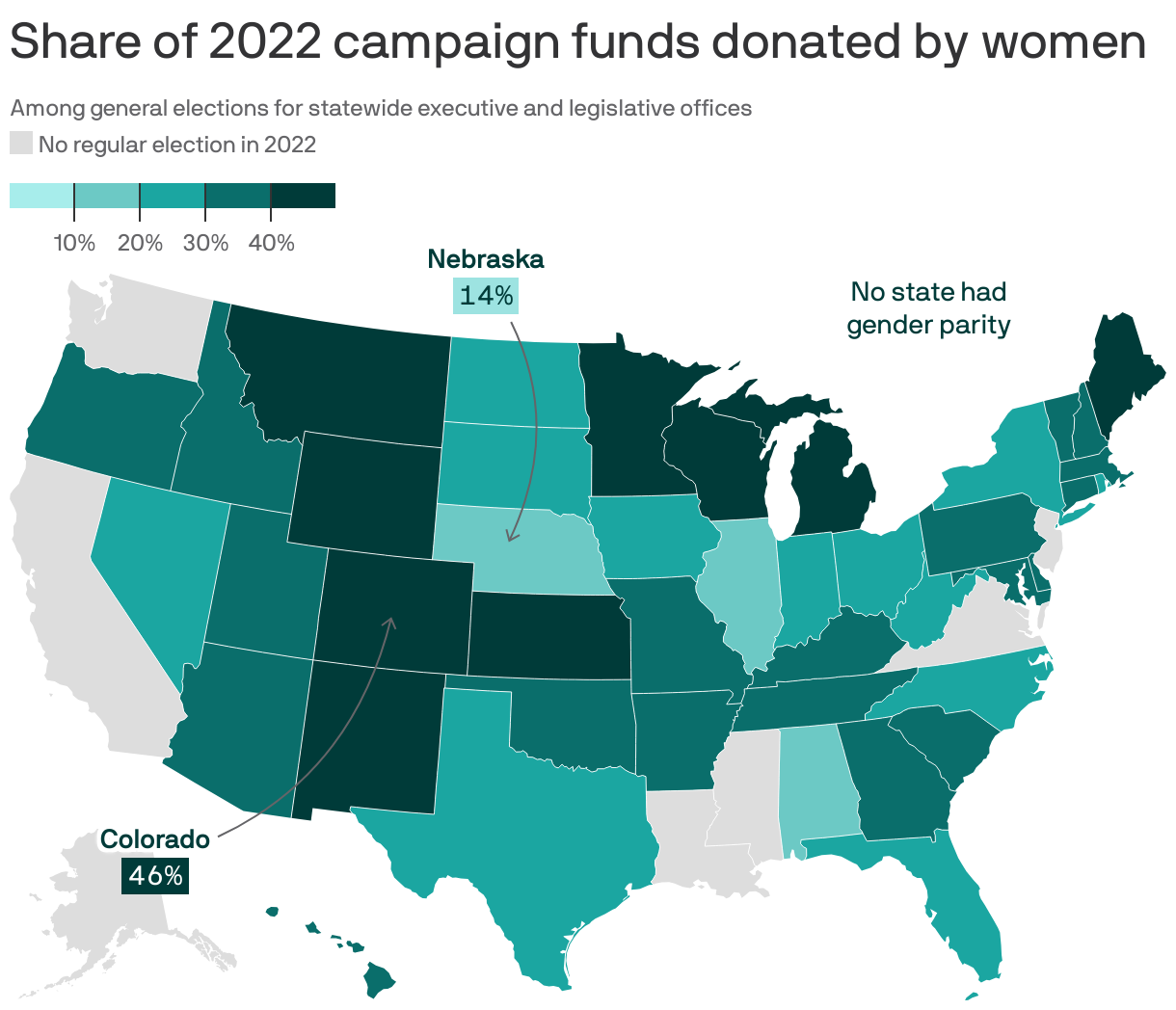
Women contributed 30% of the donations to Ohio's statewide and legislative campaigns in last year's general elections, according to a new report from Rutgers' Center for American Women and Politics.
Why it matters: Women are not just underrepresented in the halls of power, they're underrepresented as the political donors that fuel those halls, Axios' Emma Hurt writes.
The big picture: Nationwide, women donors made up between 29-33% of contributions to general election candidates at statewide and state legislative levels between 2019 and 2022, per data from campaign finance tracker OpenSecrets.
Meanwhile, one-third of state legislators in the U.S. are women, while eight of the 28 governors who ran for re-election last year were women.
- About 50.4% of the U.S. population is female, per census data.
Between the lines: The underrepresentation of female politicians and donors is entwined, Kira Sanbonmatsu, a Rutgers political science professor and the report's lead researcher, told Axios.
- It's a cycle that puts women at a disadvantage — female donors on both sides of the aisle disproportionately support women candidates, but the number of women running for office is significantly lower than the number of men.
- Incumbents, most of them men, tend to raise more money than challengers and well-funded candidates are most likely to win on election day.
Zoom in: In Ohio last year, 49% of campaign contributors were women, but their money made up a much smaller percentage of the total amount donated.
- While 50.6% of the population is female, only 29% of state legislators are women.
- In 220 years of the state's legislative history, the record high is 31% of seats held by women, during the 2021-22 term.
- Men hold all six statewide executive office positions, both U.S. Senate seats and a majority of Ohio Supreme Court seats.
Of note: That trend is expected to continue — all four major candidates for next year's U.S. Senate race are men.
The last word: There's a "need for some new strategies and new mobilization ideas" to rectify the "donor gap," Sanbonmatsu said.
- "Women are voting. They're interested in politics. They're engaged. They maybe haven't been recruited yet in this capacity."