How Charlotte could spend its $19.4 billion in transit sales tax revenue

Add Axios as your preferred source to
see more of our stories on Google.
Photo: Alexandria Sands/Axios
Does Mecklenburg County want to spend more of its transit sales tax money on rail or build more miles of bus rapid transit sooner?
- That's the question taxpayers will be asked as local leaders finalize updates to 30-year transit plans.
Why it matters: For years, Charlotte leaders have dreamed of ambitious rail lines — but without money to accomplish their goals. But now they're making headway to establish a 1-cent sales tax increase by 2026. CATS needs to be realistic about what projects it can afford with the tax revenue and an expected 40% cap on rail projects from the state legislature.
By the numbers: The tax would generate $3.8 billion for buses, $7.8 billion for rail and $7.8 billion for roads over 30 years. The city expects to leverage that money to secure grants and matches from the federal government.
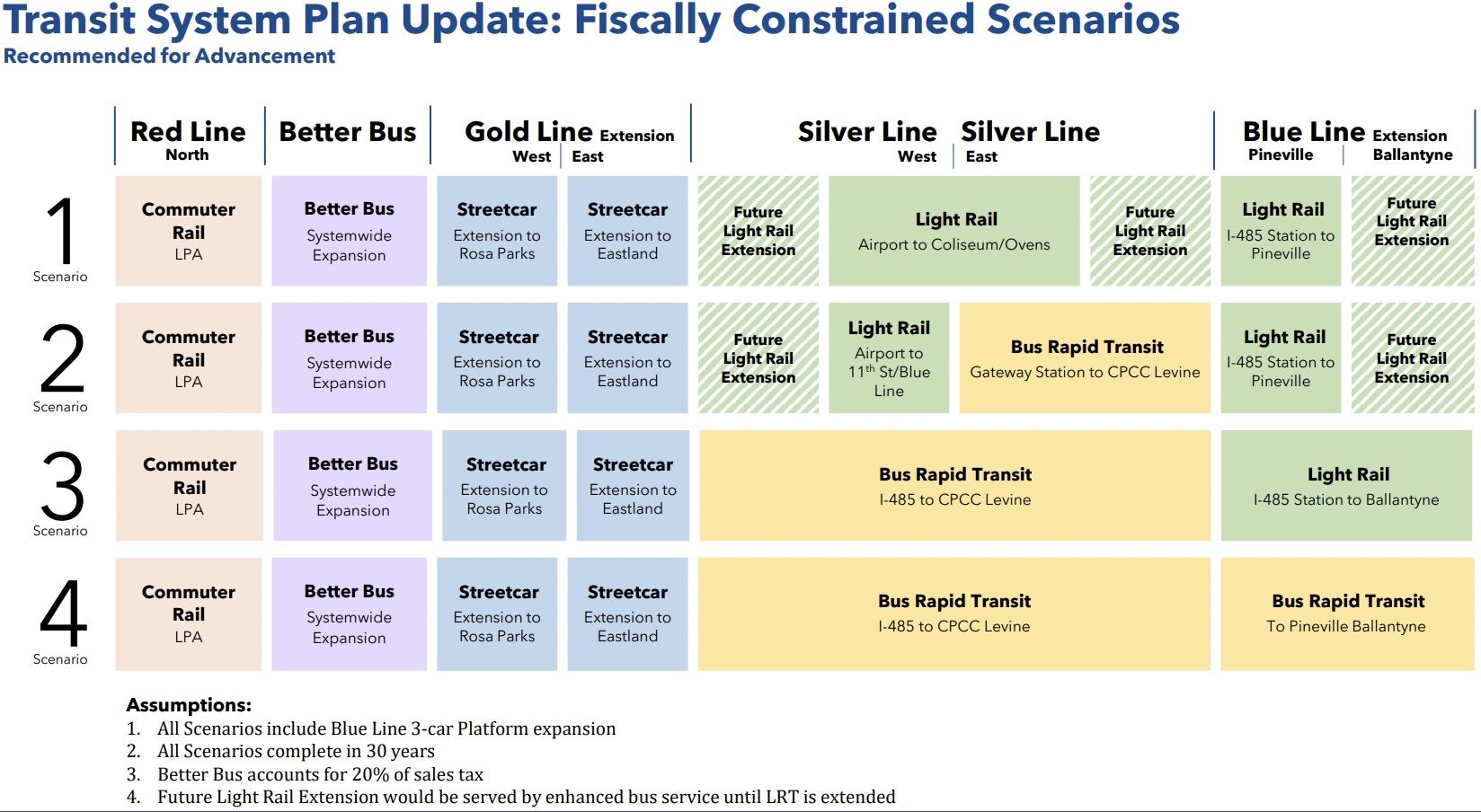
Based on updated cost estimates, the Charlotte Area Transit System has calculated four scenarios for spending the revenue. All options include:
- The $1.38 billion, 25-mile Red Line commuter rail from Uptown's Charlotte Gateway Station to Mount Mourne in Iredell County;
- $522 million for bus improvements, including renovations to the main transit center and new shelters and benches at stops;
- The $845 million Gold Line streetcar extension in both directions, from French Street to Rosa Parks and Sunnyside Avenue to Eastland.
The main difference between the alternatives is how much of the Silver Line and Blue Line extensions are built as rail versus bus rapid transit.
- Bus rapid transit, or BRT, is a lower-cost option than rail by about 30-50%, according to CATS. BRT is faster to board than a regular bus. The vehicles have signal priority on the roads and, in some cases, dedicated lanes to bypass traffic.
Scenario 1: Rail emphasis
In this scenario, the Silver Line would be built as a light rail from the airport station through Charlotte Gateway Station to Bojangles Coliseum.
- In the future, the Silver Line light rail could be extended in both directions, to the west to I-485 and east toward Matthews. But that may not happen for at least another 30 years.
The Blue Line light rail would be extended from its I-485 terminus to Pineville. It could be extended to Ballantyne in the future.
Scenario 2: Mix of rail and bus
The Silver Line would be built as a light rail on Charlotte's west side. But the route would be shorter than the first scenario. It would only travel from the airport station to 11th Street, where it'd intersect with the Blue Line.
- On the east side, the Silver Line would be built as bus rapid transit instead of rail, from the Gateway Station to Central Piedmont Community College's Levine Campus in Matthews.
- In the future, the light rail could be extended west.
Like the first scenario, the Blue Line light rail would be extended only to Pineville. It could be extended to Ballantyne in the future.
Scenario 3: One full BRT, one full rail
The entire Silver Line would be built as bus rapid transit — no rail — from I-485 to Matthews.
The full Blue Line extension would be built as a light rail. It would extend from the I-485 terminus to Community House Road Ballantyne.
Scenario 4: "Double down on BRT"
Both the Silver Line and Blue Line extensions would be built entirely as bus rapid transit. No rail for either route.
What's next: The Metropolitan Transit Commission, the policy board for CATS, will vote on an updated transit plan this spring.
- Charlotte still needs approval to put a sales tax referendum on the 2025 election ballot. The General Assembly is considering legislation to allow the referendum to take place.
- In the meantime, CATS will seek feedback from the community on these four scenarios. It needs to pick a plan that voters will support come November, if they want the tax to pass.
Go deeper: Charlotte transit bill has "50-50" chance of passing, Senate transportation chair says