Boston's tourism spots, expecting summer boon, saw mixed results

Add Axios as your preferred source to
see more of our stories on Google.
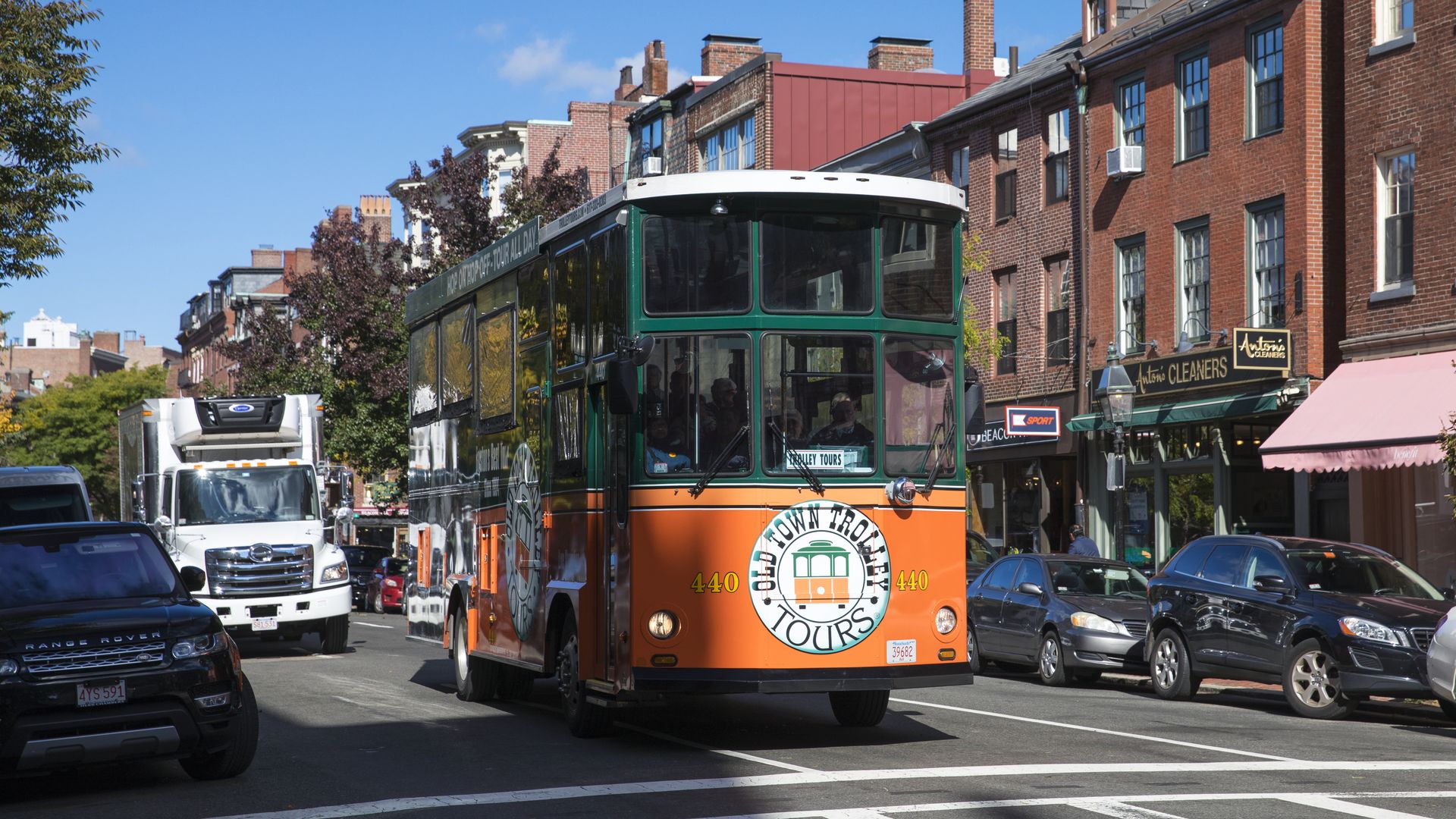
Old Town Trolley Tours on Beacon Hill. Photo: Tim Graham/Getty Images
Boston-area tourism attractions usually perform best in the summer.
- Not so much this year.
The big picture: Boston Mayor Michelle Wu called it the "best summer ever" thanks to a trio of major events, treating it as a model for how to stimulate the local economy in the next few summers.
- But this summer also resulted in losses for some of the city's biggest tourist destinations, per a city survey obtained by Axios through a public records request.
Driving the news: Tour companies like Vibe Your Journey, Old Town Trolley Tours and Boston Duck Tours saw no change or even a dip in their typical clientele, despite an influx of World Cup visitors.
- Other businesses, like an escape room and some souvenir shops, also said they felt the absence of traditional tourists, per the survey responses.
- Some organizations, like Hub Town Tours and Revolutionary Spaces, fared better, but noticed shifting foot traffic during historically busy months.
What they're saying: "While international soccer undoubtedly filled hotel rooms and dining rooms, it did virtually nothing for the city's cultural attractions, tours, and historic landmarks," Piper Smith, vice president of marketing for Old Town Trolley Tours, wrote in a statement to Axios.
- The windfall the company expected from America 250 celebrations never materialized, which Smith attributed to soaring hotel and travel prices during the FIFA tournament.
- Tour companies said sudden road closures during the World Cup and Sail Boston prompted them to reroute tours at a discount or cancel some altogether.
The other side: "Meet Boston is aware that 2026, while very successful for some travel businesses, has not been as robust for many of our tour and attraction partners," Martha Sheridan, Meet Boston's CEO, said in a statement to Axios.
- "For some, it has been a struggle."
- The tourism council is reviving its attractions committee, which will analyze the sector's performance and brainstorm marketing strategies, Sheridan said.
- The Wu administration declined an interview, but a spokesperson said "the city will continue engaging local businesses ahead of any future large-scale events."
Reality check: "Every event isn't going to help every business," said Cindy Brown, CEO of Boston Duck Tours.
- That doesn't mean the World Cup, Sail Boston and other events this summer weren't worth it.
- In fact, she said, the events raised Greater Boston's profile as a welcoming region and could make international visitors more likely to visit, even as foreign relations under President Trump have deterred other tourists.
- "The short-term loss is a long-term gain for my business and for the city," Brown said.
Revolutionary Spaces saw a slight boost from the World Cup crowds and far less from Tall Ships, said Nat Sheidley, the president and CEO.
- The organization, which runs the historic Old South Meeting House and the Old State House, did report a 42% increase in revenue in July compared to July 2025.
- That's thanks to the 250th anniversary of the Declaration of Independence, and the launch of "Ruckus!" an immersive historical show recreating the American Revolution.
- That turned the historic site into an entertainment destination of sorts, Sheidley said.
Yes, but: Brown and other business leaders said they'd still like to see local leaders communicate some disruptions, like sudden road closures, with more notice.
- Meanwhile, Smith and other tour operators suggested that local leaders courting major events either incorporate cultural attractions as part of the festivities or help draw visitors during slightly slower seasons.
What's next: With Revolutionary Spaces, Sheidley said he won't know until later if the summer events attracted new customers or drew the typical tourists to visit at the same time.
- But he sees this summer's events boosting Boston's profile for years to come.
- The city will test that theory in 2030, when it celebrates 400 years.