The rising costs that Massachusetts' poverty rate overlooks


Add Axios as your preferred source to
see more of our stories on Google.
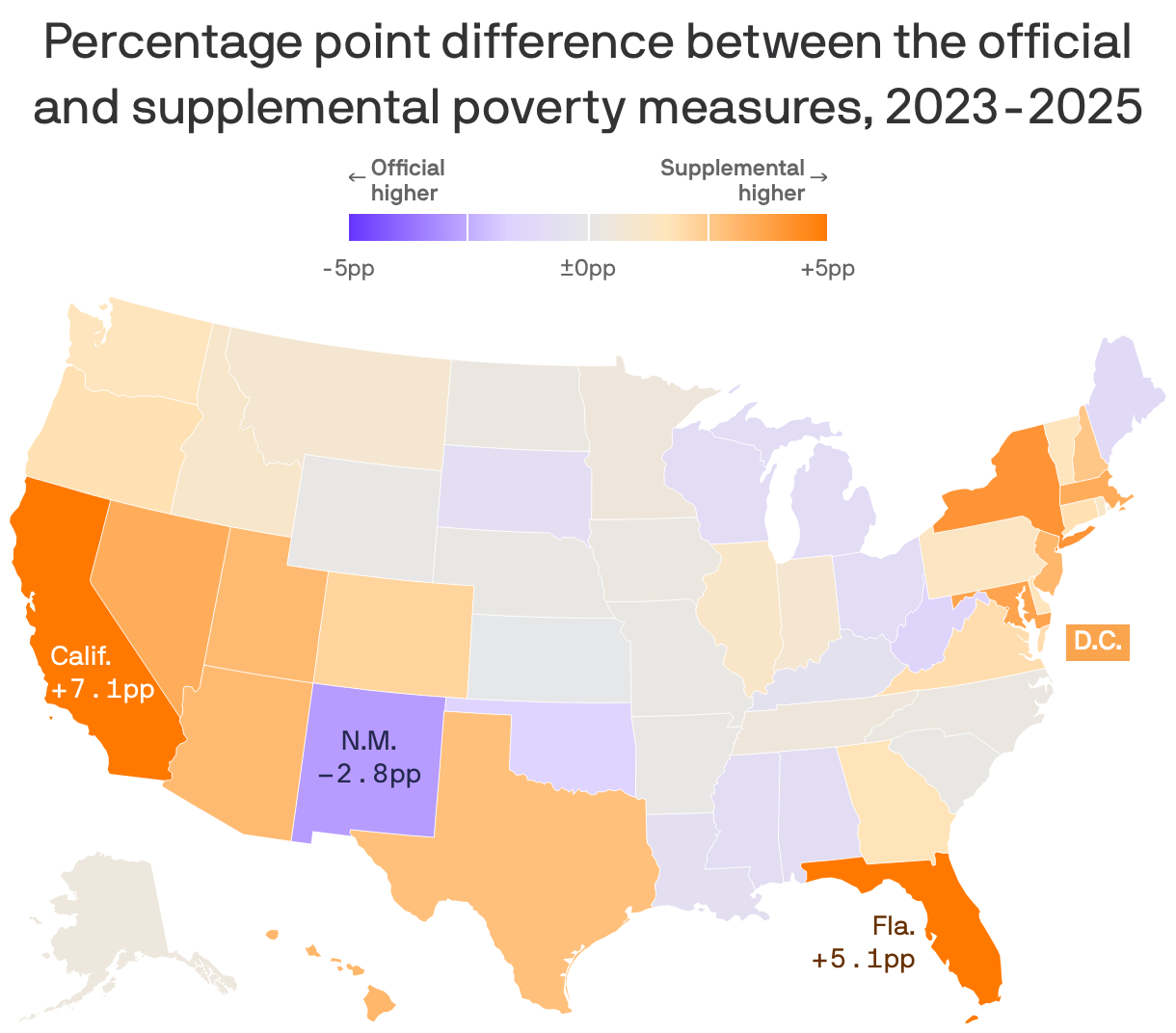
On paper, the poverty rate looks worse in Ohio, West Virginia and Oklahoma than in Massachusetts.
- But factor in the cost of living, and all three states fared better in recent years, per new U.S. Census Bureau data.
Why it matters: Southern states dominate America's traditional poverty rankings. But that familiar geographic divide starts to disappear when more of a family's financial realities are taken into account.
- Axios analyzed 2023-2025 state poverty estimates from the Census Bureau to see what happens when housing, taxes, medical expenses and government benefits enter the picture.
What we found: Massachusetts' poverty rate jumped from 9.1% to 12.5% under the broader Supplemental Poverty Measure (SPM), a difference of 3.4 percentage points.
- Five states saw a more drastic jump: New York, Maryland, Florida, Nevada and California.
How it works: The traditional measure compares pretax cash income with a family-size threshold that doesn't change by geography.
- The SPM adds benefits like SNAP and housing assistance, factors in taxes and tax credits, subtracts work and medical expenses, and adjusts for geographic differences in housing costs.
Zoom out: Under the Census' traditional-style official measure, Louisiana had a 19.6% poverty rate and California was at 10.7%. New Hampshire was the lowest at 5.4%.
- The South is home to 10 of the 11 states where the traditional poverty rate significantly outpaced the national average.
- California's poverty rate jumped by nearly two-thirds to 17.8% under the broader SPM. Louisiana remained near the top at 19%.
- Maine posted the nation's lowest SPM rate at 6.4%, followed by Nebraska at 7.5% and Minnesota at 7.9%.
The official U.S. poverty rate fell for a third straight year to 10.2%, while child poverty reached a record-low 13.4%.
- Yet the SPM remained statistically unchanged at 13.1% — nearly three percentage points above the official rate.
- Real median household income hit a record $87,460 in 2025.
Yes, but: The SPM doesn't replace the official poverty rate.
- Census designed it as another lens — one that captures resources and unavoidable expenses the traditional measure misses.
- The state figures also aren't single-year 2025 estimates. Census recommends three-year averages because state samples in the Current Population Survey are smaller.
The bottom line: Income alone doesn't tell you whether a family can make ends meet.
Axios reporter Steph Solis contributed reporting.