Inside Boston's rat war, from the city's plan to local resistance

Add Axios as your preferred source to
see more of our stories on Google.

Bobby Corrigan, a renowned rodentologist, authored the Boston Rodent Action Plan. Photo: Steph Solis/Axios
Boston officials have armed city blocks with rodent-resistant trash cans, birth control and thermal cameras that can detect rat clusters, but every war has its rogue vigilante.
- In the North End, that's Lilly, a 7-year-old dachshund.
Why it matters: Boston's war on rats — or at least the Wu administration's offensive — is still young, which means neighbors of Cutillo Park still benefit from Lilly's hunting streak.
Catch up quick: Rodent experts and government officials from around the world are in downtown Boston this week for the second National Urban Rat Summit.
- Boston officials shared their multi-agency game plan for tackling the city's infamous rat problem, which entails eradicating massive infestations while taking stock of the enemy's numbers.
What they're saying: "There is a rat world right beneath our feet," says Bobby Corrigan, the rodentologist who wrote Boston's Rodent Action Plan.
- Pretending otherwise only lets the problem fester, exposing the city to dangerous viruses and bacteria, he added.
Friction point: Boston-area residents are well acquainted with the rat underworld.
- Thousands of complaints every year report rat activity — not just around trash strewn on the streets, but behind apartment walls and inside cars parked on the street.
- One even bit a person in Fenway last year.
Reality check: Boston has killed rats, but the best long-term strategy is to deter rats from gaining new ground, says John Ulrich, assistant commissioner of environmental services.
State of play: City workers have tested various sensors to track rat activity, some more useful than others at scale.
- Inspectors in several departments have started searching for traces of vermin as part of their restaurant or housing visits, in one case issuing violations and encouraging a landlord to get a consultant to tackle an infestation in a 12-story building in Chinatown.
- Other tools include surface-level traps that blend into building facades, steel wool and special pavement-like material in tree pits and "containerization" stations on public housing property.
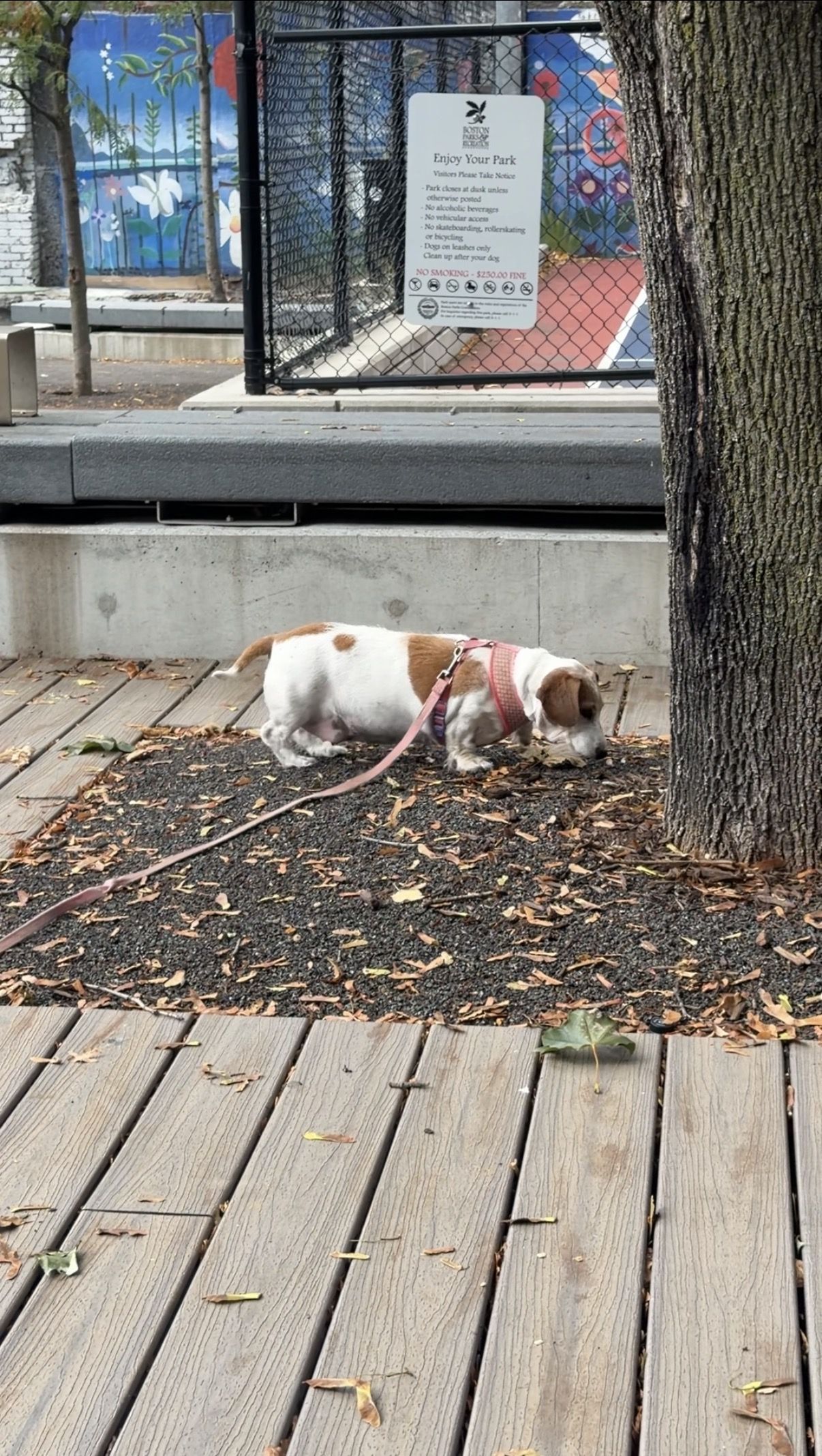
Case in point: Cutillo Park, located a few blocks from Hanover Street, is a textbook case of what happens when cities don't take a rat-centered approach.
- A $1.2 million renovation in 2022 gave the park new life with playground equipment a multi-use court and a deck — the perfect hidden breeding grounds for rats.
- For a hunter like Lilly, it was a feast. She had caught multiple rats by the mouth and snapped their necks.
- For everyone else, it was a nuisance at best, or a safety hazard for the neighborhood children at worst.
Zoom in: Several complaints and a new bid later, crews ripped out the deck and two inches of sub-base, finding hordes of rats.
- They wrapped up the second renovation this summer.
- The deck was reinstalled and filled in with cement restraints and gravel.
- The new park also has rodent-proof bins and some Flexi-pave pavement around the trees where rats would burrow, says Nate Hinchcliffe, the city's park maintenance director.
Flash forward: These days, Lilly sniffs around the park and usually comes up empty.
- Meanwhile, Dorothy Dasaro, her owner, picks up garbage that she says tourists leave behind.
- "People don't respect the community, but at least the people that use this park, they pick up," she says.
What we're watching: Lilly still catches the occasional rodent that slips out from an alleyway. She's spotted some small burrows developing on the street.
- Only time will tell if the battle for Cutillo Park is over, and if it can become a model for other rat-infested pockets.
- In the meantime, city workers will keep collecting data to determine just how big a threat the rodents pose and how to drive them out for good — if that's possible.