Boston-area Haitian leaders brace for next steps after TPS ruling

Add Axios as your preferred source to
see more of our stories on Google.
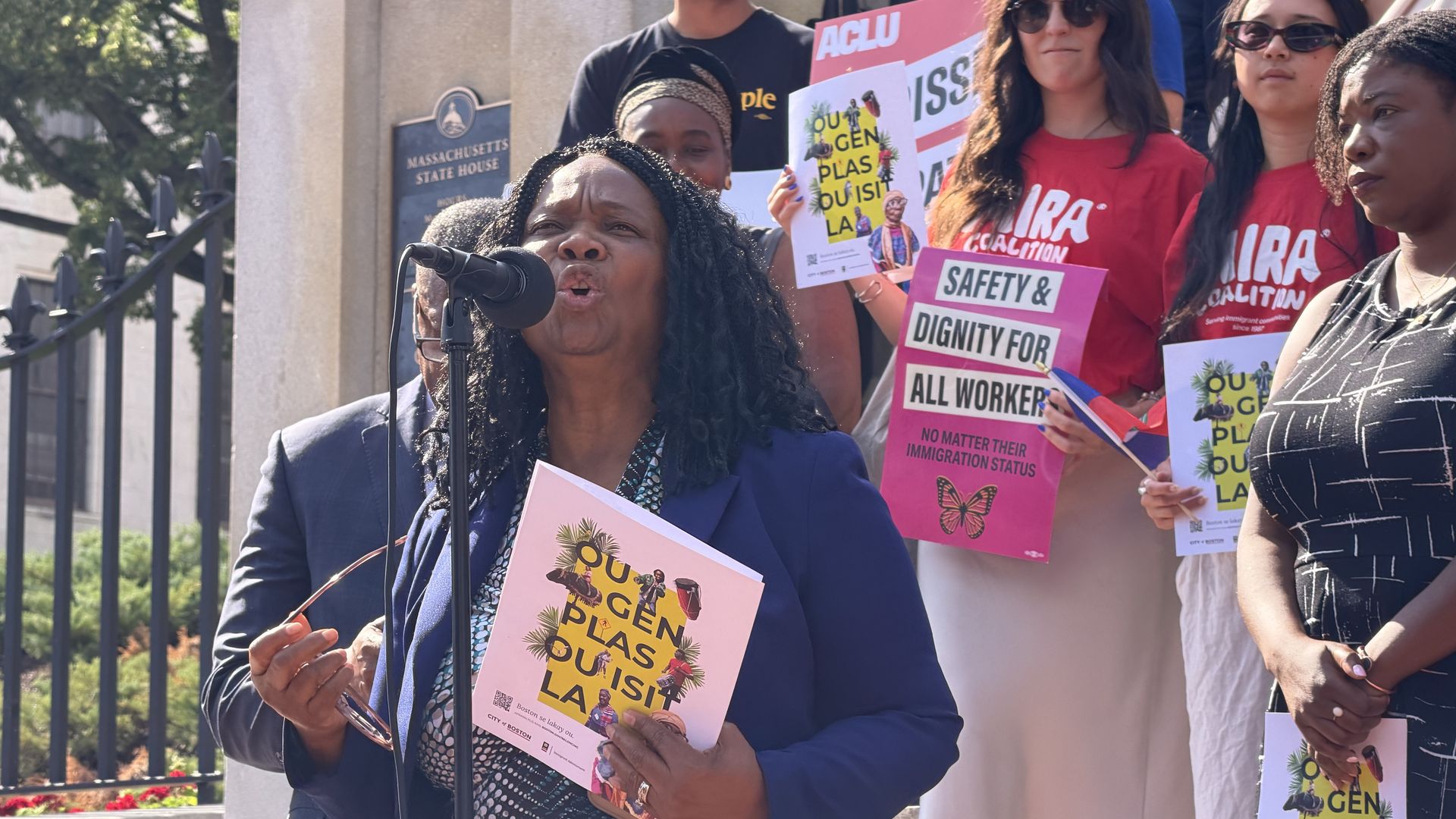
Geralde Gabeau, IFSI-USA's founder and executive director, delivers remarks alongside Boston City Councilor Ruthzee Louijeune (right) outside the State House. Photo: Steph Solis/Axios
Haitian families across Greater Boston were still coming off the high of watching their national team score two goals in the World Cup when they started learning the news.
- The Supreme Court had ruled that the Trump administration could end Temporary Protected Status, a designation that elders, neighbors and young adults had relied on for years.
The big picture: The ruling clears a path for the government to end the status for the estimated 37,000 TPS holders in Massachusetts, including at least 22,000 from Haiti.
Catch up quick: The Supreme Court ruled, 6-3, on Thursday that the Trump administration could end TPS for Syrians and Haitians for three reasons:
- The 1990 TPS law shields the determinations from judicial review except when constitutional questions are raised.
- The Department of Homeland Security properly consulted all the appropriate agencies required under the law before making its decision, contrary to plaintiffs' arguments. (DHS emailed the State Department but never got an answer about the countries' conditions, which the majority ruling said still counted as a "consult.")
- The plaintiffs failed to prove the terminations were racially motivated.
Friction point: The majority opinion called the government's arguments race-neutral, which Haitians across Massachusetts disputed.
- So did Justice Elena Kagan, who wrote that the evidence "includes statements by the president so repellent and racially inflected that the majority declines to put them in print."
- Kagan's dissent goes on to list some of them, including the infamous, false claims that Haitians are "eating the dogs" in Springfield, Ohio.
The latest: Elected officials and advocates are turning their attention to the remaining options:
- Enlisting voters, business leaders and other influential residents to pressure the U.S. Senate into taking up a bill extending TPS for Haiti for three years, a proposal by U.S. Rep. Ayanna Pressley (D-Mass.) that the House passed in April.
- Persuading attorneys and business leaders who employ TPS holders to explore alternative immigration pathways for them, including company-sponsored work visas.
What they're saying: "We have no choice but to be victorious," said Boston City Councilor Ruthzee Louijeune, a Haitian American, from the front steps of the State House.
- "We have no choice but to build a coalition that is going to continue to fight back against the heinous actions of this administration every day."
The other side: Stephen Miller, the White House's deputy chief of staff for policy, told Fox News, "This is a victory 10 years in the making."
- "We can finally remove these Haitian illegal migrants from the United States," he added, referring to Haitian TPS holders, who still have temporary protections and work permits.
Zoom out: The decision threw cold water on the jubilee surrounding the World Cup festivities in Boston, where residents cheered on Melrose's Frantzdy Pierrot as he played for Haiti and welcomed international visitors.
- "City Hall right now is welcoming people from around the world for the FIFA Fan Fest, Louijeune added, "showing the best of who we are as a city and as a country."