Quincy statues lawsuit tests separation of church and state

Add Axios as your preferred source to
see more of our stories on Google.
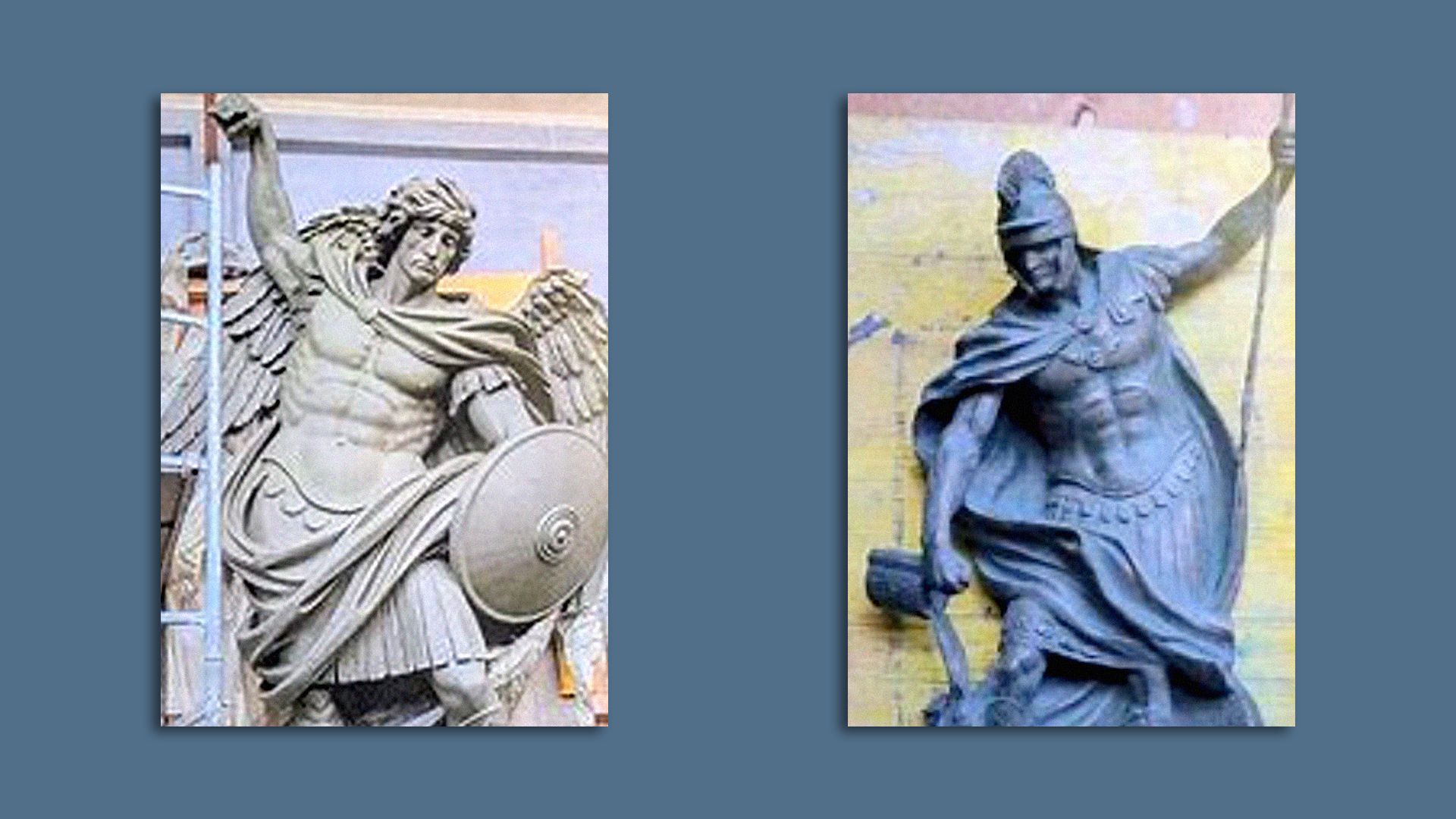
Statues of Catholic saints Michael and Florian as pictured in the Quincy residents' lawsuit. Photo: ACLU of Massachusetts
A Norfolk County Superior Court judge must decide whether Quincy's plans to install two statues of Catholic saints violate the separation of church and state and related state laws.
Why it matters: The figurines stirred controversy in the birthplace of John Quincy Adams over the use of taxpayer dollars for religious statues without any public input.
The big picture: Now the conflict has evolved into a legal battle testing the limits of Massachusetts' doctrines around free speech and equal protection for residents of all religions.
Catch up quick: A coalition of Quincy residents is criticizing Mayor Thomas P. Koch over his decision to spend $850,000 in taxpayer funds without notice to install 10-foot-tall bronze statues of two Catholic saints, Michael the Archangel and Florian.
- Koch spent the funds in 2023, but the public only learned about it in February when the Patriot Ledger exposed the spending.
The latest: Judge William F. Sullivan held off on ruling on the city's motion to dismiss or the residents' requests for a preliminary injunction Friday.
- If approved, the preliminary injunction would bar city officials from installing the statues on the facade of Quincy's new public safety headquarters, which is set to open in the fall.
State of play: Residents had also asked the judge to bar the city from spending any more taxpayer funds on the statues' creation, transport or installation, calling it a violation of the Massachusetts Declaration of Rights section on equal protection of all religions, court documents say.
- But the statues are expected to be shipped next week, said James Timmins, who is representing the city of Quincy. It will take five weeks for them to reach Boston.
The other side: Timmins said Michael and Florian are well known for their contributions prior to becoming Catholic saints, including Florian's record as a firefighter.
- "When people refer to them as Catholic saint statutes, they limit what they're about because they're more than that," Timmins said Friday.
What they're saying: Sullivan, who noted the figures were made saints by the Catholic Church, asked Timmins at one point what he thinks Adams would think of the statues.
- Timmins replied that he believed Adams wouldn't impose restrictions on free expression.
- "We're calling this public art, and we're supporting the police and fire department, and I'm virtually certain, he'd accept that in the discussion," Timmins said.
Flashback: Renderings of the building approved by Quincy city councilors in 2017 didn't include the statues as recently as February, when the Patriot Ledger reported on them.
- Koch said in the story the statues weren't presented publicly because "large projects like this one sometimes 'evolve' and the idea 'wasn't on the table' when councilors cast their votes."
Zoom in: The plaintiffs include residents of Catholic, Jewish and Unitarian faiths as well as atheists.
- They argue in their complaint that installing religious icons at a government facility suggests that "those who do not subscribe to the city's preferred religious beliefs are second-class residents who should not feel safe, welcomed or equally respected by their government."
- Attorneys representing the city wrote that Michael's and Florian's status as Catholic saints "is incidental to their being internationally recognized symbols of first responders."