These pedestrian signals are inches from a Castleberry Hill resident's window

Add Axios as your preferred source to
see more of our stories on Google.
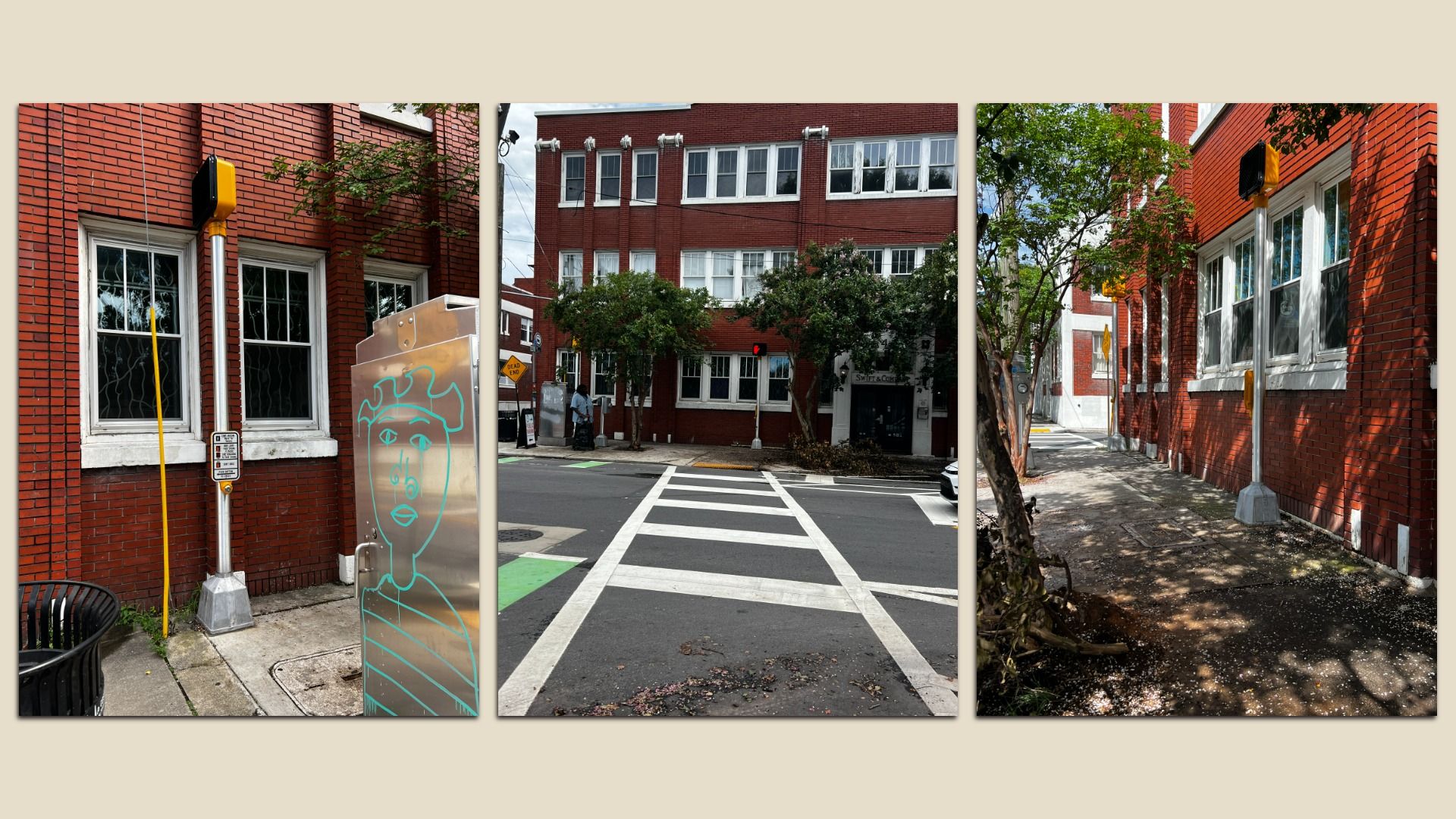
The pedestrian signals outside the Swift & Co. Lofts in Castleberry Hill. Photos: Courtesy of David Mitchell/Atlanta Preservation Center
What would you do if you woke up one morning to find a pedestrian crossing signal installed right outside your window?
- It's a situation Castleberry Hill residents and historic preservation advocates have been trying to remedy for several months, ever since the Georgia Department of Transportation installed two signals in awkward locations.
Why it matters: Both signals, which were installed as part of larger improvement projects, are just inches away from the Swift & Co. Lofts building at 244 Peters St. SW.
- One signal is installed with its front facing out toward Peters Street.
- The other is installed perpendicular to the ground-floor window of a residence, with the face of the signal pointed toward Peters' intersection with Fair Street.
- That means when the light is active, the white walk signal or the orange countdown and the accompanying hand could shine brightly into a person’s living space.
- Or the resident could have the misfortune of making eye contact with random people while hanging out in the comfort of their home.
Zoom in: Rebecca Bily, chair of the transportation and code enforcement committee of the Castleberry Hill Neighborhood Association, said she and the community were “appalled” that the signals were installed so close to the building.
- She also said mast arms installed as part of the improvements aren’t compliant with standards and regulations outlined in the National Register of Historic Places, which the Castleberry Hill neighborhood has been listed on since 1985.
- “It's just piece by piece taking away the historic charm of this neighborhood, and that's the whole thing we’ve been trying to protect."
What they’re saying: Sarah Borcherding is the executive director of Easements Atlanta, a local nonprofit that holds conservation easements on dozens of historic properties around the city.
- Those easements, which are agreements between property owners and a governing body, prevent demolition or changes that would alter the properties' historic character or value.
- Borcherding told Axios that upon learning about the signals, she reached out to GDOT to inform them about the federal easement at the Swift & Co. building that prevents altering its façade.
- “We have just been advocating for the building and … were hoping they could provide some additional consideration for these particular circumstances,” she said.
The fine print: The National Historic Preservation Act of 1966 requires that projects funded with federal dollars and that have the potential to affect historic properties to undergo a Section 106 review.
- Agencies undertaking projects must consult with all affected parties and allow them to provide feedback.
- Borcherding said that Easements Atlanta was not notified of GDOT’s plans and that after corresponding over the last several months, a meeting was held last Thursday where GDOT agreed to extend the public input period for another 30 days.
The other side: GDOT spokesperson Natalie Dale told Axios a follow-up meeting is planned for Aug. 26.
- Dale said GDOT complied with the Section 106 requirement but added that the agency is “committed to evaluating whether any options for relocating some of the signal equipment could be done.”
What we’re watching: If the pedestrian signals will remain in their current locations, be moved closer to the street, or be relocated to another utility pole.