Georgia Senate and gubernatorial candidates fight for Black voter support

Add Axios as your preferred source to
see more of our stories on Google.
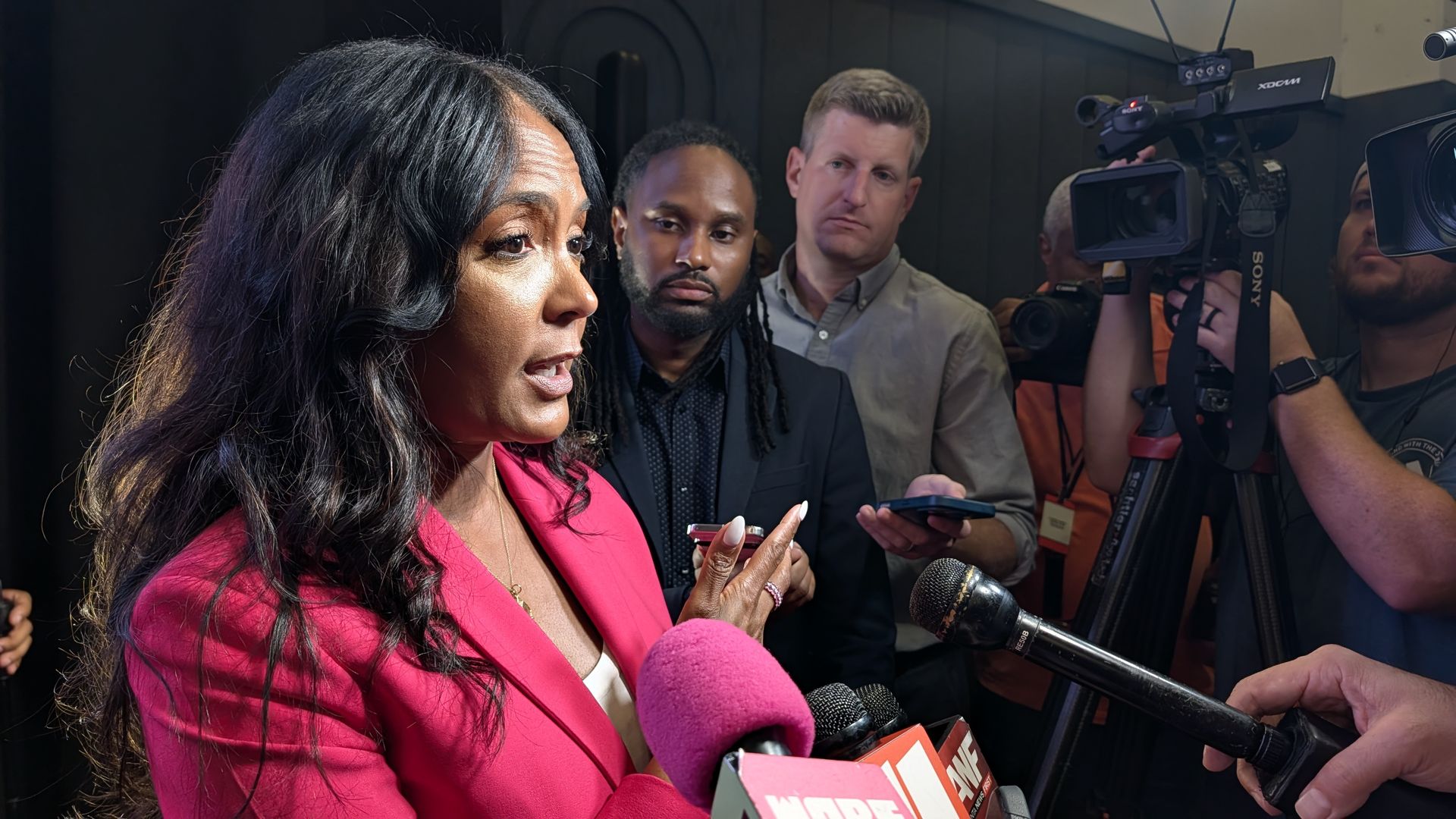
Democratic gubernatorial candidate Keisha Lance Bottoms answers questions from reporters at The Gathering Spot on July 27. Photo: Kristal Dixon/Axios
Black voters have long scolded Democrats and Republicans for taking their votes for granted or ignoring them entirely.
- But in Georgia, nearly all candidates running for U.S. Senate and governor are trying to court Black voters ahead of the election Nov. 3.
Why it matters: Democrats are banking on the surge of Democratic voter turnout in the May 19 primary to lead to a victory while Republicans are hoping to peel away just enough Black voters — who consistently vote Democratic — to push them over the victory line.
The latest: There's a much more coordinated effort to court Black voters this year, said Andra Gillespie, a political science professor at Emory University.
- She told Axios the state Democratic Party's recent decision to open 30 field offices shows "they are trying to do their best to make sure that they have the type of infrastructure in place so they can touch as many voters as possible" before Nov. 3.
What they're saying: Historically, Gillespie said, Democratic candidates have relied on the 30-30 rule proffered by Charles Bullock, a University of Georgia political scientist and author of "The Changing Political South."
- In other words, Democratic candidates must earn 30% of white voter support and Black voters have to turn out at a percentage that's proportional to their statewide population.
- "If Black turnout is worse than white turnout, that doesn't bode well for Democrats," she said.
Flashback: The discussion around Black voter support was thrust back into the spotlight when Republican gubernatorial candidate Rick Jackson last month shared a series of photos of him meeting and greeting people at Black-owned businesses.
- Jackson's visit to Toast on Lenox, which the campaign posted about and later deleted on social media, sparked swift backlash against the business and its co-owners.
The intrigue: Fred Hicks, a political strategist and consultant who is not involved in Bottoms or Jackson's campaign, said Jackson's team has a Black voter outreach director who's put him in spaces where he can talk about his rough childhood and his success as a businessman.
- "The game plan is to be where people want to hear Rick Jackson and want to learn from Rick Jackson about who he is," Frank Murphy, the former NFL player who is leading Jackson's Black voter outreach efforts, told Capital B Atlanta.
Zoom in: Democratic Sen. Jon Ossoff, who has the advantage of being an incumbent, has maintained strong communication and outreach with Black voters after he and fellow Sen. Raphael Warnock campaigned together to win their seats in 2021, Hicks said.
- Jackson's opponent, former Atlanta Mayor Keisha Lance Bottoms, "embraces her Blackness" in a way other candidates have not, Hicks told Axios.
- She's not only a member of the Black sorority Delta Sigma Theta, she graduated from an HBCU (Florida A&M University) and often talks about her family.
- Bottoms also has focused on attracting rural voters, especially those living in counties that make up Georgia's so-called Black Belt, where she performed well enough to avoid a primary runoff.
- Two weeks ago, Bottoms discussed her campaign's platform and Black male voter engagement in a town hall discussion held at The Gathering Spot.
Yes, but: The weak spot in Bottoms' campaign is in metro Atlanta counties Fulton and DeKalb, where she only received 49% and 43% of Democratic votes during the primary, respectively.
- "Everybody has access to the same data, and so I don't think it is any accident that Rick Jackson is poking the bear, so to speak, with Black voters in Fulton County," Hicks said, adding it would be impossible for her to win the race with just 55% of the vote in Fulton.
What we're watching: Ossoff challenger and U.S. Rep. Mike Collins has "not yet at this point made any real effort or outreach to African American voters," Hicks told Axios.
- Collins, who is embroiled in controversy over his son-in-law's social media posts promoting white nationalist views, over the last week has posted video clips of Black voters explaining why they support him.