Data center fight hits Georgia politics



Add Axios as your preferred source to
see more of our stories on Google.
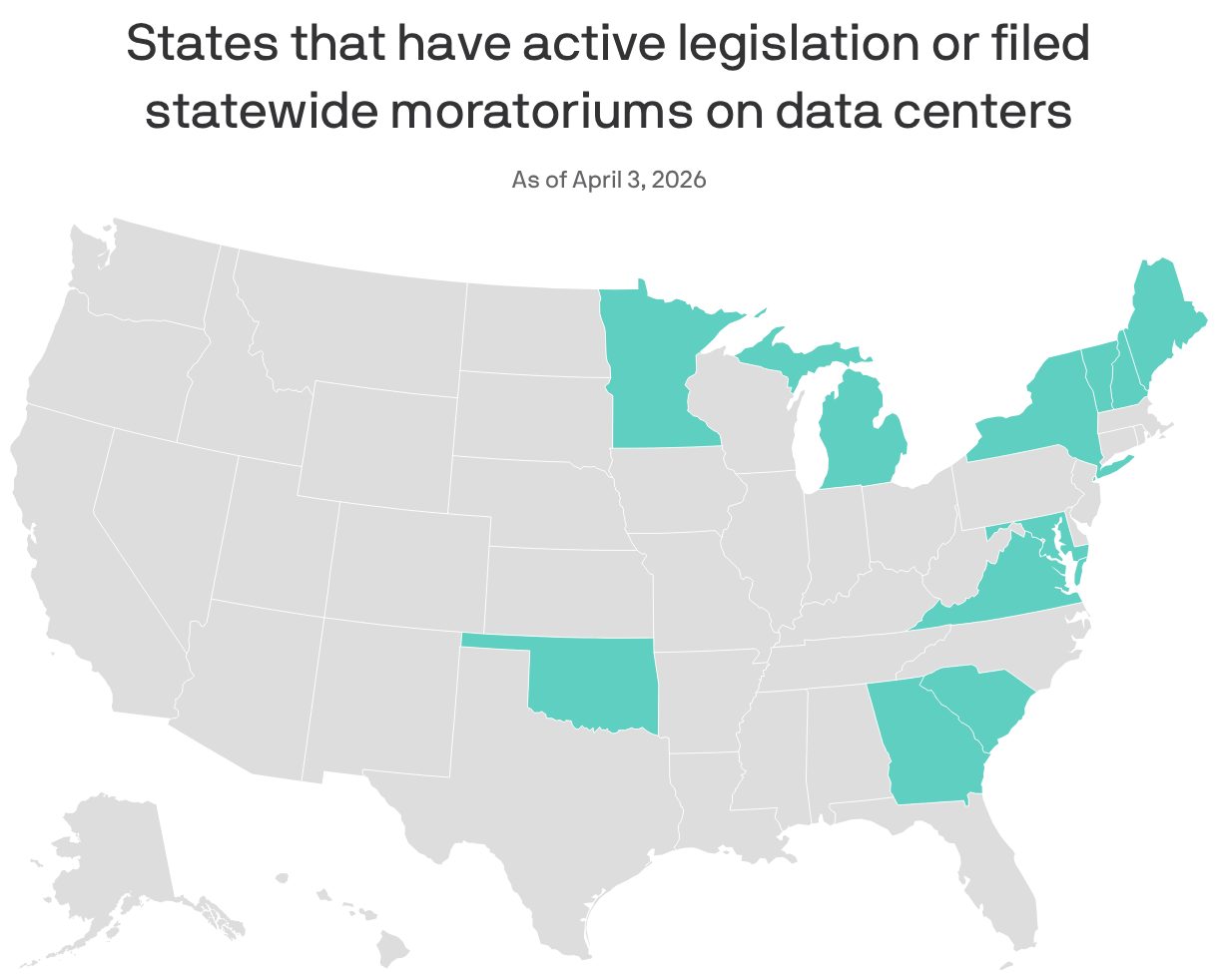
Data centers have become a boxy, hulking flashpoint across Georgia and the nation heading into the midterms — and the backlash is spreading fast across red and blue states.
Why it matters: With no federal action, states are fielding constituent anger over power grids, water supplies and strained local infrastructure.
- But investment keeps accelerating; Wall Street isn't slowing down, and neither is Washington's appetite for AI dominance.
Zoom in: Elected officials in at least 11 states, including Georgia, have proposed some legislation to restrict or ban data center development since late 2025.
- More than a dozen Georgia counties including Clayton, DeKalb and Athens-Clarke and cities like Roswell, Hampton and LaGrange have adopted moratoria, according to Georgia Tech's Data Center Ordinance Hub.
- Separate moratorium proposals by state Reps. Ruwa Romman (D-Duluth) and Derrick Jackson (D-Tyrone) were two of roughly 20 proposed measures that failed to pass during the most recent session of the General Assembly.
Zoom out: Maine is on track to be the first to ban construction outright. A bill pausing development until Nov. 2027 is expected to clear the state Senate and be signed by Gov. Janet Mills (D), who is also running for U.S. Senate.
- Last month, Sen. Bernie Sanders (I-Vt.) and Rep. Alexandria Ocasio-Cortez (D-N.Y.) introduced a bill to pause data center construction nationwide — an instant political lightning rod.
The big picture: Politicians are positioning themselves carefully on data centers ahead of the midterms, and their stances are often a direct response to local voter angst.
The bottom line: This isn't a red or blue state problem. It's a tangible, physical manifestation of how AI is changing and dividing the country.
Go deeper: AI data center fight blurs political lines
Axios' Sara Wise contributed reporting.