Allergy season is getting longer in Atlanta


Add Axios as your preferred source to
see more of our stories on Google.
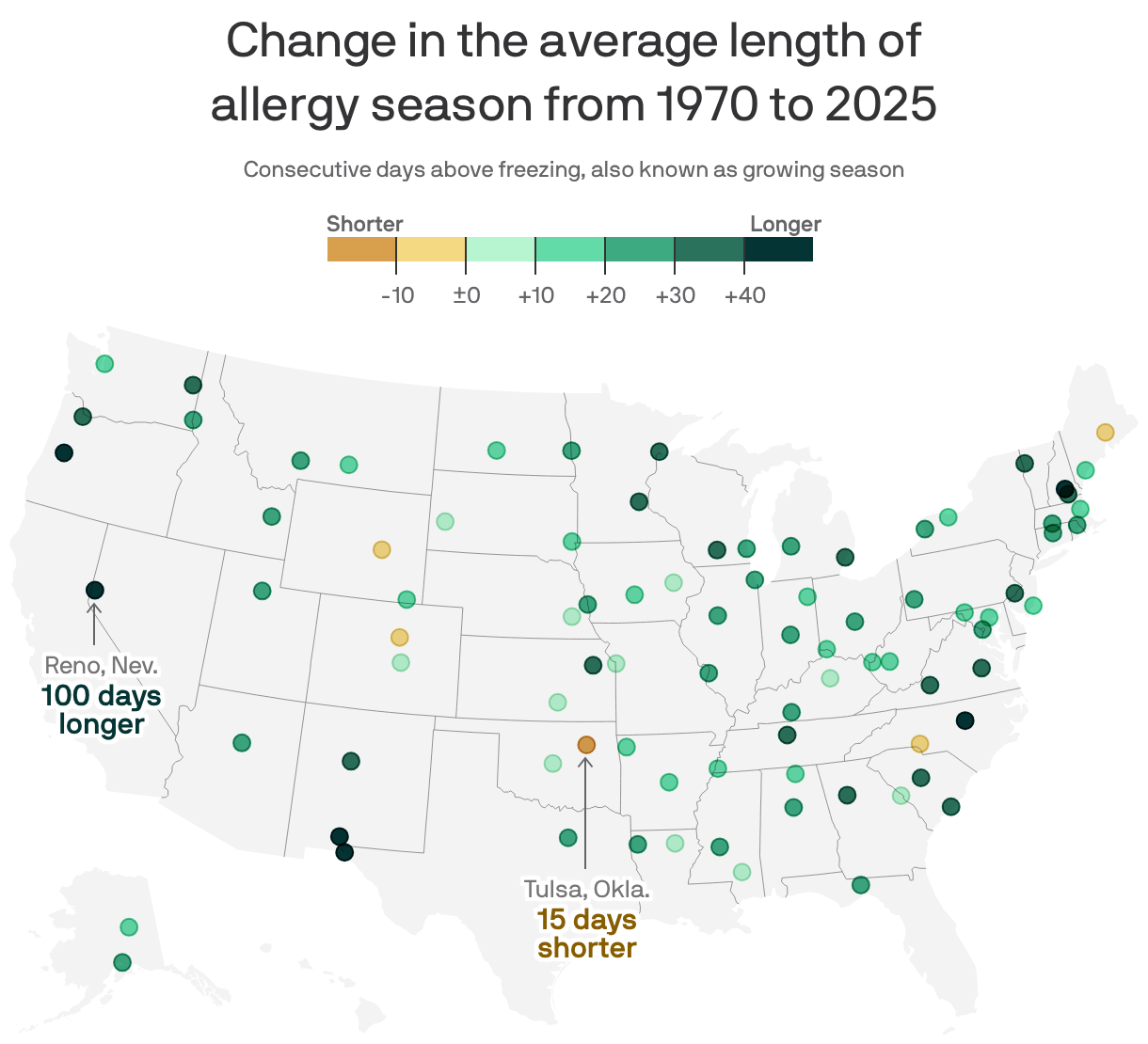
If you feel like your seasonal allergy symptoms start earlier each year, it's not your imagination.
- Allergy season is getting longer in many U.S. cities amid climate change, according to a new Climate Central analysis.
Why it matters: A drawn-out allergy season means prolonged sneezing, sniffling, wheezing and coughing, which can greatly affect a person's quality of life.
The latest: The freeze-free growing season for plants lengthened from 1970 to 2025 in nearly 90% of the 198 cities analyzed in the climate research group's latest report.
- Among cities with an increase, the freeze-free period grew by an average of 21 days.
- That's the time between the last and first freeze, used here to represent allergy season.
Zoom in: Allergy season has lengthened the most in the Northwest, where the freeze-free period is now 31 days longer on average.
- In Atlanta, the season is, on average, 37 days longer.
Zoom out: Some cities have it worse. Eugene, Oregon, El Paso, Texas, Raleigh, N.C., and Concord, N.H., all saw their seasons increase by at least 40 days.
Stunning stat: The allergy season in Reno, Nevada, has grown by an eye-watering 100 days. For Las Cruces, N.M., the season is 65 days longer.
The intrigue: Tulsa, Oklahoma, is one of the few cities that experienced a shorter season, with its period decreasing by 15 days.
What they're saying: "A longer allergy season is nothing to sneeze at — it's a clear signal of a warming world, driven by carbon pollution," said Climate Central vice president for science Kristy Dahl.
- "As temperatures rise, freeze-free seasons are stretching in every region of the country, giving plants weeks of extra time to grow and release pollen.
- "For millions of Americans, that means earlier, longer, and often more intense allergy seasons that can take a real toll on health and daily life."
What's next: NOAA's Climate Prediction Center is calling for high chances of above-normal temperatures across the Southeast for March, and an elevated chance of above-normal temperatures in the Southwest for the early spring months.