After 20 years of cityhood, Sandy Springs focuses on the future

Add Axios as your preferred source to
see more of our stories on Google.
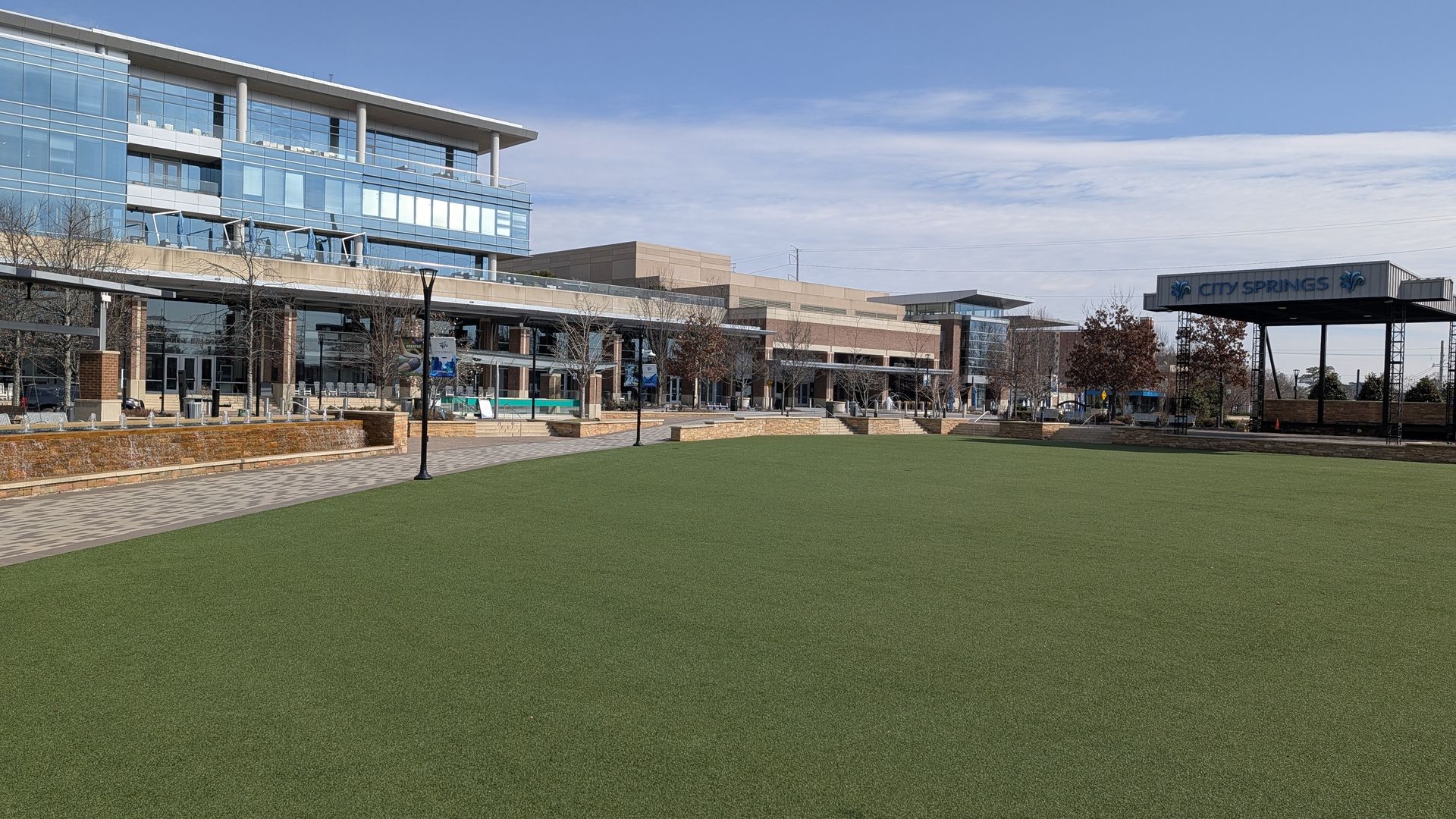
Sandy Springs City Hall, Performing Arts Center and City Green are all situated on the City Springs development. Photo: Kristal Dixon/Axios
Sandy Springs, the place that sparked metro Atlanta's cityhood movement, just celebrated 20 years of carving out its own identity.
- As the city ponders the next two decades, its leaders are working to ensure Sandy Springs remains a place that attracts people from all walks of life.
Why it matters: Sandy Springs, which incorporated on Dec. 1, 2005, was the first city to establish itself in Georgia since Peachtree City became a municipality in 1959.
- Its incorporation created a domino effect of several new cities born in its wake: Milton (2006), Johns Creek (2006), Chattahoochee Hills, (2007), Dunwoody (2008), Brookhaven (2012), and many others.
- "All these cities have been created because of the success that these communities saw going on in Sandy Springs and they said, 'We want to do the same thing,'" Mayor Rusty Paul, who was recently sworn into office for his fourth term, told Axios.
Flashback: To understand Sandy Springs today is to understand how — and why — its cityhood movement gained traction.
- In the 1970s, The Committee for Sandy Springs was formed after the city of Atlanta expressed interest in annexing it into its boundaries.
- Former City Council member Tibby DeJulio, who along with founding Mayor Eva Galambos, was among those who were fighting for incorporation.
- DeJulio, who served on the Council from its founding until he retired last year, told Axios that Fulton County was responsible for zoning, police and fire and other services within Sandy Springs' 38 square miles.
Yes, but: The county had a special tax district that funded services in the area, but DeJulio said the county "used it as slush funds for other parts of the county."
- DeJulio also said residents were unhappy with zoning decisions made on their behalf, as well as the lack of adequate police protection.
- "We weren't getting the services we were paying for," he said.
Adrianne Murchison, a longtime Sandy Springs resident and veteran Atlanta journalist, said the feeling among most residents was that they wanted to run things their own way.
- "They wanted control over their own destiny, and what they could create up here," she said.
- After years of lobbying legislators, the question of incorporation was put on the ballot, and on June 21, 2005, 94% of voters said yes.
- The inaugural mayor and council were elected and sworn in, and the grunt work of establishing a city kicked into high gear.
How to start a city
It was late 2005 when John McDonough, then the city manager in Beaufort, South Carolina, got a call from a colleague who ran an executive search firm about a unique job opportunity.
He filled McDonough in about Sandy Springs, the folks behind the push to incorporate and the major issues the city was facing.
- McDonough said the chance to become Sandy Springs' first city manager "sounded like a very interesting opportunity" because he would help establish a new city in another state. He accepted the position.
McDonough told Axios the city began the work of implementing a legal framework to operate, which included initially adopting existing Fulton County ordinances and regulations.
The intrigue: Sandy Springs took a bold step — and at the time very unusual in Georgia — and began public-private partnerships with corporations to provide most city services.
How it works: The method, touted by fellow Sandy Springs founder Oliver Porter, called for the city to approve contracts with companies to provide staffing and services for departments like parks and recreation, community development, public works, and zoning.
- Along with city management, police and fire services, which the city subsequently took over from Fulton County, were all kept in-house.
Between the lines: As the city grew, so did the cost of those privatized services.
- So in May 2019, City Council members voted to bring nearly all of its contracted services back in-house, a move the city has said saved around $26 million.
Creating a downtown
With government operations up and running, city leaders focused on creating a collective identity of what it means to be a Sandy Springer.
After he was first elected in 2013, Paul said he pitched city leadership his idea of creating "a space where we bring people together."
- Council members in 2008 already approved the purchase of a former Target store on Johnson Ferry Road for a future city hall, but Paul said he envisioned something that would create community pride.
This dream would eventually become City Springs, the 14-acre mixed-used development just west of Roswell Road between Mt. Vernon Highway and Johnson Ferry Road.
- Along with City Hall, City Springs includes a Performing Arts Center, City Green and interactive water fountains.
- Private sector development on the site includes an apartment complex, as well as restaurants and retail shops.
- Current City Manager Eden Freeman said the project initially caused some "consternation" among some wary residents, but she hears all the time how people can't envision the area not being developed.
- "I walk here all the time," she said. "My neighbors are out every day. They all love and appreciate everything that is here."
Confronting challenges
With about 108,000 residents, Sandy Springs has an active and vocal base of homeowners who regularly show up at Council meetings and public hearings to weigh in on topics, both meaty and minor.
Friction point: However, half of the city's housing units are renter-occupied, and Murchison told Axios the city's efforts to engage with this demographic of people could be more robust.
- "I don't feel like the city engages that part of the community enough, and I don't see where it has to be that hard," she said.
Melody Kelley, who just started her second term as a City Council member, helped create the city's popular Juneteenth event.
- The annual celebration, she said, is possible due to partnerships with community organizations.
- Paul said the city has made more of a conscious effort to seek out and host events that highlight Sandy Springs' racial and ethnic diversity.
Sandy Springs for all, not just the wealthy
State of play: Like every other city in the country, it's becoming harder to afford a home. Freeman said the city will update its housing needs assessment, which will be formally introduced to Council members.
- Paul said Sandy Springs' neighborhoods are dotted with plots where people demolished homes valued at around $500,000 and built newer residences that would sell for millions.
- While a lot of communities would love to have that problem, Paul told Axios the city's housing stock needs to include options for people who work in Sandy Springs, but can't afford to call it home.
- That may include more rental housing, but there also has to be an option for people who eventually want to buy a home.
The bottom line: "Those of us in public places have to figure out, what are the policies that we have [that] are making it more difficult," he said. "What are the opportunities that we can create?"