Georgia is an immigration enforcement hot spot


Add Axios as your preferred source to
see more of our stories on Google.
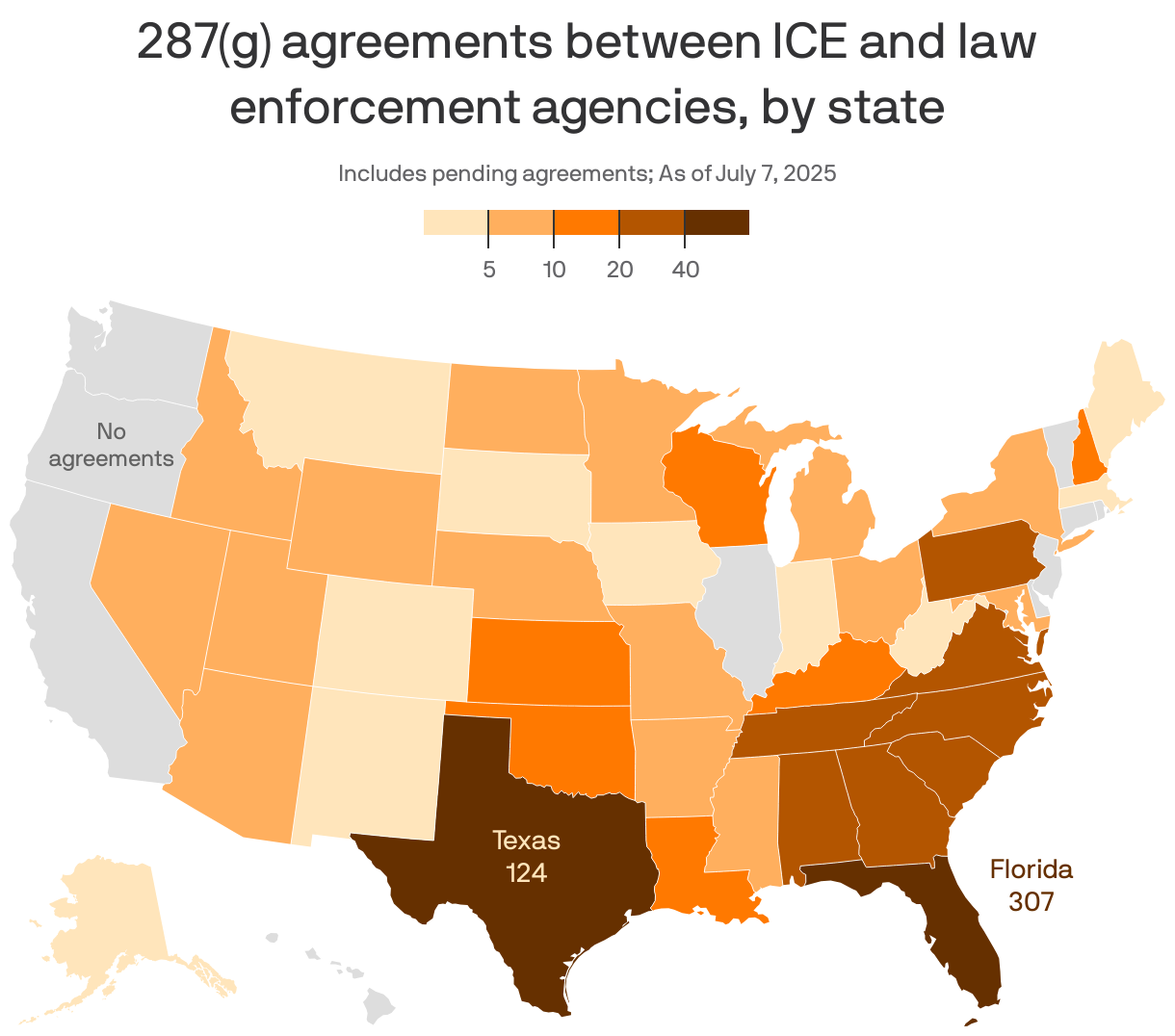
Efforts to arrest and remove unauthorized immigrants appear most aggressive in Georgia and other southern states with Democratic-leaning cities, while deeply red, rural states are seeing less activity, according to an Axios analysis.
Why it matters: Our review of removal orders, pending deportation cases and agreements between immigration officials and local law enforcement agencies sheds light on where the Trump administration is dispatching resources to support its mass deportation plan.
- The analysis shows local law enforcement agencies here and in Texas, Florida, North Carolina and Virginia have been most cooperative with Immigration and Customs Enforcement (ICE) in rounding up immigrants through deals known as 287 (g) agreements.
- There are 629 such agreements now in place across the country. About 43% of them are in Florida, followed by 14% in Texas and 5% in Georgia.
Zoom in: The death of Laken Riley, a nursing student who was killed in Athens by an undocumented immigrant, spurred Gov. Brian Kemp and Republican state lawmakers to push local governments to partner with federal immigration efforts.
- In March, Kemp directed Georgia Department of Public Safety Commissioner Billy Hitchens to ask ICE to train the force's 1,100 sworn officers under the 287 (g) program.
- The Georgia Senate earlier this year passed legislation to waive sovereign immunity for "sanctuary cities" that do not enforce immigration laws. The bill awaits a vote in the state House.
Reality check: Sanctuary cities — local governments that do not assist with federal immigration enforcement — have been prohibited in Georgia since 2009.
Zoom out: Federal agents also have been especially active in New York, California and Illinois — blue states where some local and state laws prohibit authorities from assisting in immigration arrests.
By the numbers: Of the 42,000 removals of immigrants ordered in March, nearly 50% involved people in Texas, California, New York, Virginia and Florida, according to an analysis of data from the nonpartisan Transactional Records Access Clearinghouse (TRAC).
The big picture: The data analyzed by Axios and the locations of the agreements between federal and local authorities reflect a few simple truths about immigration enforcement across the U.S.
- There aren't nearly enough federal agents to meet President Trump's unprecedented deportation goal of deporting a million immigrants a year.
- In some places where the Trump administration faces a gap in resources, local law enforcement agencies are unable or unwilling to meet the feds' demands or expand beyond their usual enforcement duties.
- With the nation's borders essentially locked down, the administration has shifted much of its deportation operations to the nation's interior.
National Sheriffs' Association executive director and CEO Jonathan Thompson said some sheriffs are concerned that their departments could undermine their communities' trust by working with ICE.
- "What I've heard them say is, if you're going to take somebody out of the community, do it in a way that demonstrates due process," he said.
- There is a cost to these arrests, Thompson said. "It costs the community because [an arrested immigrant] may be a contributing member ... to the fabric of the community."
Catch up quick: Metro Atlanta sheriffs, including Cobb County's Craig D. Owens Sr. and Gwinnett's Keybo Taylor, won their elections pledging to end 287 (g) partnerships after taking office.
- The result, they told Axios in 2022, made communities safer; Taylor said he redirected some of the $3 million spent on 287 (g) toward combating human trafficking and gang violence.
What they're saying: Trump border czar Tom Homan, a former ICE director, told Axios he rejects the notion that working with immigration officials can undermine community trust in local authorities.
- He cites the administration's focus on arresting criminals — though many of those detained by ICE haven't had criminal records.