Half of metro Atlanta adults are single


Add Axios as your preferred source to
see more of our stories on Google.
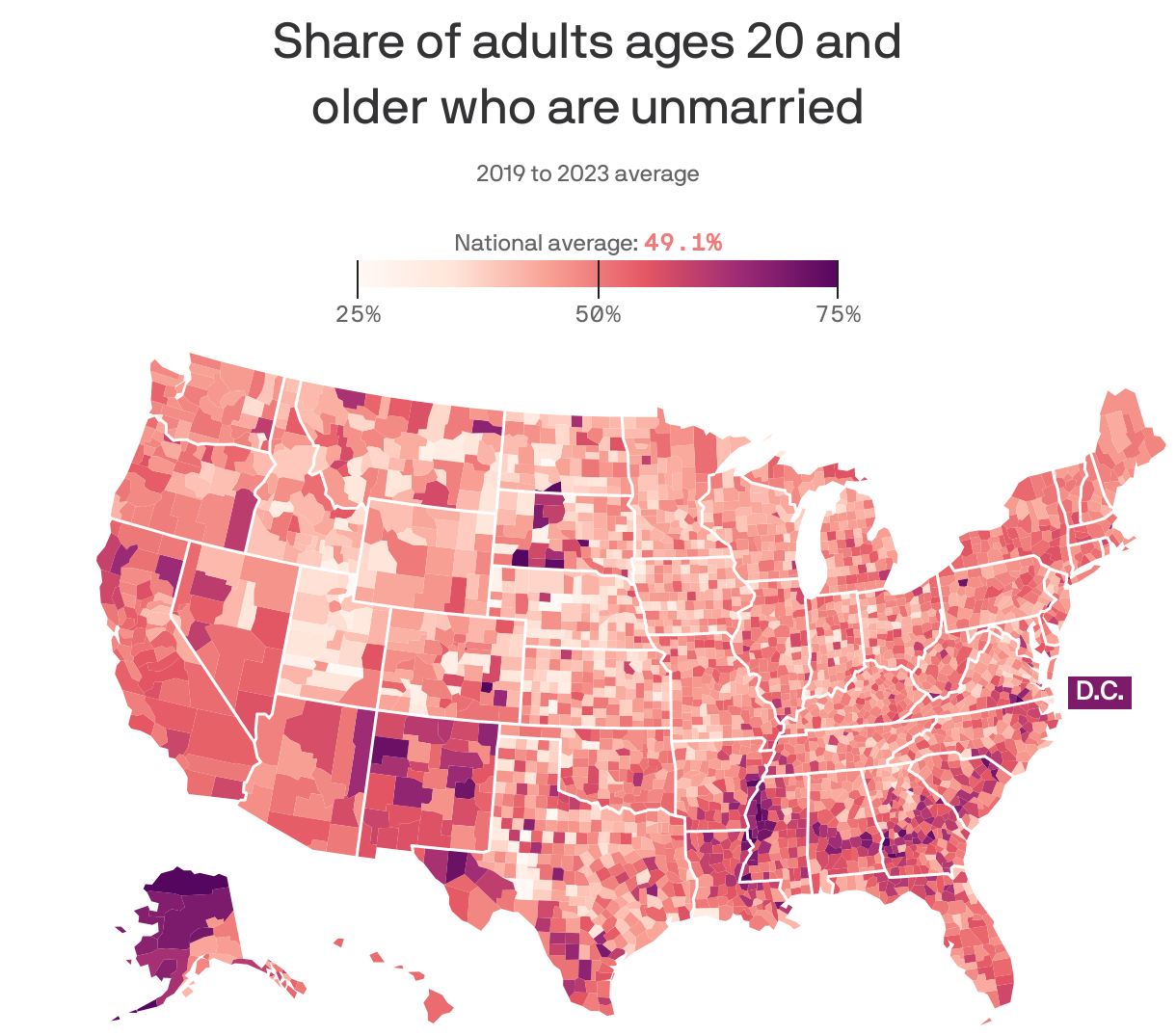
Searching for a partner? Half of metro Atlanta's adults are unmarried, so the odds for finding love here could be in your favor.
Why it matters: More Americans are delaying or foregoing marriage for a host of reasons, but it remains a bedrock of U.S. socioeconomic life and a strong predictor of happiness.
By the numbers: 51% of Atlanta's approximately 4.5 million adults 20 and older are unmarried — higher than the national average of 49%, according to data from the U.S. Census American Community Survey.
- 54% of metro Atlanta women are unmarried, compared to 48% of men.
- Those numbers are similar statewide, with 54% of Georgia women and 49% of men are unmarried.
- 52% of Georgia residents are not married.
How it works: These figures include people who have never been married, as well as those who were married at one point but have since gotten divorced or separated, or have been widowed.
The intrigue: The share of Georgia adults who aren't married is mostly concentrated in counties in south- and west-central parts of the state.
- Counties with the highest rates of unmarried adults are: Stewart (78.3%), Calhoun (73.9%), Macon (72.6%), Wheeler (72%) and Chattahoochee (70.2%).
- Oconee (30.1%), Forsyth (32.6%), Union (35.3%), Morgan (37%) and Bryan (38.4%) have the lowest rates.
Zoom out: Nationwide, Baltimore, the Bronx and Washington, D.C. have the highest rates of unmarried 20-and-older residents among counties with at least 25,000 such residents overall.
- 74% of Baltimore's approximately 440,800 20-and-up residents are unmarried.
- 71.9% of the 1.03 million Bronx residents in that age group are unmarried — as are 69.3% of Washington, D.C.'s 529,000 residents 20 and up.
Between the lines: Marriage rates are tied to a variety of socioeconomic factors, including income, employment, education and more — though there's some debate among social scientists over exactly how that all plays out.
- The modern era's historically low marriage rates can also be understood as a reflection of women's decreasing reliance on men compared to past decades.
- It was only 50 years ago that women needed a husband or male relative to co-sign with them for a loan or credit card, for instance.
Go deeper: